
Women’s Soccer Rankings: How to Compare the Best Teams in the World
Even though it was rather overlooked in the past, women’s soccer is starting to get a long-overdue recognition. There are many great women’s soccer teams out there, but which one is best? Ranking the best women’s soccer clubs might seem simple and easy – just look at which team has the most wins, right?
Well, wins are certainly one of the most important metrics for women’s soccer rankings, but there are other important metrics for determining the best women’s soccer team. In this article, we’ll answer questions such as “What are the world rankings for women’s soccer?” so keep reading!

Evaluating Team Strength
Before we show you the ranking methodology, you need to understand where the data comes from. Nowadays, every match generates large amounts of data, and this data is no longer reserved for clubs and sports professionals only.
Even casual fans can access match, team, and player data through the results provided by 180Score. Getting this data is the first step in evaluating team strength, but this is also where the first problems arise.
Historical football data is useful within one competition. When teams play against each other quite often, it is easy to compare them and make future predictions. However, the situation becomes more complicated when you try to compare teams that have never played against each other.
This is where soccer rankings come in handy, as they allow us to compare teams from different leagues and competitions. But how do soccer rankings work?
How Rankings Measure the Strength of Women’s Soccer Teams
First, you need to decide whether you need soccer world rankings for clubs or national teams. Hence, there are two approaches to women’s soccer world rankings: Opta Power Rankings for clubs and FIFA Women’s World Ranking for national teams.
Let’s first see how the Opta soccer rankings work:
How are women’s clubs rankings calculated?
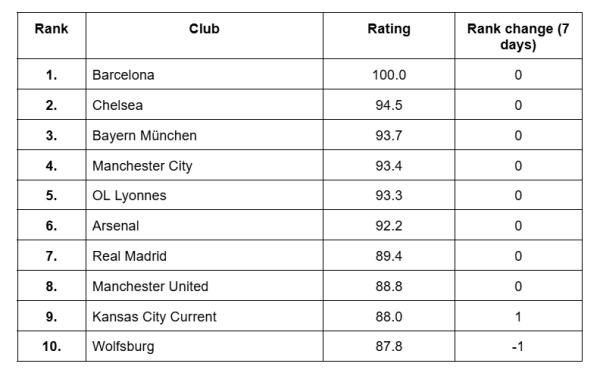
Opta football rankings are based on the hierarchical Elo rating system. This system takes over 2,000 women’s clubs from all over the world and grades them on a scale from 0 to 100 (100 being the best). Elo points are distributed based on the match outcome, opponent quality, and the margin of victory.
Here is how it works:
- The winning team gets x points, while the losing team loses those x points, which means there is a point exchange between teams.
- If the winner is a higher-rated team, fewer points will be exchanged.
- If the winner is a lower-rated team, more points will be exchanged.
- In case of a draw, the lower-rated team will get some points, while the higher-rated team will lose them.
- The greater the goal difference is, the more points will be exchanged.
As the teams keep playing against each other, their positions will change over time.
Examples of Top Women’s Clubs
Accurate as of July 9, 2026
How are women’s national teams rankings calculated?
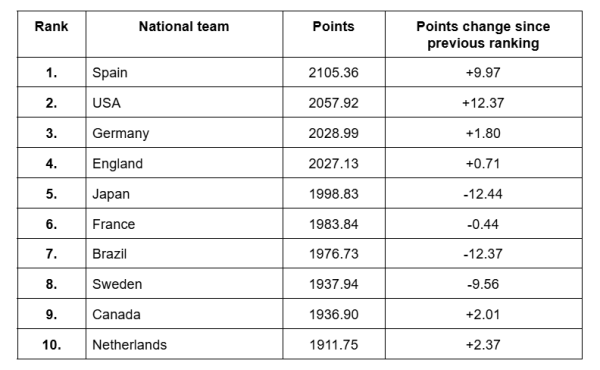
On the other hand, FIFA rankings (WWR) observe several factors:
- The match result
- Did the team play at home, away, or on neutral ground?
- How important is this match
- What are the current FIFA women’s rankings of both teams?
There is also the basic formula that calculates WWR for every team:
WWR,new = WWR,old + K × (Actual result – Predicted result)
Where, K reflects the importance of the match. “Actual” represents the actual match outcome, while “Predicted” represents the predicted match outcome. If Actual > Predicted, it means that the team has performed better than expected and its WWR (FIFA soccer rankings) will increase (and vice versa).
Examples of Top Women’s National Teams
Why Women’s Soccer Rankings Can Change Quickly
We have listed the best women’s soccer teams at both the club and national levels. However, soccer team world rankings can change practically overnight. The team that was in the top 3 could get kicked out of the top 10.
Women’s soccer is growing quickly and becoming more popular among prospective players and sports fans. As a result, new clubs and teams can evolve fairly quickly and seriously impact women’s football rankings.
Until recently, women’s soccer was overlooked and neglected. That’s why even the smallest investment in clubs, academies, and infrastructure can improve teams fast. Additionally, there aren’t many “superstar” players, and if one of them gets transferred from one club to another, it makes a huge difference in a team’s future performances.
Finally, major tournaments can change the ranking of national teams drastically. If you come to read this article in a few years, you might be surprised by how much the national team rankings have changed.
This is why it’s so hard to predict future rankings with women’s soccer. Men’s soccer is already established, and the strongest clubs and national teams keep their rankings for a long time. Women’s soccer is far less established, but it’s also full of potential.
Conclusion
In this article, we have answered, “What are the world rankings for women’s soccer?” for you. However, while rankings are important, the data behind them is just as important. Understanding which data is used in rating calculations will give you a deeper insight into which national teams and clubs are truly the best.