

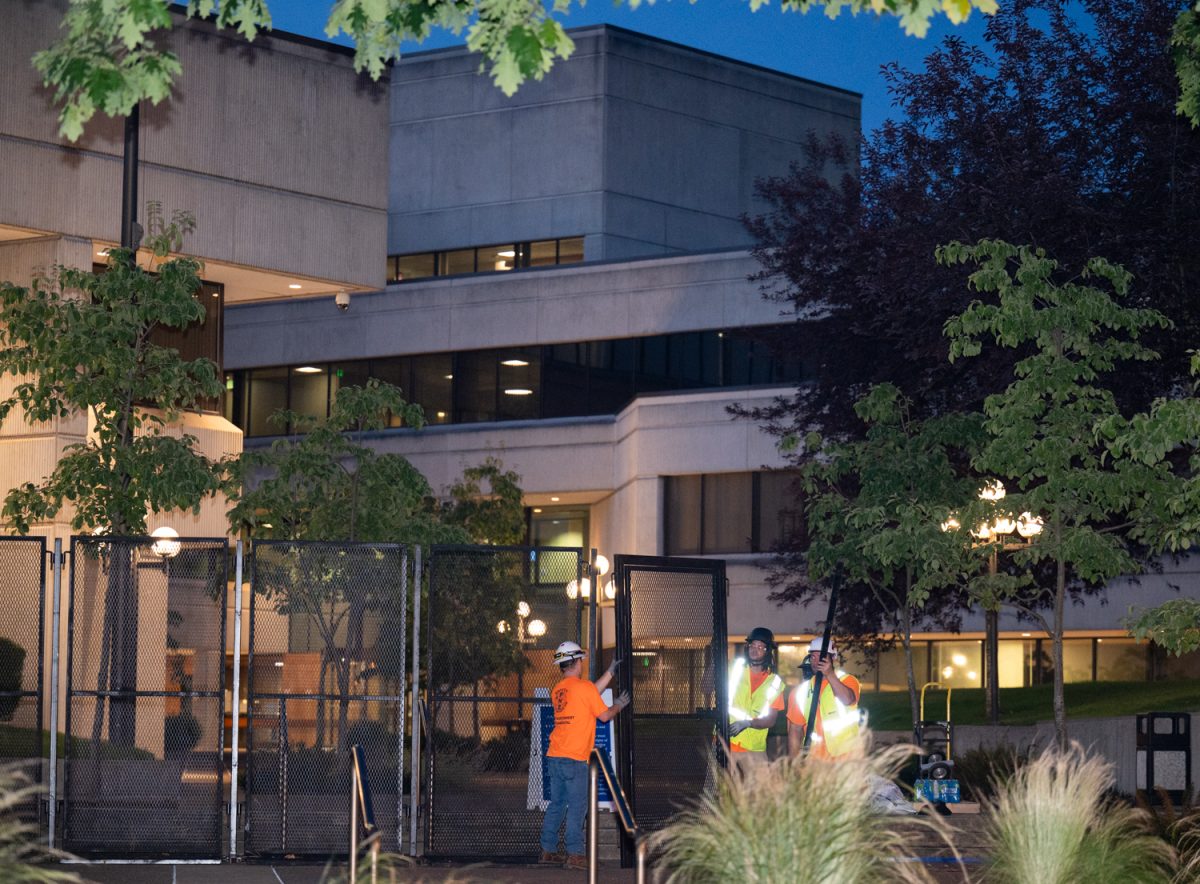
Hamilton Hall will be completely demolished by the end of this year, completing the final phase of the Hamilton Walton Transformation Project.
The project first broke ground in 2021 with the construction of Unthank Hall, which houses a dining hall and dormitory space for 700 students. The second phase, completed in August 2023, was the construction of the two new residence halls — Yasui Hall and New Residence Hall. The three new residence halls, combined, will offer 400-800 more bed spaces than were available in Hamilton.
The demolition of Hamilton will be followed by the development of a new green space. After renovation is completed, which is currently expected to be summer 2026, there will be 20% more green space in the area. This green space will replace Humpy Lumpy Lawn, the lawn on which Unthank was built, and will also include three beach
volleyball courts.
The construction began in June with a salvage operation, or removing all the usable furniture and appliances from the building. Abatement, the containment and removal of hazardous material to minimize risk to health and the environment, will begin in August.
Hamilton, which was constructed in 1961, is known to contain asbestos. Asbestos exposure could happen if the material covering it, such as paint or drywall, is damaged. All students sign a disclaimer as part of their housing contract when moving into the residence halls. Despite this, it was a point of concern for several freshman students who lived in Hamilton.
As per the housing contract, walls are regularly inspected for damage and ensured to lack asbestos exposure to students prior
to their move-in date.
Asbestos abatement is a lengthy process in which the asbestos-containing materials are sealed prior to demolition. It seeks to minimize the release of asbestos fibers into the air through a series of inspections to identify materials and isolations of the
work area.
Demolition of the building itself will not begin until November, beginning on the north side of the building. The final wing to be removed will be the one closest to Unthank. According to UO spokesperson Eric Howald, most of the project will occur during the winter break to minimize interruption to students.
Hamilton’s demolition and the development of new green space will cost approximately $10 million, according to Howald. University Housing is funded by room and board and dining fees and its projects are managed separately from the university’s primary academic budget.
Hamilton was originally intended to be demolished during September 2023, but was delayed following the two-year long closure of the Kalapuya Ilihi residence hall. Hamilton remained open for incoming freshmen because of the number of rooms lost by the closure of Kalapuya.
Kalapuya will be reopened this fall, allowing for the second and third step of the Hamilton Walton project to be completed. In addition to the demolition being put off, Hamilton’s delays pushed back the possibility of an on-campus beach volleyball facility for UO’s women’s beach volleyball team. The team had previously sued the university for Title IX violations. A facility for their team was part of the lawsuit’s demands from the university.
Currently, the green space, including the volleyball courts, is anticipated to be completed by summer 2026.




Greg Bryant • Aug 18, 2025 at 12:59 pm
Shame on the U of O for tearing down 400 units of already paid-for, essentially free housing — when we’re in the midst of a severe affordability crisis. If provided to student workers, for example, this would put downward pressure on rents in Eugene, make available hundreds of affordable units in the community, and stop commutes from the edge of town. The new housing replacing Hamilton will be expensive, burdening students and pushing rent prices upwards across town. The $10 million spent on demolition could have been used to lower tuition, and retain teaching and research faculty. The “separation of UO housing and academics” is just an excuse. They are both owned by the State of Oregon. And murdering mature trees, in the midst of a climate crisis, when we know mature trees are more effective for meeting climate goals than young ones, is just another criminal act.