College is a strange kind of purchase; you pay a small fortune and in exchange, a group of experts teach you, then judge you. “This academic endeavor is one of human confidence; we vet each other’s ability to interact with the world,” Cy Abbott said. Abbott is a geography doctoral candidate.
Beneath the pomp and circumstance of celebrating learning, what students pay for is that vetting; the person who reads their work and certifies it shows aptitude. As Abbott said, “I can lecture you all day long, but ultimately it’s the grading … (that) you pay for.”
That is why the idea of substituting human judgment with AI is a bait and switch. “It feels disingenuous,” senior computer and data science major Zain Saeed said. “We pay for a certain service, and if you’re outsourcing that service to a third party, why wouldn’t I just use that third party myself?”
And it’s not just that AI grading violates an expectation; it is genuinely an inferior service because grading is relational. “Part of my job is to get to know you as a student and what your capacity is, so I can tell when you’re trying to learn and engage,” Abbott said. What students are paying for, in other words, is context: someone who knows their name, understands their history in the class and can read an assignment as part of a larger story.
AI erases all context and treats each assignment in isolation, and a statistical model that only sees decontextualized documents can’t recognize the student who grew and improved, or one that finally took a risk in expressing their thoughts. It can only score the page in front of it.
AI is also shallow. It can’t weigh whether an argument is honest, courageous or intellectually ambitious, but merely scans for surface patterns like word count, vocabulary range, grammar and sentence length. “The best it can do is follow directions and find the things it’s been instructed to look for, but it can’t get a real sense of the writing, Nadia Foster said. Foster is a senior human physiology major.
That’s why it’s no accident that AI tends to favor work done by itself. A study by Zhong et al. found that AI “consistently assigned higher scores to AI-generated essays” compared to human reviews, simply because AI tends to “perform systematically better on many language features.” In that kind of grading regime, the honest and messy work of a human gets penalized. The student who actually labors over an imperfect assignment is at a systemic disadvantage to their cheating counterparts. As a result, AI grading will train students to see sincerity as naïve.
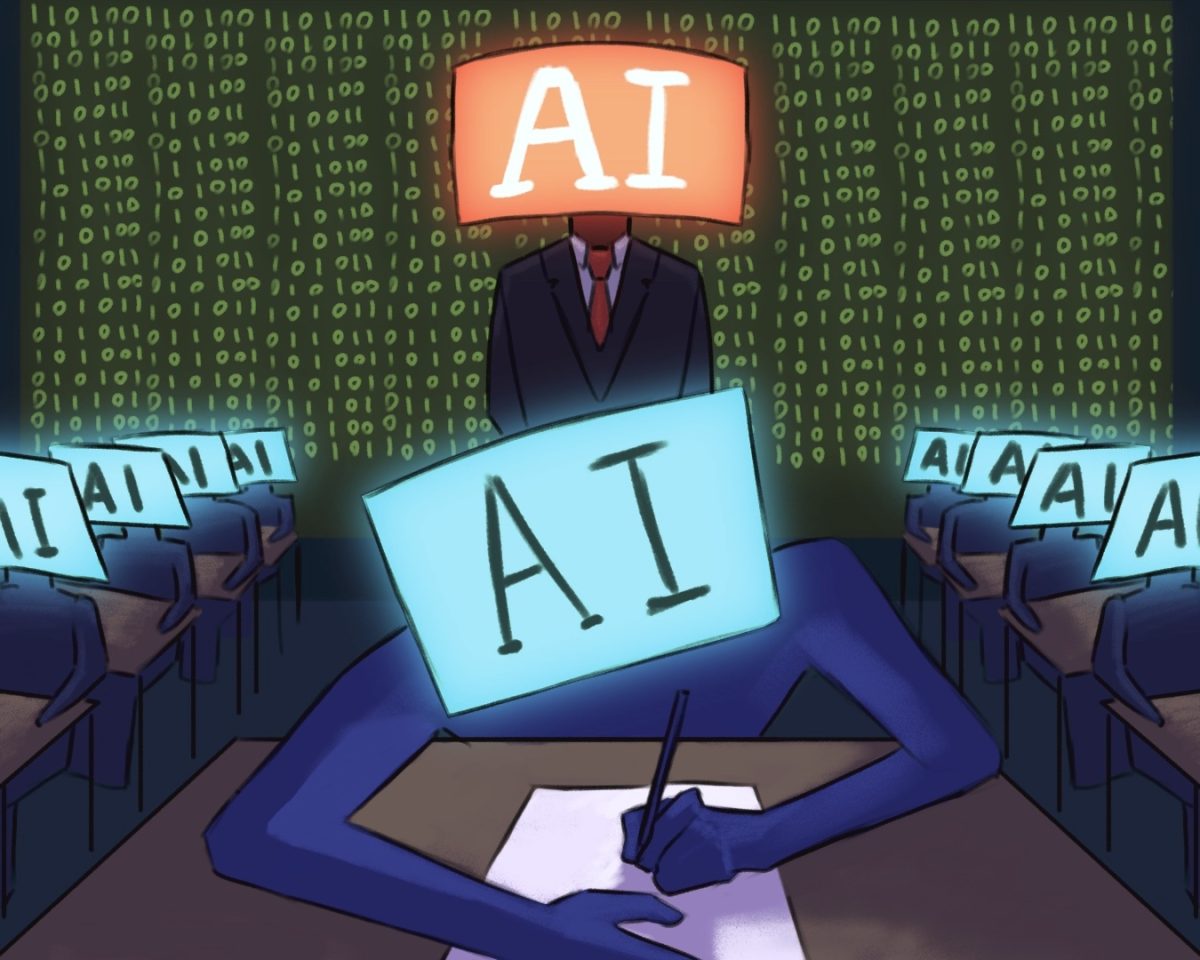
Then there’s the ethical whiplash. “It’s unfair to ask students to honestly do work without AI and then use AI to grade it,” Saeed said. This will only further justify students using AI to cheat. The classroom will drift toward a pointless equilibrium: AI-generated work, AI-generated grades, what Abbott aptly put as “robots talking to robots.”
Used carefully, AI can help at the margins though, like “computation-heavy classes where there is only one way to do the problem,” Moaaz Alqady said. Alqady is a math doctoral candidate who thinks AI grading may be doable in some math courses, but warns it makes “logical fallacies and errors” when questions have multiple valid approaches. Abbott believes AI could also “aggregate patterns on grades and mistakes” to help flag for the instructor where students are struggling. But both draw the same line: when it comes to the actual verdict for a student’s work, that belongs to the human.
AI grading would be very convenient for instructors, but the strange trade at the heart of higher education was never about convenience. It’s about being seen, known, taught and judged by someone who knows your name, your effort and your growth. If universities hand that judgment to machines, they are not modernizing the bargain, but merely replacing human grading with an inferior machine and still charging human prices for it.