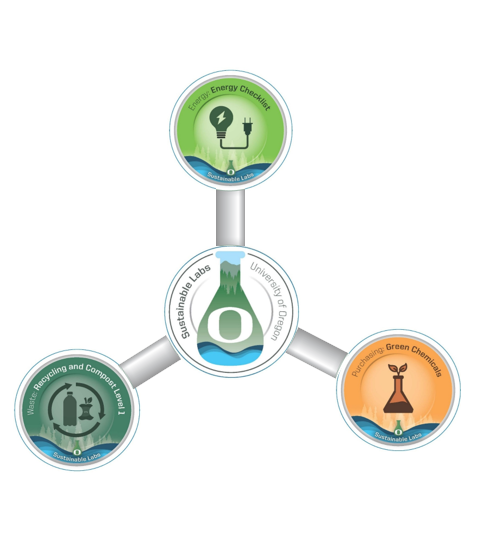
The University of Oregon Sustainable Labs Program was rolled out in November 2025 through a partnership between the Office of Sustainability and Environmental Health and Safety.
The program hopes to find ways to lower energy costs, water usage and waste in UO research labs. According to Sarah Stoeckl, associate director at the Office of Sustainability, laboratory buildings are the most energy-intensive on campus.
Stoeckl said that sustainable lab programs are “fairly common” at universities across the country, but that UO needed its own interpretation.
“It’s long been on our office’s wish list,” Stoeckl said. “We realized that UO was going to need its own homegrown version of a sustainable labs program that fit our community, our researchers and their needs.”
EHS was a “crucial partner” during development for the program Stoeckl said. This was primarily because of their existing channels of communication and close relationship to research labs, which the sustainability office didn’t have.
After the program was initially designed, a pilot program was launched last academic year with about four labs participating.
“We did a pilot, testing out a couple pieces of the program, took the information from that over the summer, completely revamped it and what has ultimately emerged is a program based on several different focus areas,” Stoeckl said.
The focus areas are recycling waste, energy and water, purchasing, travel and innovation. Innovation accounts for things labs are
doing to increase their sustainability that goes beyond what is outlined in the program.
Under each focus area are badges that become more focused the more you earn. Stoeckl said the goal for the program was to be
“choose your own adventure,” and that there is no set process that a lab must go through.
After the pilot program last year, badges were simplified to make them more achievable and more rigorous. The badge framework and making each badge a smaller task leading to a bigger overall sustainable goal is “unique to UO’s program,” according to Stoeckl.
An example of what a lab can do to save on energy waste is to lower the amount of air being constantly sucked out by a fume hood when it’s not in use. Stoeckl said that lab workers can close a hood all the way or almost all the way in order to use less energy.
More examples is ensuring samples are defrosted and organized in ultra-low temperature freezers to optimize their efficiency,
and to post the newest recycling guidelines from the Zero Waste Program for hazardous waste, lab waste and recycling around a lab.
“The program is open to any lab on campus to be involved in,” Stoeckl said. “Underscoring that, how do we empower our lab researchers and give them opportunities to get involved, rather than forcing them into boxes that may or may not work for them, may not work for their research.”
Currently, there is one lab that is still participating from the initial pilot program, and three to four that are actively pursuing badges.