

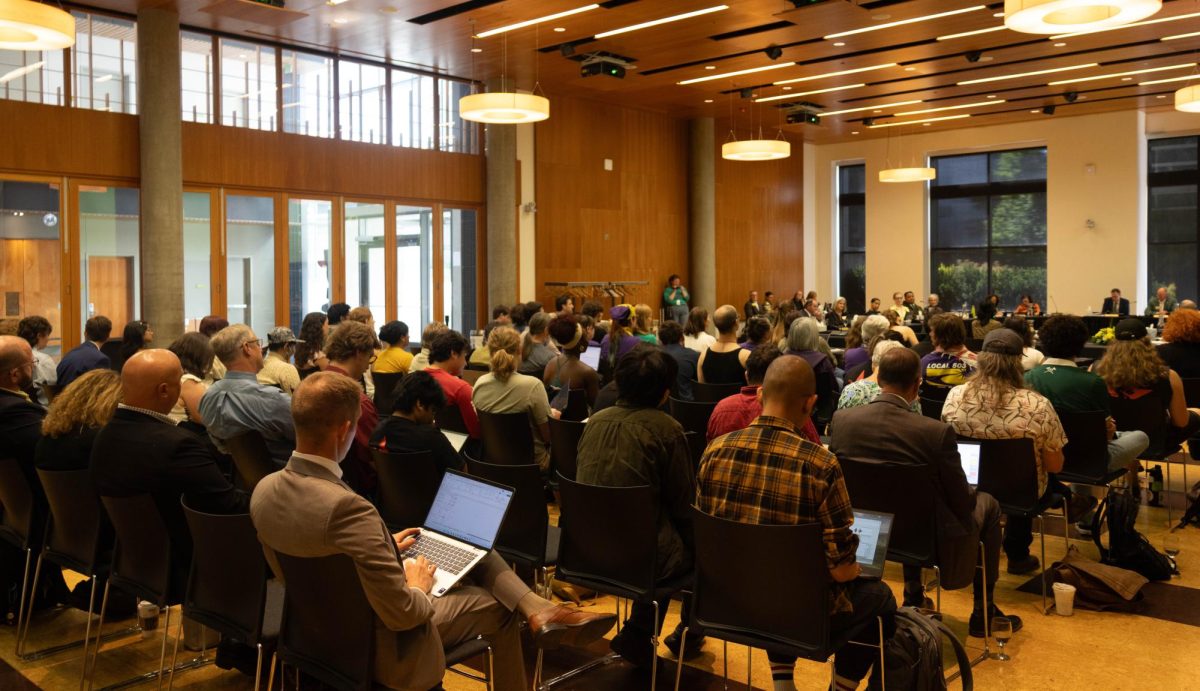
The President’s Tuition Forum took place at the Erb Memorial Union from 6 to 7:30 p.m. on Feb. 19. The forum included a review of the University of Oregon’s budget and its projected tuition increases for the incoming 2027 class.
The projected tuition increases came from the Tuition and Fee Advisory Board, a group of roughly 20 to 22 individuals from the university, including students, faculty members and staff. After being educated on the university’s budget and tuition, the board met weekly in January to view all budget proposals, then made a recommendation to the university’s president, John Karl Scholz. The information will later be presented at the March 2026 Board of Trustees meeting, where they will officially approve or decline the proposal.
“We try to have lots of different people on the group, who bring different perspectives … it’s a pretty interesting group, and the feedback I’ve gotten from folks who have been on it is they learn a lot about the university,” Senior Vice President for Finance and Administration Chief Financial Officer Jamie Moffitt said.
TFAB recommended that tuition for the following year should increase by 4.5% for resident first-year students and be 3% higher for nonresident first-year students. This would mean that tuition for incoming resident students would be roughly $14,531.85 per year and $44,523 for incoming nonresident students.
TFAB also recommended that administratively-controlled mandatory fees should increase by 2.98% for both incoming resident and nonresident undergraduate students.
“TFAB did a significant amount of work this year to come to a tuition recommendation,” Associate Vice President for Budget, Financial Analysis and Data Analytics Brian Fox said. “This included looking at other competitor institutions that students are choosing between to try (to) target an appropriate tuition level for incoming students, and recognize the budget realities when we receive such limited state funding support.”
TFAB also recommended increasing the College of Business undergraduate differential tuition from $30 per student credit hour to $50 per student credit hour for incoming business students. These fees would apply to all business courses and would not impact current students. The fee would cover services business students get that other students do not, such as career services, tutoring, labs and higher-paid faculty.
“The leadership in the Lundquist College of Business did significant work this year to review their tuition differentials with those at other competitive universities, both in Oregon and outside of Oregon, that students are choosing between,” Fox said.
TFAB also projected that graduate tuition increase for the following year would vary between 0-4%, depending on graduate programs, of which the university has over 80 separate rates.
“This year, we saw limited graduate tuition change requests from colleges. Most programs came in somewhere between 0-4% increases, which are fairly moderate levels of increases,” Fox said.
In the summer of 2020, UO established the guaranteed tuition program, which set each entering class with a set resident and nonresident tuition rate per student credit hour. According to the university, this allows students to know the expected cost of their education before declaring themselves to UO.
“We think guaranteed tuition provides students with a number of good advantages. For students, it gives them predictability, peace of mind and also protection of scholarship value, because in the past, scholarships used to stay flat and tuition used to grow,” Moffitt said.
According to the budget summary, tuition increases are the result of a $33.8 million total projected cost increase. This accounts for a $31 million (5.5%) Faculty, Staff and GE compensation, a $1.8 million (3.1%) Institutional Expenses increase and a $1 million increase in Strategic Investments.
“Total expected annual cost increases are large numbers for any of us individually, but when you start thinking about an institution that has 23,000 students and thousands of employees, even relatively small percentage increases in costs start to add up quickly,” Fox said.






Charlie • Feb 25, 2026 at 12:29 pm
If you believe this process was anything but a cynical pantomime, you may want to rethink if you’re ready for college. OF COURSE tuition is increasing, making UOwe less attainable for OR residents.
The only way anything changes is for OR residents to finally realize UOwe isn’t serving the interests of the average Oregonian. This institution is nothing more than a boiler room loan mill, preying on inexperienced teenagers. The solution is stay away…