Having recently graduated from the University of Oregon and moved back home to Eau Claire, Wisconsin, to save some money, Simon Adler needed something to listen to as he moweds his client’s lawn. Following a friend’s recommendation, he puts on a podcast called “Radiolab,” a series of inquisitive audio documentaries. After that moment, he knew he wanted to do more than mow lawns.
“I remember so clearly how, even with the roar of that lawn mower in the background, this thing in my ear sounded unlike anything I had ever heard,” Adler said. The ideas that they were exploring, the sort of compositional nature of the way they were putting sound and music together — it was surprising, it was confusing, it was wonderful. In that moment, I was like ‘this is what I want to make, this is what I f*cking want to do with my life.’”
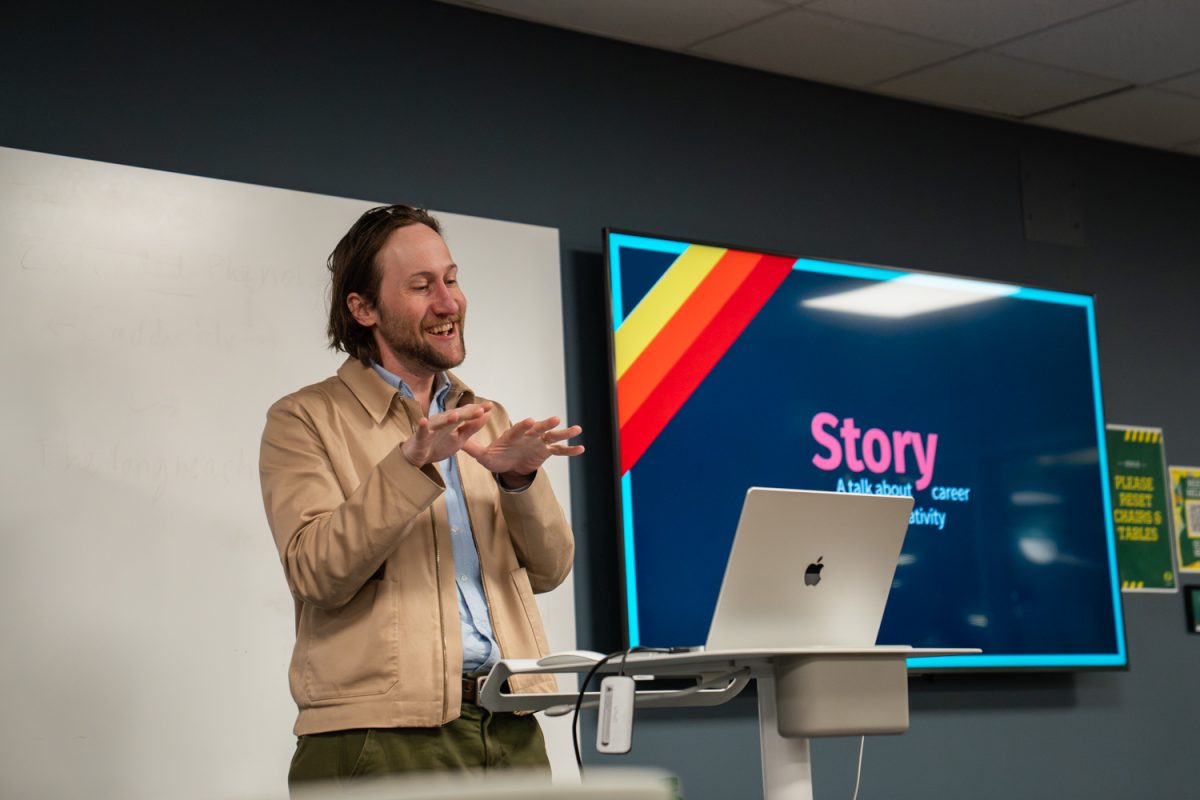
A few years later, Adler joined Radiolab as a producer. After a decade, he’s on his own as a freelancer, and recently flew from New York City to speak to UO students about his past and what makes a great story.
While his presentation was plagued by more audio issues than advantageous for a lecture surrounding audio storytelling, the Knight Library DREAM Lab garnered a small, engaged crowd happy to hear from a self-made professional.
“As someone who wants to go into audio storytelling, it was really amazing to hear from some- one who’s been in the industry for so long, and especially a producer for Radiolab, which is such a unique program,” senior and journalism major Julia Boboc said. “It’s really awesome to have an opportunity to pick someone’s brain who’s been in that space and really knows how audio reporting works in real life.”
Given his lack of formal training, Adler’s body of work is entirely composed of real-world experience. His first pieces came in the wake of Hugo Chávez’s death in 2013. Adler, who had spent a month in Venezuela after majoring in Spanish, saw firsthand how fascinating the country was and how few English-speaking journalists were reporting on it.
“I thought, ‘there are no English-speaking reporters down there. I know how to speak Spanish pretty fluently, I know how to record stuff, I’d like to talk to people. Maybe I should move down to Caracas and just become an international freelance reporter.”
With a microphone and a Tumblr blog, Adler began building a portfolio and pitching to editors. After three weeks, “The World,” a public radio show, offered him $500 for a piece on the situation in Venezuela. After some work in Ireland, Adler applied for an internship position at Radiolab.
While Adler told this story and many others during his speech, he always made sure to explain its relevance to every type of journalist in the room. When he wasn’t sharing his own story, Adler detailed what makes a great story.
“Storytelling is the intentional and artful reveal of information,” Adler said during his speech. “We’re always trying to tease and reveal information. The tease is the question that is put in the person’s head that makes them want to keep listening. The tease is oftentimes the engine that creates the narrative tension that makes people want to stick around.”
As a producer at Radiolab, Adler would spend each year creating five different hour-long documentaries. These documentaries were “soup to nuts,” meaning fully encompassing of the story, as Adler said. He pitched, reported, produced, and even created the music for each piece himself.
Adler had to learn all of these parts of the process on the job. While scoring was a new experience for him, the music side of things is perhaps the only part of the process that he had any formal training in. In fact, he contributed to the jazz program while attending UO.
Now a freelancer, Adler is putting his efforts into Windstar Enterprises, a musical project with Bon Iver’s Sean Carey. He also runs a creative studio where he works creating audio pieces for companies and publications.
Though his studies at the UO bore little significance to his career, Adler expressed an appreciation for having the opportunity to speak at his alma mater.
“Thank you all so much, it really is an honor,” he said. “I never expected to be able to come back and be proud of anything I had accomplished.”