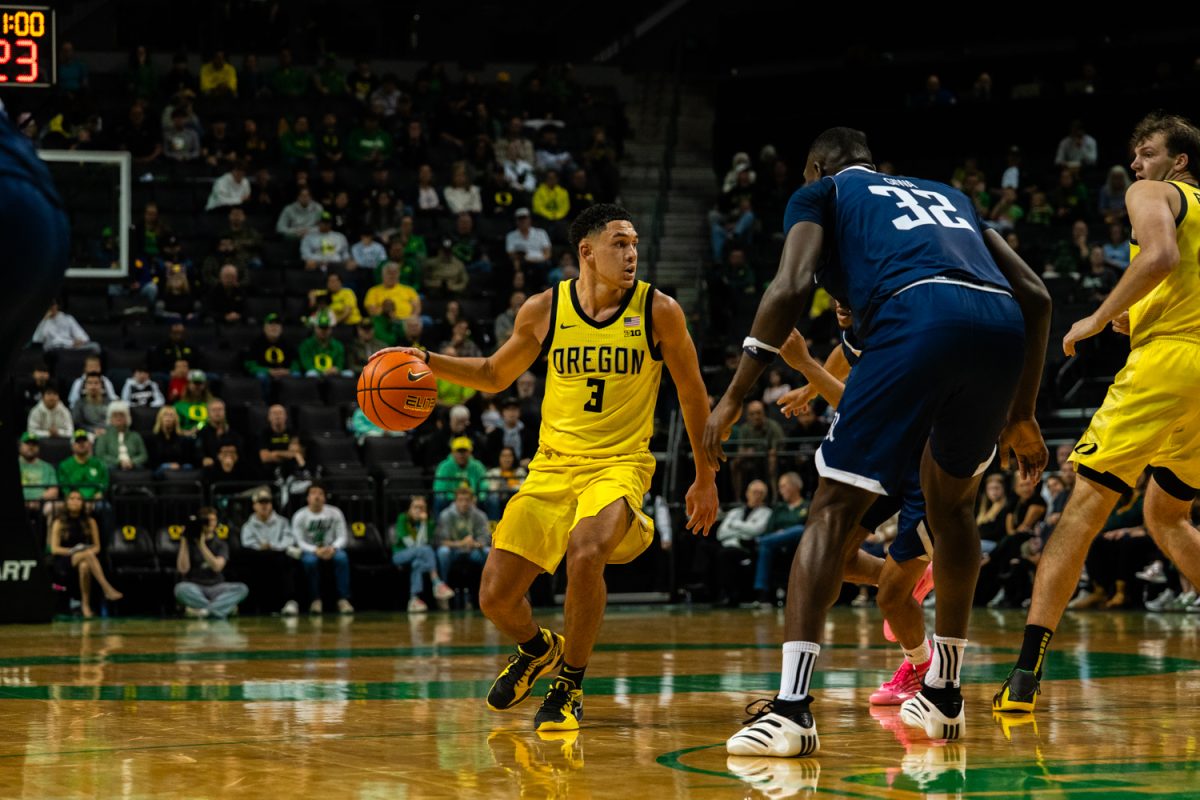
The early return of Jackson Shelstad became an impact that went far beyond the statline.
His 11 points on 2-12 shooting and 2-7 from three in 35 minutes didn’t do all that much to bolster the Ducks’ final score, but the surprising return of Jackson Shelstad became a major factor in Oregon’s 67-63 victory over the Rice Owls on Friday night.
That came as a result of the Ducks’ surrendering 21 turnovers in their season opener against Hawaii. Shelstad returning meant Oregon got its primary ball handler and offensive engine back.
“(Having Jackson back) was really important,” head coach Dana Altman said. “We cut our turnovers way down against a team that pressured much more than what we saw against Hawaii. He had the ball in his hands a lot, and didn’t turn it over.”
Shelstad’s impact on the ball
Ten seconds into the contest, he had already gotten open for a 3-pointer. Although he missed his first attempt of the season, the return of the Ducks’ star point guard turned into a positive impact as the game progressed.
For one thing, having such a skilled ball handler back in the lineup can only mean good things. His ability to create shots for himself as well as his teammates adds a crucial fold to Oregon’s offense.
“The (defenders) gotta be on it,” junior forward Kwame Evans Jr. said about Shelstad’s impact. “Him getting guys into spots, getting Nate (Bittle) easy shots. Nate had a great night tonight and Jackson was the cause of that. Him being out there just opens up the floor for us too.”
Shelstad’s second shot attempt nearly fell through after he left the entire Rice defense in no-man’s land and almost dropped one in from mid-range. His dribbling yet again led to sufficient space on the next offensive possession when Shelstad came off a Nate Bittle screen and sunk his first 3-pointer of the season.
The crowd’s reaction said it all: Matthew Knight Arena erupted for the team’s brightest star and emotional heartbeat.
How it impacted the rest of the team
Something else that stuck out, especially relative to Oregon’s season opener three nights previous, was how other players were able to play around Shelstad offensively. Each guard that appeared on Friday night looked as if they had a major burden taken off their backs — which was definitely the case.
Playmaking isn’t the selling point for Oregon’s other ball handlers, Wei Lin or Takai Simpkins, so being able to freely spot up and wait for shots can help improve their production.
“Now that Jackson’s back, (Lin) will get a feel of playing with Jackson. I think that’s really important for both because I think Wei can make shots for Jackson and Jackson can make some shots for Wei, so they don’t have to get everything off the dribble.”
That impact also extended to the plays Shelstad wasn’t involved in, as the Owls could never send the extra defender to help in the paint, which opened up shots there. When a Simpkins/Bittle pick and roll went towards Shelstad’s side, the interior remained so open due to the focus defenders needed to have on preventing him from shooting open 3-pointers.
Shelstad’s shooting didn’t improve enough to avoid being behind 32-27 by the end of the first half. Rice shot 42 percent from three in the first, and compared to the 20 percent Oregon shot, the Owls looked much more equipped to take the game.
Rice’s focus in the second half turned to preventing Shelstad’s off-ball movement, which opened up the Ducks’ ability to score in the paint.
On screens, the Owls hedged hard on Shelstad, which opened up the lane and created a man advantage for Oregon in the paint. Two consecutive pick and rolls into Bittle led to four straight points and helped the Ducks take their first lead of the second half.
That became an 11-1 run where Bittle scored nine. Six of his points during the run came from aggressive moves to the paint leading to either free throws or a layup.
By the end of the contest, the Ducks racked up 38 free throw attempts and made 26 of them. They attempted 25 of those in the second half with Bittle going 9-10 and Shelstad going 4-4 from the line in the period. Oregon only scored 20 points in the paint in the game, but its ability to get to the rim consistently changed the game due to the amount of fouls the Ducks drew.
“We’re gonna have to shoot ‘em better,” Altman said about the free throws. “We got to the free throw line because we went inside in the second half and really attacked the basket, but we’re obviously going to have to shoot better than 60 percent from the free throw line to have a good ball team.”
What does Shelstad’s role look like going forward?
Adding such a high caliber of playmaking, ball handling and shooting will only improve Oregon’s offense as the season progresses and Shelstad still has to get back to fitness before he can reach full effectiveness.
“His legs weren’t there, so he didn’t shoot it well,” Altman said. “Having an experienced guard out there really helped us.”
Shelstad, even at less than 100 percent, was still able to apply his athleticism, speed and basketball IQ to collect three steals, two of which came off of intercepted passes.
The Ducks look forward to a Wednesday night matchup against the South Dakota State University Jackrabbits, where they’ll look to Shelstad to give them that scoring edge they’ve lacked so far this season. Tip is set for 6:30 p.m.