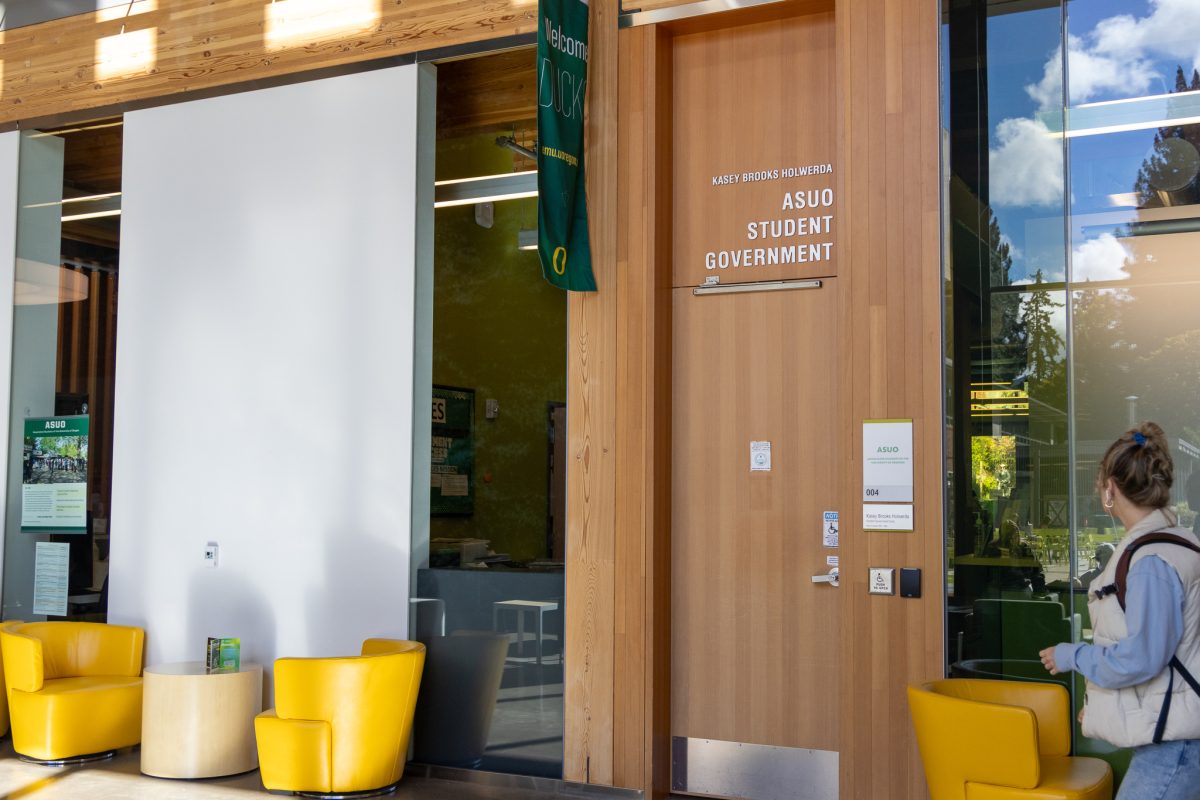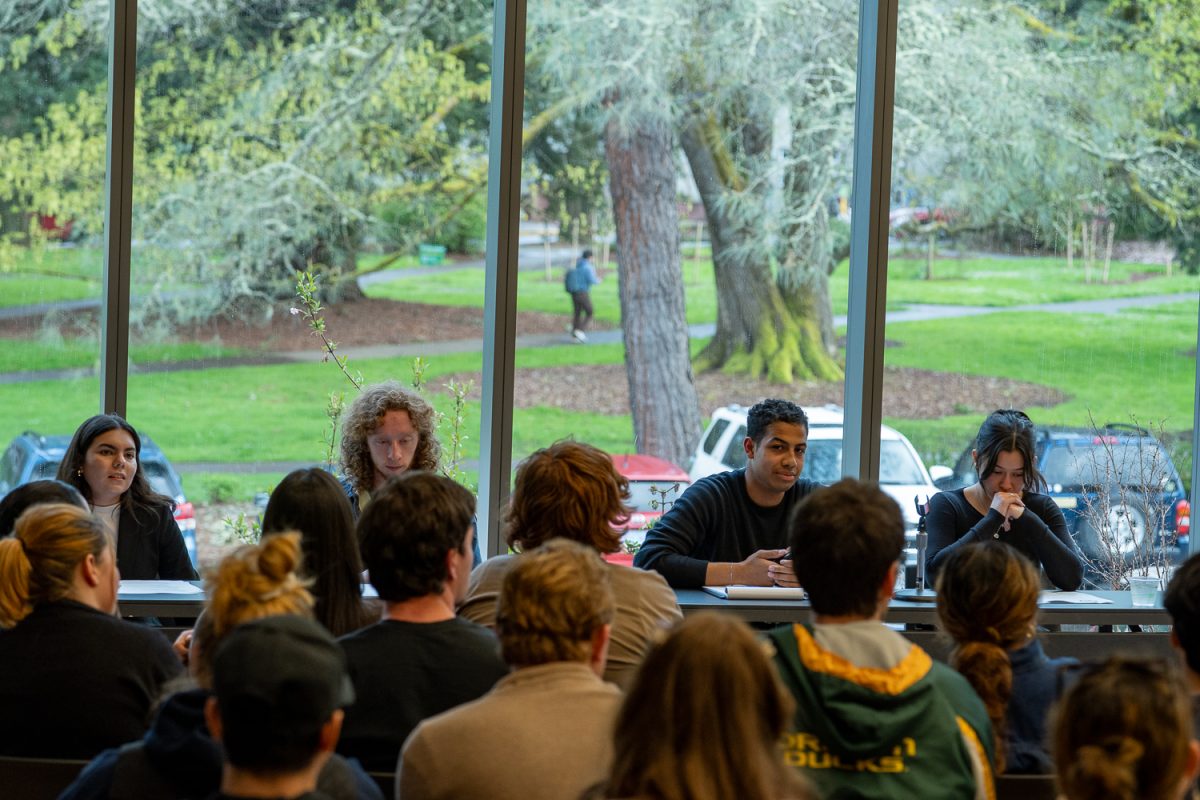
Well after 7 p.m. every Wednesday at ASUO’s senate meeting, student organizations ask for critical funding for cultural events, such as the annual 800-strong University of Oregon Lū’au as well as travel funds for academic competitions at which UO is represented on a national stage.
As of the time of this publishing, all student organizations at UO are competing over a pot of around $300,000 as of ASUO’s last senate meeting, meant to be spread across the entire year. Surplus requests fall in the range of tens of thousands of dollars, and Quadrian Gill, ASUO’s speaker for the student senate, thinks there will be no money by spring.
The surplus fund
The ASUO surplus fund consists of money from the incidental fee, a mandatory fee for all students that is allocated to student organizations but not spent by those organizations, including funds that were meant to be used but got caught up in bureaucracy and paperwork.
During the COVID-19 pandemic, clubs did not use most of the money allocated to them since fewer events and less traveling took place. This caused ASUO’s surplus to grow to around $1.5 million in 2022, and $2 million dollars in 2023. In the nine months from September 2024 to June 2025, the surplus budget fell to just over $200,000.
Of the million dollars spent last year, about half of it went to travel benefiting around 1% of UO’s student population, as The Emerald previously reported.
“I think ‘benefited 1% of the university’ is relative because maybe 1% of the university got to travel, but when they come back, they get to share the stuff they learned. They also represent the university wherever they go, so that helps expand more opportunities for folks,” prior senator Taliek Lopez-DuBoff said in an interview earlier this year.
Lopez-DuBoff did not respond to a request for comment for this article.
New student organizations will not be as affected by the smaller surplus because for the first year a club is ASUO-affiliated they are using funds from another pot called “unallocated reserves.” This fund is used since they do not go through the budget processes for another year.
The Surplus Accountability Committee
The Surplus Accountability Committee was re-established at the beginning of this academic year with aims of making a “blueprint” to address spending issues.
“I would say my first goal (on the committee) was to try to get senate to be on as much as the same page as we could with surplus because surplus is going very fast,” Kayla Fisher, the committee’s chair, said.
Gill said another of the committee’s goals was to “see that the money (is) not concentrated like it was last year in such a small portion of the student body.”
Given the issue of distribution, one of the major focuses of the committee is travel.
SAC developed recommended travel limits of $8,000 for trips on the West Coast and $12,000 for traveling longer distances. The weekly senate meetings mainly consist of senators working to whittle down travel requests.
During a recent senate meeting, UO’s American Marketing Association initially requested $9,000 for a Chicago conference after already having spent around $4,000 in surplus for a Los Angeles trip earlier in the year. Several senators, thinking the expense was too high, debated on the cost of plane tickets and hotel rooms for an hour before the amount was lowered to around $6,600 for the club.
Gill said it is difficult to deny requests for travel, supplies and events brought to senate, but he thinks having those hard discussions brings ASUO and student organizations closer.
“Telling an org they can’t go on a trip hurts really bad but one of the things that’s come from this is that it’s honestly strengthened our relationships with these orgs,” Gill said.
One of the reasons so many requests to use surplus for travelling happened in the first place, according to Gill, came from the “culture” of not putting much money in a student organization’s regular budget for travel because of the reliance on surplus — a chicken and egg type of situation.
“The last couple years it (the surplus) has been so large that basically everything had been rubber-stamped,” Fisher said.
Despite negotiations in the senate, for some clubs it still hurts when their requests are approved but fewer members are able to travel, compete or attend a conference.
Students in AMA had been preparing all year to participate in a Chicago competition representing clients to marketing professionals.
“This isn’t just about getting students across the country; this is about getting students that hands-on experience,” Hailey Sandler, vice president of strategy, said while pitching the trip to senate.
In the end, only eight members out of over 130 club participants were able to attend.
“It really does suck to say we are only taking (eight) of you and you have been training since week two,” Sandler said.
Increasing fundraising and creative resourcing
According to Fisher, the SAC was also developed to help student organizations understand what kind of requests might get approved and what requests might not be approved. Fisher and Gill said approvals often center on whether the request fits into the organization’s existing budget, how much the club has fundraised and how well-planned and creative the club’s proposal is.
Ultimately, Gill is asking that student organizations rely more on fundraising, which several student organizations seem to be taking to heart.
Muxeres, a Latine student organization co-hosting a music and dancing event called Noche de Excelencia, applied for funding through several grants before they came before the senate.
Hui ‘O Hawai’i, a club dedicated to students from Hawai’i or those wanting to learn more about Hawaiian culture, has plans to dedicate time and creativity to build costumes from Dollar Tree materials, and is working on fundraising through Panda Express and a Hawaiian company called Cookie Corner Hawaii to support the annual Lū’au.
“That (partnership) gives an opportunity for our families at home to support us since they’re not here with us in Oregon,” Hui ‘O Hawai’i’s Lū’au Co-Coordinator Penina Vaimaona said.
Gill said ASUO is trying to plug clubs into local restaurants and business connections, and encouraging the use of DuckFunder, a fundraising platform similar to GoFund-Me where student organizations can reach out to alumni, friends and family on one website.
For Lū’au Co-Coordinator Caleb Correa, thinking about the budget restrictions has led to more student involvement to address gaps in programming and more “creative room for people to fundraise,” but the $30,000 surplus they requested is still critical for their organization.
“We want to be eventually self-resilient, self-efficient and responsible for what we do, but being able to have this opportunity to reach out to ASUO to help us fund what means we can’t uphold is very beneficial for us,” Correa said.
The current senate
Decreased funds are causing increased tension in ASUO’s senate. Fulfilling the “social, cultural and physical development of students” at UO, as ASUO’s governance documents states as the role of surplus, is far from the clearest of tasks for a group of around 20 student senators from across the university’s schools and departments.
Every Wednesday, these senators are weighing value and cost, time and time again.
“This is such a great event but it’s so much money,” Fisher commented after the Lu’au presentation.
Fisher said the event was not worth spending $30,000, but most of the senators disagreed.
“Events like this just cost this much money especially in this school and in this state where it is harder to try to get these cultural items,” Senator Marisol Peters, who has helped plan the UO Mother’s Day Powwow for the past few years, said.
“If you break it down, that’s about 1/17 of surplus, and I don’t see 16 other events that do what this event does,” Senator Cole Stevenson said.
Gill said the nature of these approvals is inherently subjective but called some level of disagreement “healthy for a legislative body.”