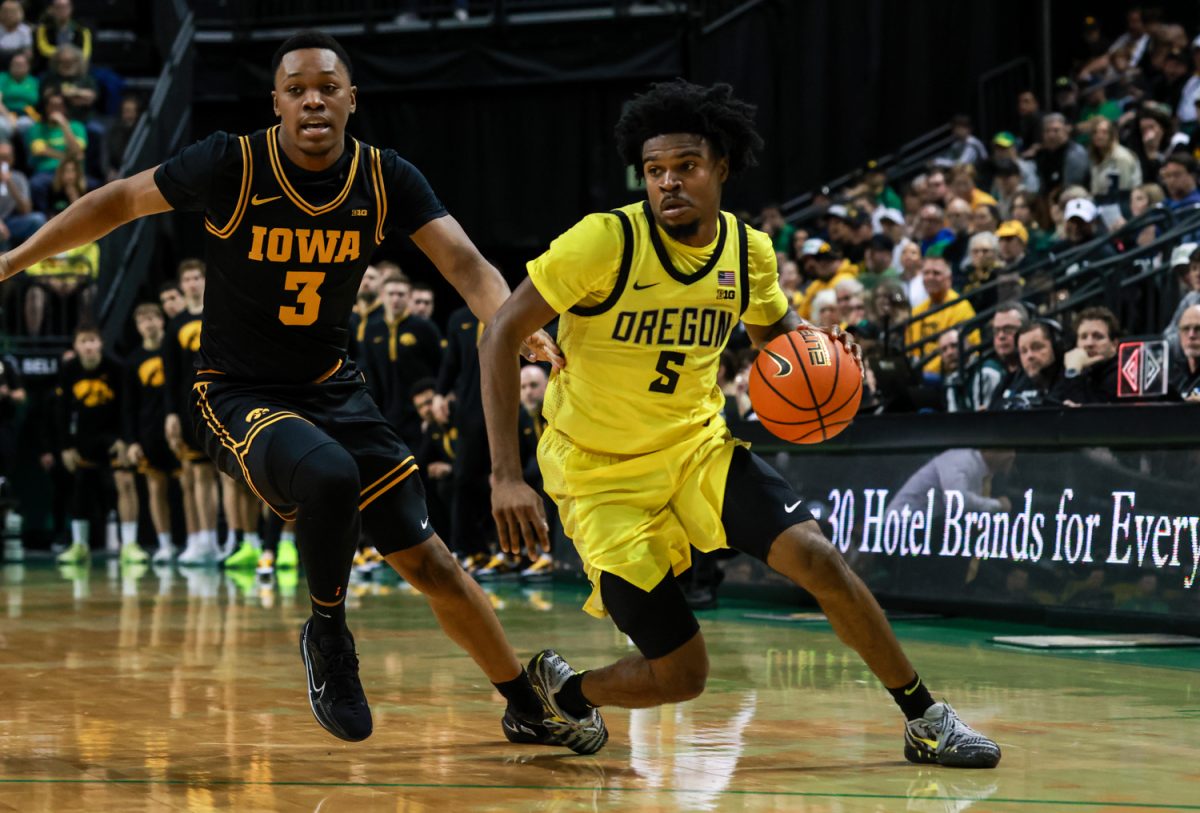
One of the most difficult parts of dealing with a major swath of injured players is having to replace output on the floor. While a “next man up” mentality can be positive, the reality of losing the top two scorers (point guard Jackson Shelstad and Nate Bittle), the top rebounder and top playmaker all in one swoop is often hard to reconcile with.
“You just gotta keep grinding,” head coach Dana Altman said. “There’s no easy answer, there’s no quick fix. There’s no strategic (way). You just play as hard as you can and try to keep the guys together.”
Between the two stars, the Ducks now have had to replace almost 31 points, 10 rebounds, seven assists, 26 shot attempts per game and seven free throws with an uninspired roster made up almost entirely of role players at this point. The Oregon men’s basketball (8-15, 1-11 Big Ten) season has moved on past the original goals lined out for it. The Ducks, now with 15 losses, are a far cry from any meaningful postseason involvement and a large part of that can be attributed to the injury crisis.
Here’s how the Ducks’ most meaningful contributors have fared through this now nine-game losing streak:
Takai Simpkins, starting shooting guard
While being a reliable piece of the rotation earlier in the season, when Shelstad was healthy, Simpkins’ role increased tremendously as the season progressed. A true two-guard, Simpkins is a willing, albeit not particularly strong, passer, so shoehorning him into a playmaking role has only proved to confuse things.
His assist numbers haven’t jumped, he’s attempted more field goals (about 3-4 more per game over the last five games) and his field goal percentage dropped from the high 40s to the mid-to-low 40s (44% as of Feb. 37). Statistically speaking, Simpkins’ contribution in a more accountable offensive role hasn’t been super successful. That being said, it would be a mistake to label his production as negative.
Without Simpkins, this team would be in the dumps. His defense remained consistent throughout January, highlighted by a four steal effort in a loss against No. 2 Michigan. He takes a great deal of shots, but none of the other players seem willing to make up the difference caused by the specific absences. While his deep-three or contested drive-in floater might not always be the shot of choice, given the current circumstances, his aggressiveness forces the action at times where that’s needed.
Kwame Evans Jr., starting power forward
Evans clearly decided to shoulder more responsibility as the injuries started coming in. Coming into the most recent five-game stretch, Evans had shot over 10 field goals just three times. During this current stretch, Evans has averaged 13.6 field goals per game. His 24-point, eight rebound and two block effort dragged the Ducks to a much closer game than they deserved in their 73-57 loss at home to UCLA. A three-year veteran on the team, Evans is used to being in the win column much more, as Oregon made March Madness in each of his first two seasons.
“It’s not easy (to stay focused). (Evans) has been here two years and we’ve gone to the tournament both years; he’s been a big part of that,” Altman said.
Defensively, Evans started playing much more actively in the paint. Losing one of the best shot-blockers in the coun- try in Bittle placed the onus of cleaning up Oregon’s weak perimeter defense on Evans. He jumped his block numbers up to 2.2 per game over the recent skid, which is impressive since Evans recently started defending smaller players on-ball and has been incredibly effective.
Sean Stewart, starting center
With the injury to Bittle and a season-ending shoulder operation for backup big man Ege Demir, Stewart stepped into the incredibly important five spot. While offensively-erratic at times, Stewart has made up for the deficiencies in rebounding and interior presence that the Ducks lost with the injuries to the frontcourt. He constantly moves, creating a great deal of space for other scorers while also cleaning up boards, increasing his numbers to now 7.1 per game this season.
Stewart only started six games until injuries rocked this roster; he’s now started the last eight games and counting. While those games have all been losses, Stewart’s impact falls under the same umbrella as Simpkins’: while he hasn’t taken the world by storm in his increased minutes, he’s carved out a crucial role.
While none have been able to replicate the production of the team’s stars, each of these three players has been partially responsible for this season not turning into a complete disaster. Simpkins, Evans and Stewart are currently the heart and soul of this team, and if the Ducks are going to pick it up, it’ll be on the backs of these three players.