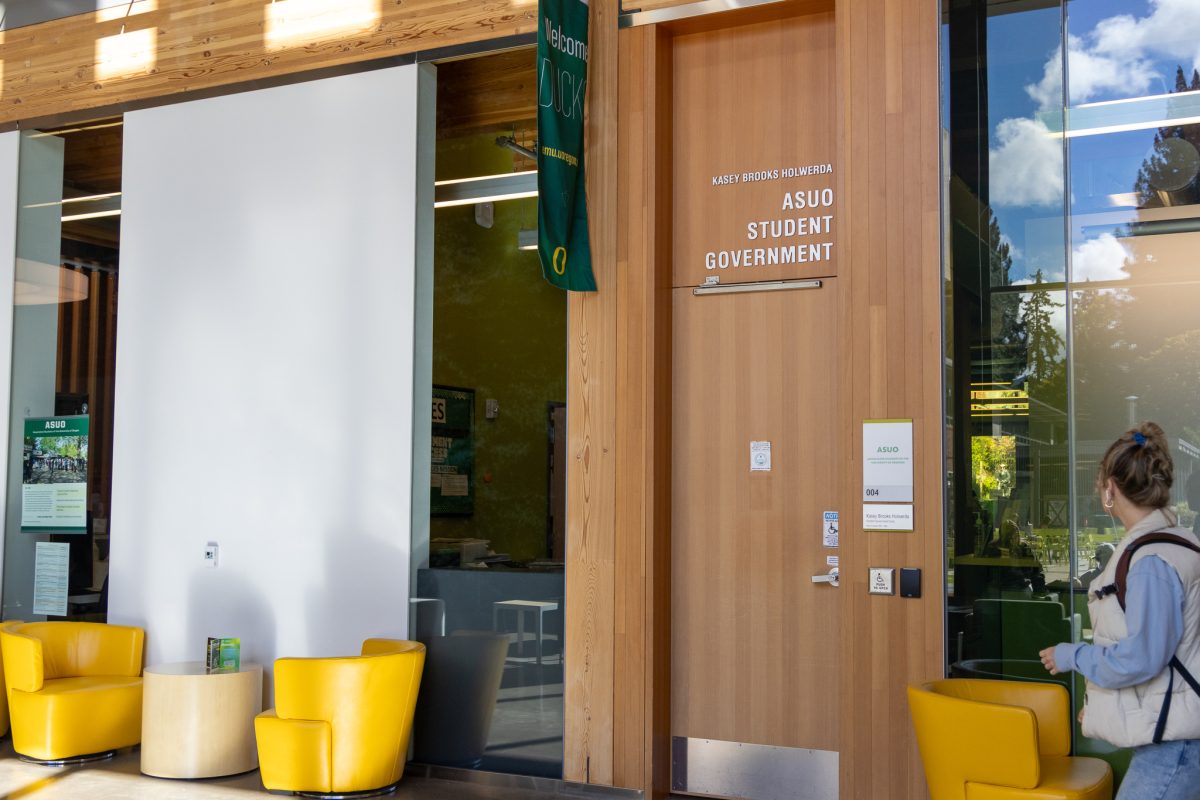
The Associated Students of the University of Oregon’s surplus budget is on track to be much lower than it was last year.
After starting the previous year with over $1.4 million in surplus budget, the annual sweep brought that number to $795,588, leaving ASUO with over $600,000 in budget surplus reduction as of Sept. 19.
ASUO began the 2024-25 fiscal year (FY25) on July 1, 2024, with a surplus balance of $1,445,246; by the end of FY25 on June 30, 2025, it had dropped to $197,512.14 before the sweep, according to ASUO Finance Director Justin Begley in an email to The Daily Emerald.
Breaking down the budget allocation
Each term, UO students are required to pay an “incidental fee,” more commonly known as the “I-fee.” Funding created from the fee goes to ASUO to fund student programs and initiatives.
“Over those two years (during the COVID-19 pandemic), we just had all this money, and I’m of the belief that we charge that tax to students; it doesn’t belong to us,” ASUO Senator Taliek Lopez-DuBoff said. “It’s our job to invest this money back into the student body. Surplus is not something for us to hold on to.”
The surplus budget is the incidental fee fund under direct control of the ASUO, meaning it is the remaining balance of funds that ASUO had at the end of the fiscal year after paying all budgeted allocations and expenses. In simpler terms, it is all the money left over after all the bills and expenses have been paid, and an excess amount of money is rolled over to next fiscal year’s budget.
ASUO has historically had large amounts of surplus funding from the I-fee, allowing student organizations to make “surplus requests” seeking additional funding.
According to Lopez-DuBoff, clubs typically use surplus requests for large events like conferences and travel expenses.
According to the ASUO Surplus Report for FY25 on April 8, the total disbursements were over $1.1 million of the surplus balance. This surplus money was disbursed to over 80 student organizations, who used the money for purposes like traveling, events, administrative expenses, printing, apparel and retreats.
Nearly half of the $1.24 million in surplus funds were allocated to support club and organization travel, and in total, benefited “roughly 1% of the student body,” wrote Begley. Travel expenses made up the majority of the spending, accounting for $495,819, which was 43.72% of the total disbursements.
Event funding followed with over $387,000 in disbursements. Furthermore, over $181,000 was disbursed toward administrative expenses, roughly $58,000 for printing, $11,362 toward apparel and $8,500 for retreats.
Last school year, Lopez-DuBoff was the senate president – the body of ASUO that approves surplus requests. He said there was a big influx of travel requests from student organizations, with many requests to far-off places such as New York. Lopez-DuBoff said with inflation, flights were increasingly expensive, and on top of more student clubs and organizations requesting farther locations, it was more expensive than the senate had anticipated.
Despite collectively being surprised by how much travel costs contributed to their spending, Lopez-DuBoff said student travel benefits the university.
“I think those kinds of things are beneficial and it makes the university attractive when students are visiting,” Lopez-DuBoff said. “That might help them with their decision of what college to decide. People like to put the benefit just to the dollar we spend, or who went to something, but it really is more nuanced than that. It’s more far-reaching.”
Despite increased travel requests, the number of students who actually travelled and reaped the benefits of the surplus funding was roughly 1.68% of all students at the University of Oregon.
“I think ‘benefited 1% of the university’ is relative because maybe 1% of the university got to travel, but when they come back, they get to share the stuff they learned,” Lopez-DuBoff said. “They also represent the university wherever they go, so that helps expand more opportunities for folks.”
Lopez-DuBoff said he wished more of the money were spent on events that were at UO, but also mentioned that even though the money doesn’t have to be spent, the ASUO “would just be taking our money” since it’s sitting in a bank account in a university index, getting bigger and bigger.
“When we make these strategic investments, that’s when we’re investing our money, and when we invest it even into a small group of students, I think that benefits the entire university,” Lopez-DuBoff said. “I would say it was money well spent, and because we had it, I think it was our duty to sort of give it back to students.”
In an email statement to The Emerald, new 2025-2026 ASUO President Prissila Moreno acknowledged that many organizations had limited budgets, which had been simultaneous with UO’s ongoing $25 – $30 million budget shortfall, so it made sense that they’d take the opportunity to request surplus money for large trips and events.
Moreno added that while the senate thought through each financial decision, challenges emerged when it seemed like the amount requested would make little impact on the overall amount of surplus available.
“I think a handful of senators began to feel worried about larger requests sooner than others,” Moreno said. “Some of us joined the Surplus Accessibility Committee to try and think of ways we can ensure all organizations have equal access to surplus, which would not be possible if we spent all of it too quickly. There were ‘Financial Priorities’ set, but because of the uniqueness of each request and organization, some didn’t always vote in accordance with those.”
For example, the senate allocated $287,106.86 in November 2024 alone and $224,461 in August 2024. “This sharp decline in surplus is the source of considerable concern for this year’s senate, which will face difficult decisions about which events and projects can be funded,” Begley said.
Financial plans for the upcoming year
As a result of the spending, the available surplus for the 2026 fiscal year (FY26) was significantly smaller. After the annual “sweep,” or reclaiming any money left in the ASUO’s account at the end of FY25, the total surplus for the entire FY26 is $795,588 as of Sept. 19, according to Lopez-DuBoff.
Nearly three months into FY26, senators and officers have been working together to move forward with the budget and surplus money they have. Lopez-DuBoff said that there is a clear recognition within the senate that they aren’t going to be able to fund all the things they had last year again.
For Moreno, it’s all about transparency this year. As a senator last year, having over $1 million in surplus was a large amount that created a big opportunity and a lot of responsibility.
“From what I’ve seen so far this year, the new senate is being very transparent with organizations about the state of surplus,” Moreno said. “Since there is much less of it now, all we can do is be honest with organizations and support them in finding other sources of funding if surplus is no longer an option.”
Despite starting this year off with much less surplus money as a result of previous expenditures, Moreno, Lopez-DuBoff and the entire senate body are looking to lead ASUO and the UO student body in creating opportunities and making a lasting impact.
“It’s important for us to be good stewards of it, but also, I think sometimes senators have a tendency to get an ego or feel that it’s their money, and it really isn’t,” Lopez-DuBoff said. “Students all pay (those fees) and I think it’s important to not just sit in an account, but to change people’s lives.”
Correction: A previous version of this story referred to the reduced surplus as a budget deficit. The Emerald regrets this error.