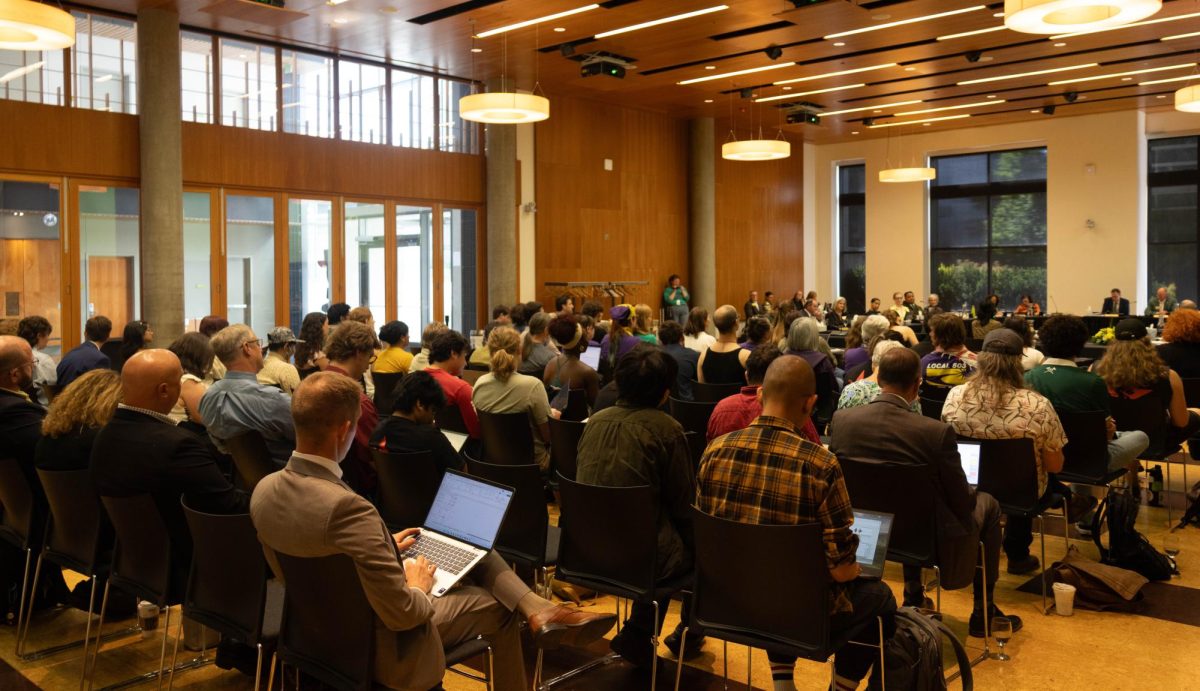
During the Eugene City Council’s work session on Sept. 17, Eugene Police Chief Chris Skinner proposed an ordinance that would prohibit drivers from giving money and other items to panhandlers from inside their vehicles.
The ordinance was proposed by Chief Skinner as an educational opportunity, only giving out citations to drivers. A similar ordinance has been in place since 2016 in Springfield, and was previously considered by the Eugene City Council in 2019.
“What they’ve seen in Springfield is the ability to have a really good community campaign and education,” Skinner said during the work session. “In the instances that the officer sees the violation, we’re able to change behavior with a simple conversation.”
Eugene has preexisting laws that penalize individuals for stepping out into traffic in an unsafe manner, but the new ordinance would punish drivers rather than pedestrians for reaching out of their car.
“If the ordinance would pass, we would have probable cause to make a traffic stop… And like any of our traffic stops we make, we have exclusive discretion on whether or not we issue a citation or a warning,” Skinner said.
Sergeant Michael Massey of the Springfield Police Department said that enforcement of the city’s panhandling ordinance has been successful in both education and compliance.
“It’s definitely something that we never wanted to cite anybody for; we’re hoping it would never get to that. To my knowledge, I don’t think it ever has,” Massey said. “We just made it super public, and at the normal spots where this was a chronic problem we posted signs for people to know not to do it. We’ve had pretty good organic compliance on both ends.”
Although the ordinance is directed toward anyone asking for items on the streets, some believe the goal of the ordinance is to reduce panhandling from the homeless population.
City Councilor Eliza Kashinsky rejected moving the ordinance to public hearing, saying that she believes the goal of the proposal is to reduce panhandlers.
“The government cannot tell someone ‘You can’t sit on a street corner with a sign,’ because that’s an infringement on their free speech rights,” Kashinsky said. “My opinion is that this ordinance is a way to design a regulation that doesn’t infringe on free speech but says panhandling is not something we want.”
City Councilor Randy Groves disagrees, saying that the ordinance would increase awareness of traffic safety. Groves, who retired from his position as Fire Chief for the Eugene Springfield Fire Department in 2016, cited his experience as reasoning.
The Eugene Springfield Fire Department has participated in the Fill the Boot campaign for multiple years. Firefighters walk the streets and have donors put money in their boots, helping raise funds to support the Muscular Dystrophy Association.
“(Firefighters were) told it was unsafe and that they ran the risk of being cited for disorderly conduct… Firefighters work on our streets and our highways every day, they’re generally very fit people, they have heightened situational awareness and they’re wearing reflective clothing,” Groves said. “So if it’s not safe for them, my question is, why do we think it’s safe for the lay public to be stepping out into travel lanes?”
Groves also says that the ordinance wouldn’t discourage donating to panhandlers. “It’s not going to stop somebody who wants to make a donation to a person soliciting funds to pull out of the travel lane, off the road and do so.”
In response to questions raised regarding the costs of the educational campaign surrounding the ordinance, Skinner clarified that potential costs would be encompassed in EPD’s community outreach budget, but wasn’t able to give a hard number.
“I think the resources that we’d be putting into debating, and if we pass it, enforcing it, would be much more effective at keeping our community safe if they were focused elsewhere,” Kashinsky said. “We have laws on the books that say don’t run red lights, and people run red lights all the time. I don’t think that we’re going to see people change their behavior in response to just passing this ordinance without additional action.”
With Councilor Matt Keating absent for the work session, a vote to order a public hearing wasn’t held. For the ordinance to pass, a public hearing would have to be held to gauge public opinion, and then a vote on the proposal itself.
Chief Skinner declined to comment until the City Council makes a decision.