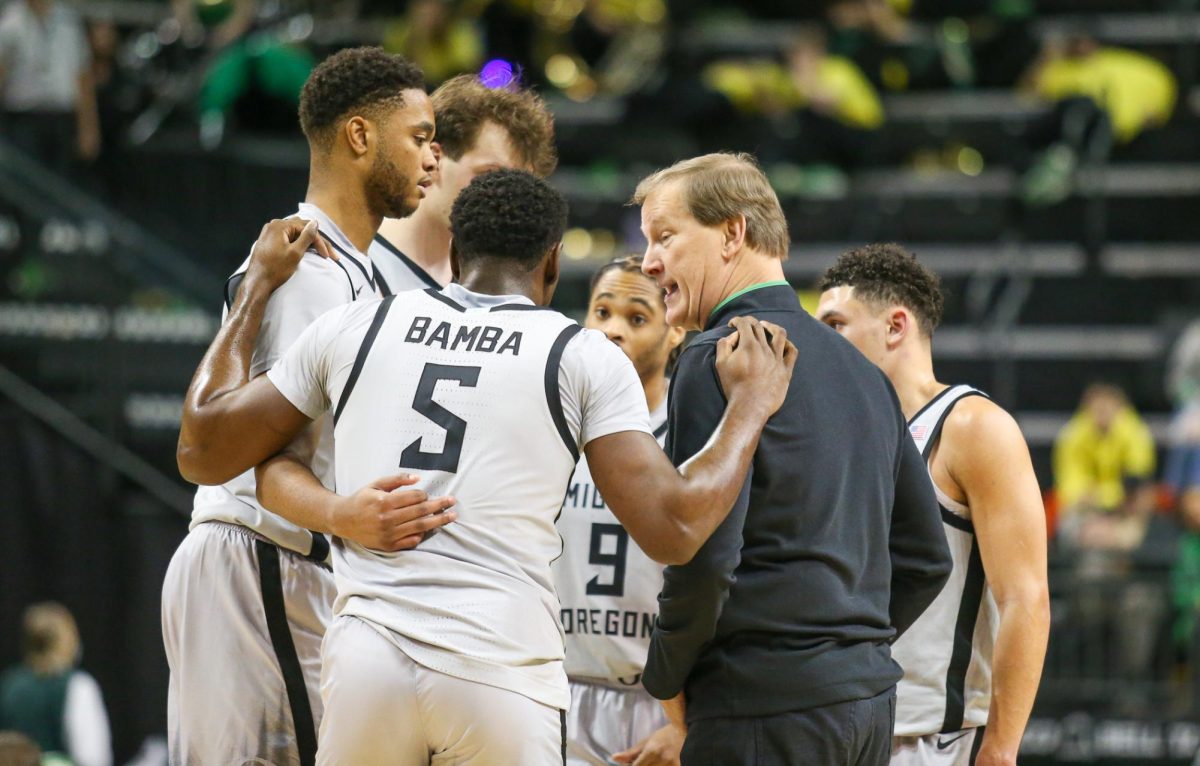
Oregon men’s basketball head coach Dana Altman has never gone into a season knowing anything is perfect, especially with the current landscape surrounding NIL and the payment of college athletes.
During the past few offseasons, Altman has contended with some of the largest spenders in the sport at the top of the Big Ten. The likes of Illinois, Michigan State and Purdue prioritize men’s basketball in terms of funding allocation, which places those programs a step ahead of Oregon in recruiting – both out of high school and the transfer portal. That’s why the 2025-26 roster might not turn so many heads in preseason; it’s not the highest profile names, but the ones that fit best amongst the current crop. Altman, yet again, needed to solve a Rubik’s Cube, as the great Jon Rothstein likes to say.
Consider it solved, as the Ducks appear to be primed for the new season with a plethora of new faces on display.
In an Oct. 24 exhibition against the Utah Utes, Oregon demonstrated the roster it built this summer in a dominant 73-53 win.
“A lot of good things to build from, good start,” Altman said.
The Ducks’ offense mirrors the system from last season pretty directly. It’s still Nate Bittle at the center, at times out on the perimeter or otherwise in the low post, surrounded by two ball dominant guards and wings that can both get to the basket and shoot.
The differences lie in the slight deviations among their play styles along with the sheer depth that the Ducks possess this season. With a player like Bittle, Oregon likely won’t have to contend with a team that’s taller than it; therein making Bittle much more effective in the interior. Once the defense inevitably decides to start crashing on those low post plays, Bittle can dish out to any of the four capable shooters on the floor at any given time.
Bittle is looking to build on his 14.2 points, 7.6 rebound and 2.1 block averages from the 2024-25 season, which led to his selection on the All-Big Ten First Team and Big Ten All-Defense First Team. Through the first two games, Bittle averaged 18 points, 11 rebounds and five blocks, picking up right where he left off.
Simply put, the Ducks’ first option in most scenarios is to move the ball inside-out in order to create this team’s best shots. The return of Jackson Shelstad also adds in an interesting fold. Shelstad, entering his junior year, was expected to be sidelined for the first month of the season with a broken right hand. Shelstad averaged 13.7 points and 2.7 assists on 45% shooting and just un- der 38% from three in 2024-25.
His absence as a shoot-first guard, but also the team’s primary ballhandler, forced Oregon into holding the ball for longer periods of time in the season opener against Hawaii. His surprise return against Rice in the second game didn’t add much scoring, but Shelstad’s impact on the offense was felt.
Against Hawaii, newcomer Wei Lin had to run the offense, and his inexperience led to 21 turnovers for Oregon. With Shelstad, against Rice, Oregon cleaned up the turnovers and the secondary shooters were able to free up from playmaking duties.
“(Lin) can make some shots for (Shelstad), Wei’s a great shooter, and Jackson can make some shots for him,” Altman said about the potential rotation between the two. “A lot of it will be dictated defensively and how well those guys can get after some people.”
Lin’s best play so far came on a pick and roll with another new face against Utah. After using an Ege Demir screen to get to his favored right hand, Lin drove right into two defenders, rose up as if he was going to lay it up but then dished a no-look, behind the head pass to the Turkish big man who finished with an easy dunk.
“When (Lin) started the (Utah) game and moved the ball, he really looked good,” Altman said. “You don’t want to take his aggressiveness away because he can score buckets, but his best quality is getting the ball moving, making plays and finding guys. Then I think shots will be a lot more open (for Lin).”
Unfortunately, Lin hasn’t been able to find his feet and is 0-12 on field goals in the young season and his minutes dwindled when Shelstad returned. Lin also adds a great deal of energy on the defensive end, particularly on-ball, which could be where Altman’s team excels the most.
Oregon has allowed just 122 points in its first two games. Oregon’s man-to-man system works into the personnel that the Ducks have at their disposal. That also makes players like Devon Pryor, Kwame Evans Jr. and Takai Simpkins much more effective, as their ability to defend any position on the floor makes Oregon’s defense one to fear.
The amount of switching also didn’t seem to phase the big men, as guys like Bittle, Demir and Sean Stewart looked comfortable getting switched onto smaller players through the first couple games.
“I’ve enjoyed playing with (Sean) a lot, he’s a different kind of five,” Bittle said. “He can shoot the middie, he’s got a very quick first step. For him, it’s just being able to take a little bit more time and get his feet under him and get to his spots on the floor. Defensively, he can defend one through five.”
Stewart’s addition gives Oregon the ability to sub out Bittle or even Demir and not sacrifice any height or rim protection on defense. The Ducks used Stewart in both the four and five spots against Utah, which gave them a wide range of versatility in their man-to-man set up.
This squad followed the recent history of Altman’s teams where the future is part un- certain and part set in stone. The return of key players such as Shelstad, Evans and Bittle allows for a healthy amount of educated prediction, but the additions of talented players such as Simpkins, Lin and Stewart adds an essence of novelty to Oregon’s current roster.