Building 2 at Knight Campus, a $330 million project, funded by a second $500 million gift from Phil and Penny Knight and $10 million in state funding, is set to open in March 2026. The building will welcome broader access following spring break.
According to Campus Planning and Facilities Management, “The exterior landscaping and planting are nearly done. Finishes are being completed and furniture installed, and the building systems are being tested.”
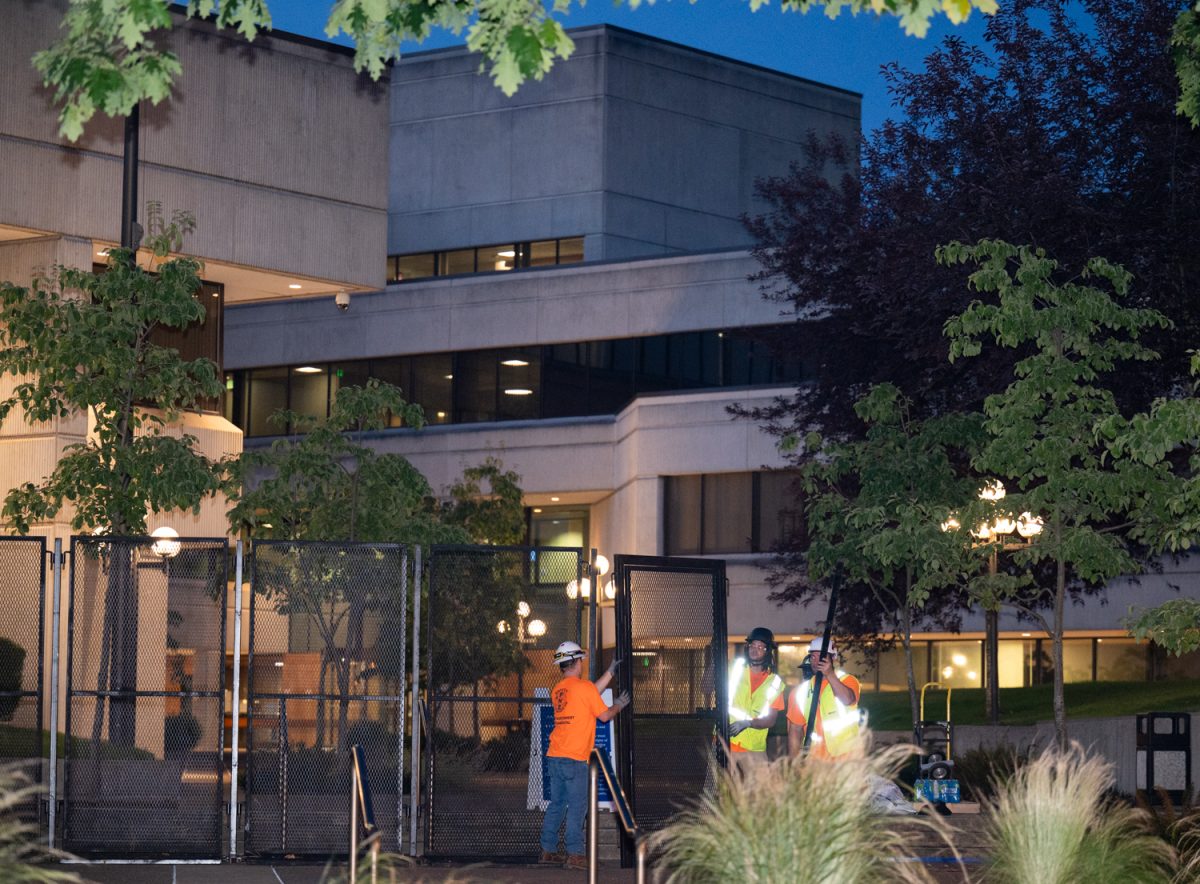
In the coming months, construction fencing will be removed, opening up pedestrian pathways along Building 2. Designed by Portland-based ZGF architects, the 184,000-square-foot building will offer expanded space for programs at Knight Campus including a bioengineering Ph.D, joint with Oregon State University, minors in bioengineering and brewing innovation and applied master’s programs in five different speciality areas.
Building 1, a $225 million project constructed by Ennead and Bora Architects, opened in spring 2020. It was funded by a prior $500 million gift from Phil and Penny Knight, along with $70 million in state appropriation. The 166,000-square foot building received a prestigious Leadership in Energy and Environmental Design Gold certification, awarded for the green building’s commitment to sustainability. ZGF is chasing the same LEED Gold accreditation for Building 2.
“Over 40% energy savings is achieved through daylight harvesting and efficient HVAC design, which includes heat recovery, chilled beams and enhanced ventilation with high-quality filtration to improve indoor air
quality,” ZGF said.
Knight Campus borders Mill Race, a channel off of the Willamette River. Mike Harwood, vice president of CPFM, states, “the project has minimal impact on the ecosystem” and “the Mill Race is healthier now than it has been in a very long time.”
Beyond sustainability efforts, architecturally, the exterior of the building will be inspired by Building 1’s glass facade. Both buildings will be connected via a skybridge. The four-story building will feature the forum, or “the social heart of the building,” and span two stories. The forum will connect public amenities on the first and second floors — a public bistro, seminar rooms, student spaces and teaching laboratories.
Notably, outdoor terraces will be accessible on each floor providing views of Building 1 and the surrounding scenery.
ZGF notes, “These volumes (level three and four terraces) evoke a treehouse quality while being covered from above to offer year-round use in the potentially wet, Northwest climate.”
New technologies and biotech facilities in Building 2 will further the overall mission of Knight Campus in creating a Science Advancing Society, Taylor said. The new building will feature 17-20 research groups fixed on advancing biomedical and bioengineering science. Both Sara Keller and David Peeler, new faculty members in the Department of Bioengineering, will open new labs at Building 2.
The Keller Lab will delve into the promise and potential of ultrasound technology to effectively treat infections.
David Peeler’s BRIDGE lab will strive to advance vaccines
and treatments to combat “infectious diseases, cancer and
support tissue repair,” states Knight Campus’s Fall 2025 Annual Report.
A key feature is a new maker space with state-of-the-art technology to include “3D printers, fume hoods, microscopes and electrical engineering tools among other items,” Taylor said.
Additionally, Building 2 will expand the Papé Family Innovation Center, which provides leasable space for early stage companies. According to the 2025 Annual Report, Building 1 housed seven startups in the 4,000-square-foot center – Building 2 will add an additional 3,000 square feet. The Center for Biomedical Data Science, opened in 2019 as a collaborative research effort between the UO and the Oregon Health and Science University, will now have a physical home in Building 2. The initiative’s goal is to train
up-and-coming biomedical data researchers to use “advanced computing and machine learning tools” to prevent and cure diseases at a faster rate, as stated by the Phil and Penny Knight Campus website.
The Knight Campus BioFoundry, a completely new core facility, will be concurrently located in Building 2. The BioFoundry will “centralize diverse cellular analysis techniques in one space, including DNA and RNA sequencing,” with the use of advanced equipment, Taylor said. Through collaboration between bioengineers and data scientists, “the hope is to reveal insights that might otherwise be missed,” he adds.
Editor’s note: A previous version of this story misstated the academic programs offered by the Knight Campus. The campus offers a joint Bioengineering Ph.D. with Oregon State University, a minor in bioengineering, a minor in brewing innovation and applied master’s degrees in five specialty areas: bioinformatics and genomics, optical materials and devices, polymer science, semiconductors and molecular sensors and biotechnology.