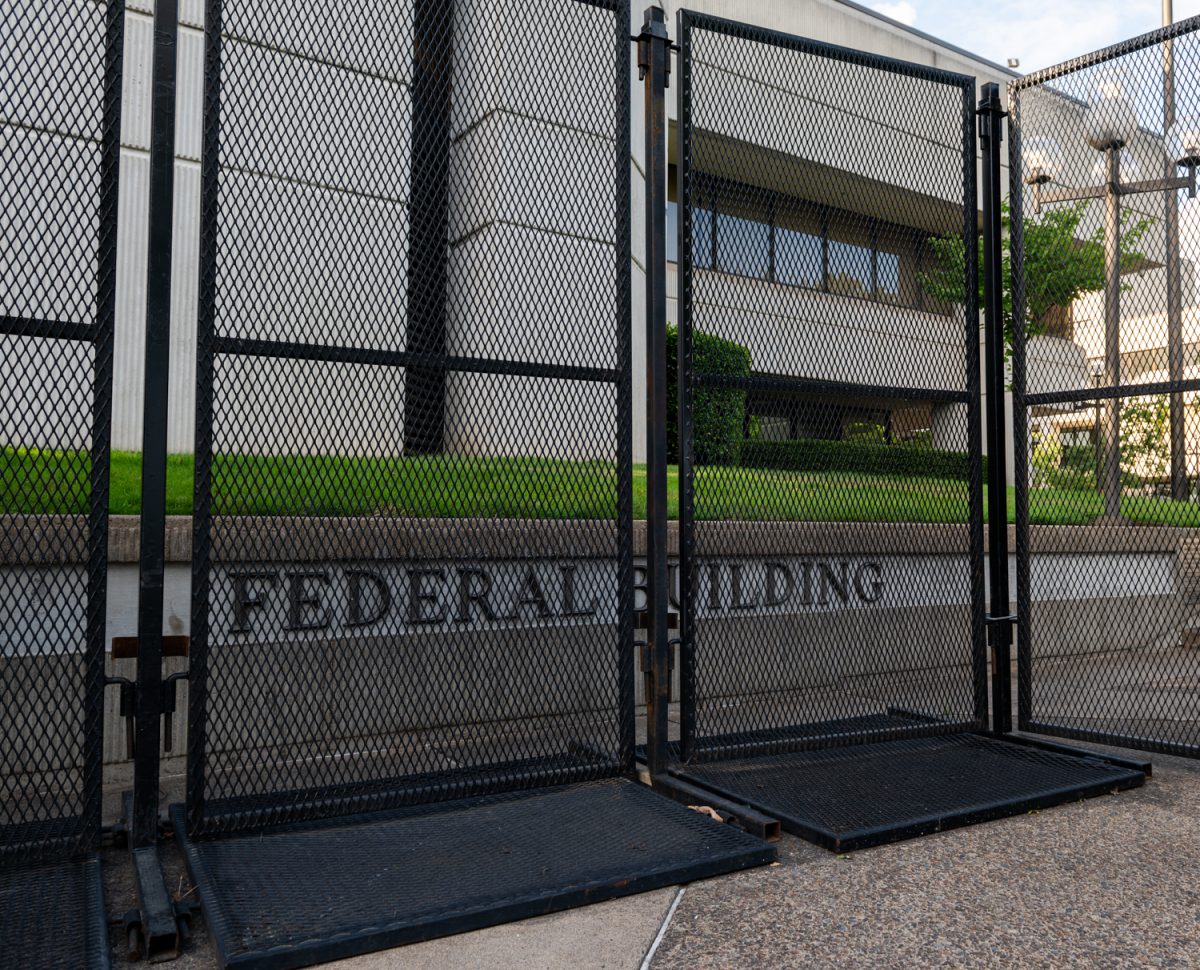
On Jan. 30, an anti-ICE protest at the Eugene Federal Building was declared an active riot by the Eugene Police Department. The next morning, protesters showed up again. And the next day, and the day after that.
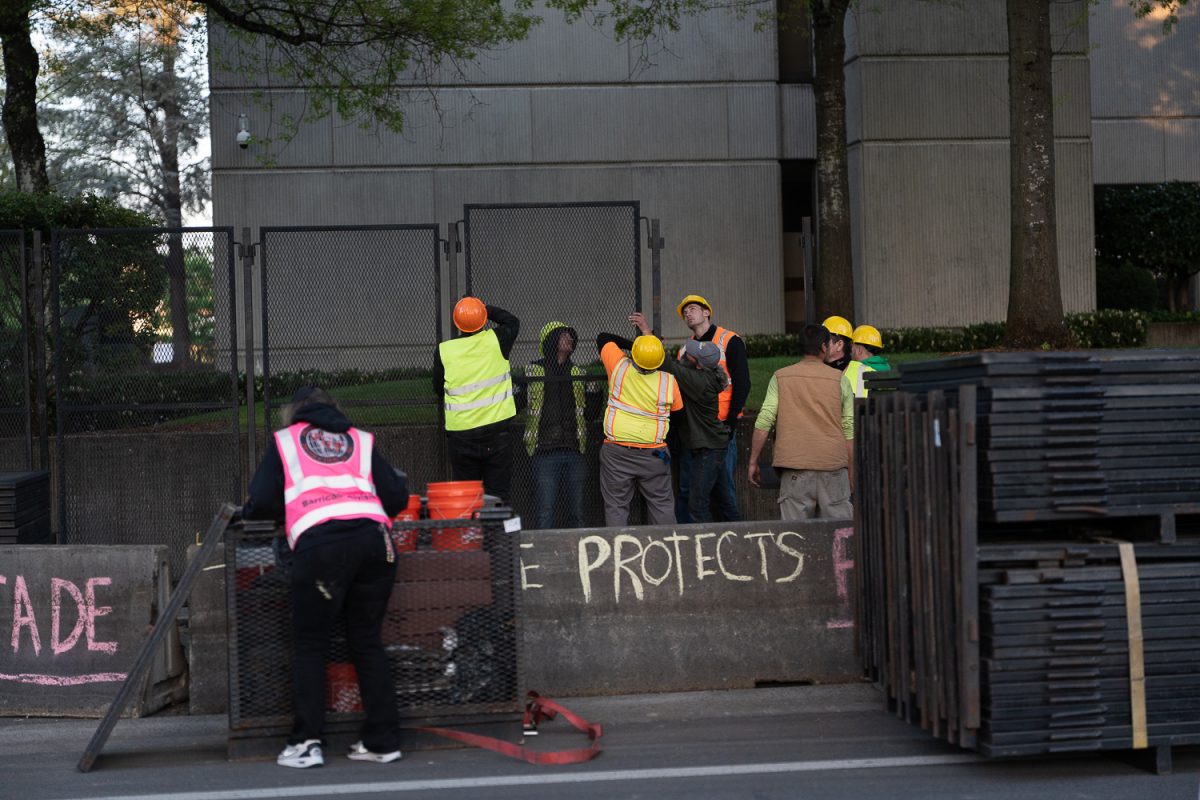
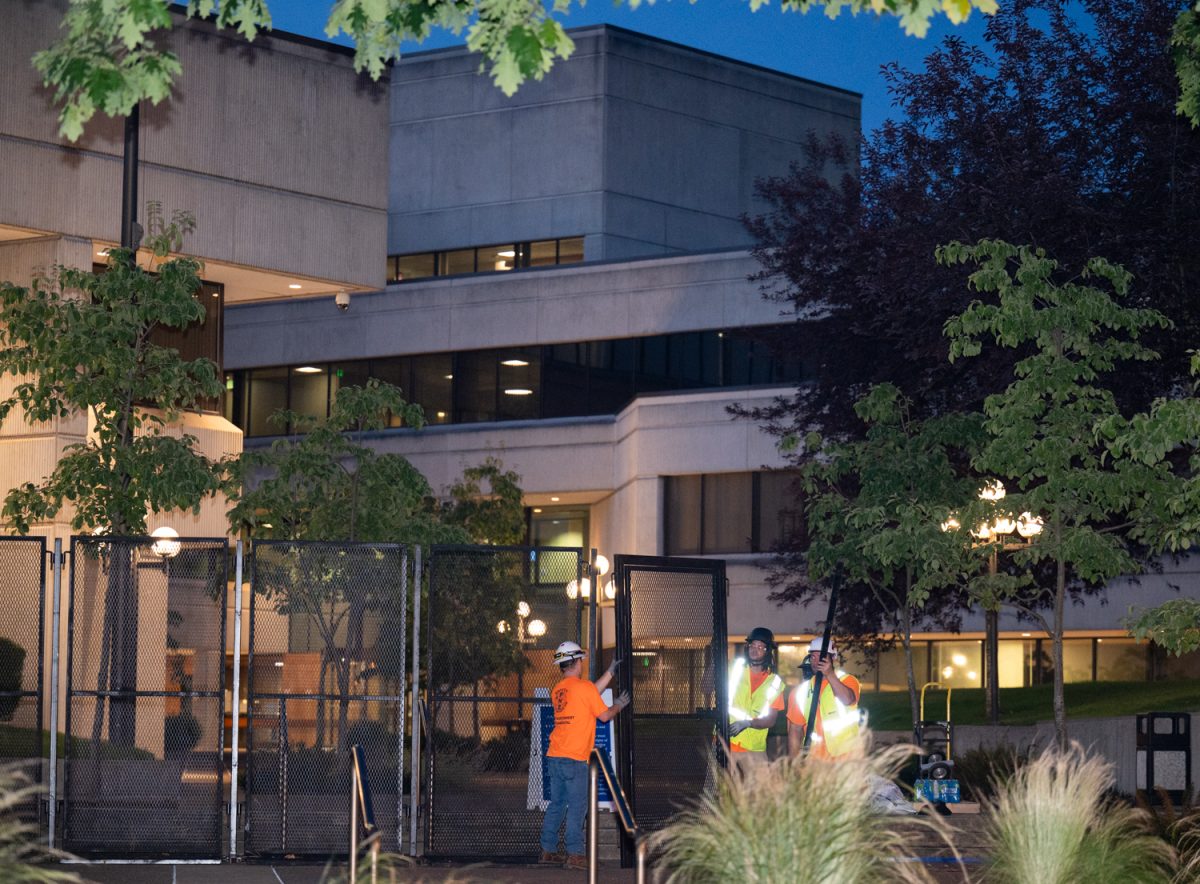
At one entrance to the federal building, construction crews repaired damage from the previous day. Broken glass was boarded up, and eggs were scrubbed off windows.
The courtyard was littered with the scattered remains of branches from the heart-shaped memorial for victims of ICE, the most recent being Alex Pretti in Minneapolis. Chalk drawings and statements covered the ground up to the sidewalk, and graffiti slogans reading “Chinga la migra” and “F*ck ICE” were spray-painted on the concrete walls of the federal building.
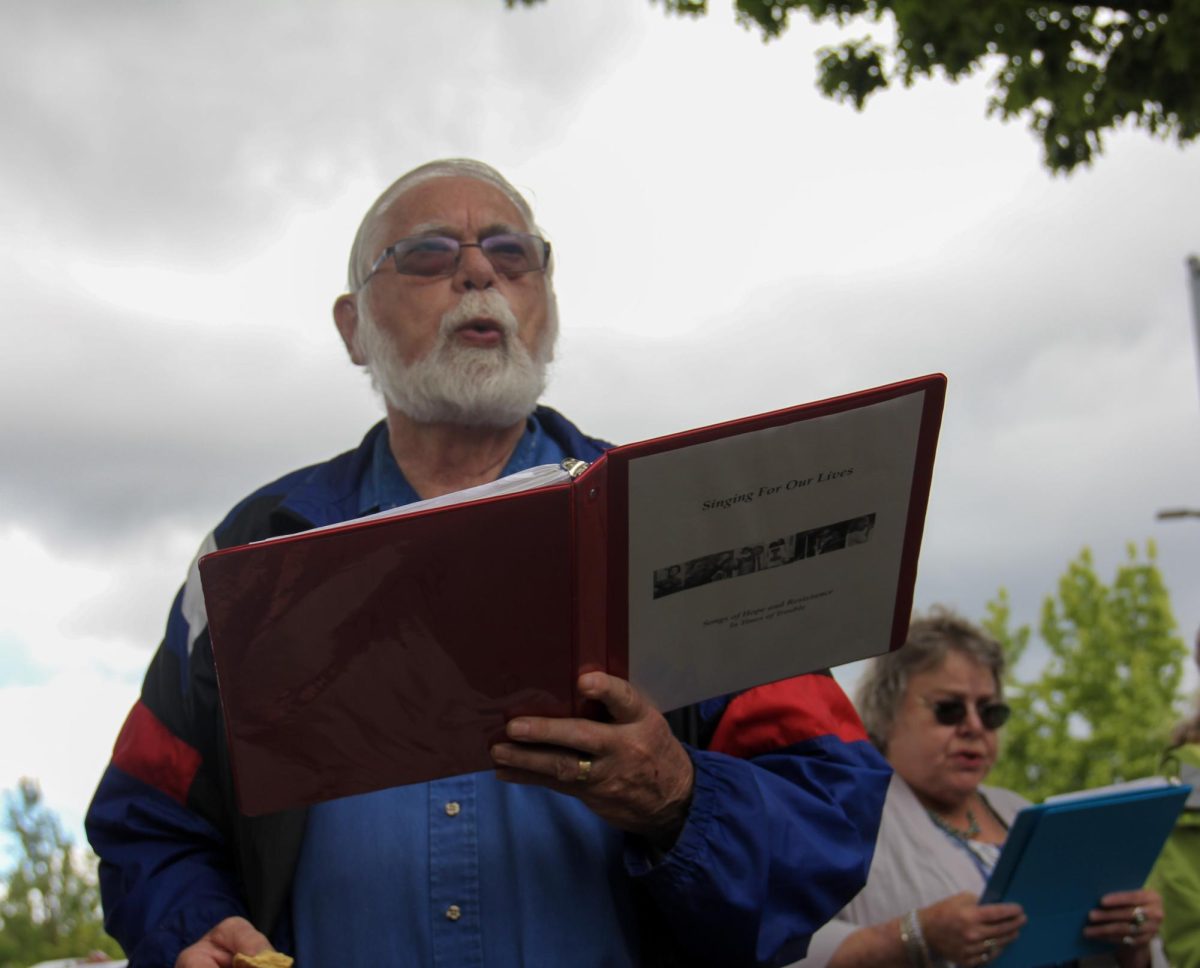
On the corner of Pearl Street and Seventh Avenue, anti-ICE activists gathered near the street, holding signs and American flags. The day began with only a handful of people, but by 2 p.m., the crowd had grown to around 150 people, occupying all four corners of the intersection.
Many said they were demonstrating out of fear and anger.
One attendee, Zephyr Elderwood, expressed their fear, saying, “I grew up here in Oregon and America. I don’t feel protected by the government anymore.”
Marvi Pruitt, a nurse who moved to Eugene a month ago, was at the federal building Friday and Saturday.
“Protesting is a way to direct my anger at what’s happening. There’s a lot to be angry about right now,” Pruitt said.
Pruitt said that while she is angry, it feels good to be out there to “show some solidarity,” and joked that going to ICE protests is a hobby for her now.
Many people who were at the protests Friday said they returned because they care about resistance. Most people interviewed said they felt compelled to show support, describing it as a civic duty within their communities.
Denelle Crommett has attended every protest she could over the last year, from Portland to Salem to Eugene, often leading chants over a megaphone. She spoke about her desire to stand up for Americans’ rights.
“Our rights are being violated in a number of ways. Our protections under the Constitution are being removed. We’ve fought so hard to get to this point, and they’ve rewound the clock 20 years. I can’t sit at home and watch it happen without trying to push back,” Crommett said. “I think that protesting shows that people across the United States are united. It is meaningful.”
Forest Pyle, a professor of English at the University of Oregon, said he feels an obligation to show up as much as possible.
“This is atrocious, what’s happening… I have students who are immigrants having their visas revoked. What’s happening in the country is an abomination. I have to be here,” Pyle said.
Danette Morrison said this was her first protest in more than 50 years.
“People my age, we need to make a statement too,” she said.
Overall, the crowd consisted mostly of people over 40.
On the outskirts of the crowd, Joan Willow McCulloch sat with his sign reading “Defund ICE, Demolish Trump’s Thugs.” At age 73, he said the issue is very important to him.
“After the killing of Pretti, it just made me realize that if you don’t say it’s wrong, that says it’s right, and I’m here saying it’s wrong,” McCulloch said.
Nick Sakys and Aaron Busi, two sophomore students at UO, attended their first protest Saturday. They said many young men may be afraid to “put themselves out there” by protesting what they believe in and that discomfort prevents many from showing support for causes they care about.
Busi said, “Men don’t want to get involved in something so emotionally challenging, and people don’t think it will affect them until it’s too late.”
Sakys discussed what pushed him to attend his first protest, citing a quote from Minnesota Gov. Tim Walz: “What side of history do you want to be on?” Sakys said the question resonated with him. He said if his future children ask him where he was during the ICE protests, he does not want to admit that he did nothing.
“I want to make sure I was out here in support, because who knows where this stuff is going?” Sakys said.
He also mentioned the historic role of universities in civil rights movements.
“Colleges are a place of revolution. We’re the future of the United States,” he said, adding that more college students need to show up because young people will be affected most by the nation’s failings.
“You can only scroll so much on Twitter seeing U.S. citizens getting murdered on the street for protecting fellow Americans from the violence used by ICE before you have to come out and show some sort of support,” Sakys said.
Audrey Engelmann also voiced her disappointment in the lack of engagement from people her age, saying her generation, Gen Z, is “passive.”
“Older generations fought for our rights and are here fighting for those rights again… I think there are a lot of youth that could be out here that are choosing not to be,” she said.
Engelmann said she was protesting in honor of her friend Jane, who died a few years ago.
“I know she would be here and it would weigh on her; she would want to be present if she were still here.”
Engelmann spoke about her appreciation for the community built through continued activism in Eugene.
“It’s really sweet getting to talk to people from all walks of life to connect and commiserate. It’s also really interesting to see how other people handle their frustrations, and how negative some people can be. That’s really not going to help. What helps is understanding and love and kindness, and I really love that in this community,” Engelmann said.
The Eugene community showed support for the ongoing protests, with near-constant honking from passing cars signaling solidarity.
Thomas Shackelford said he protests at the federal building every Tuesday and some weekends. He said some drivers are unfriendly and speed by while making obscene gestures, but he estimated they account for roughly one in every 300 cars. Most drivers, he said, are supportive.
Shackelford said he is committed to attending weekly, if not more often, and that the community will continue to show up.
“I’m out here because this is what democracy is… These folks that are here want a fair and democratic society. That’s why they’re here. That’s why we’re all here,” he said.
Protests remain ongoing daily at the federal building, as members of the Eugene community continue demonstrating against ICE activity in the city.