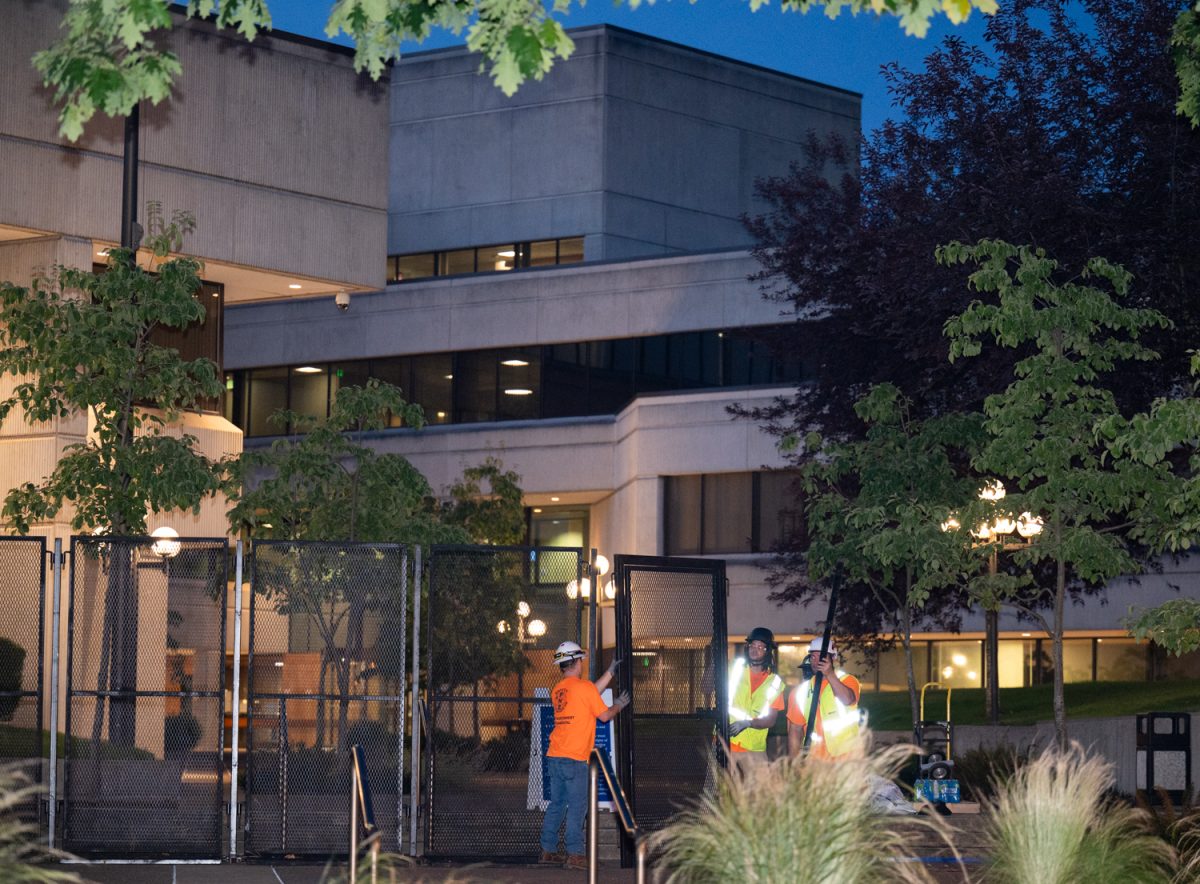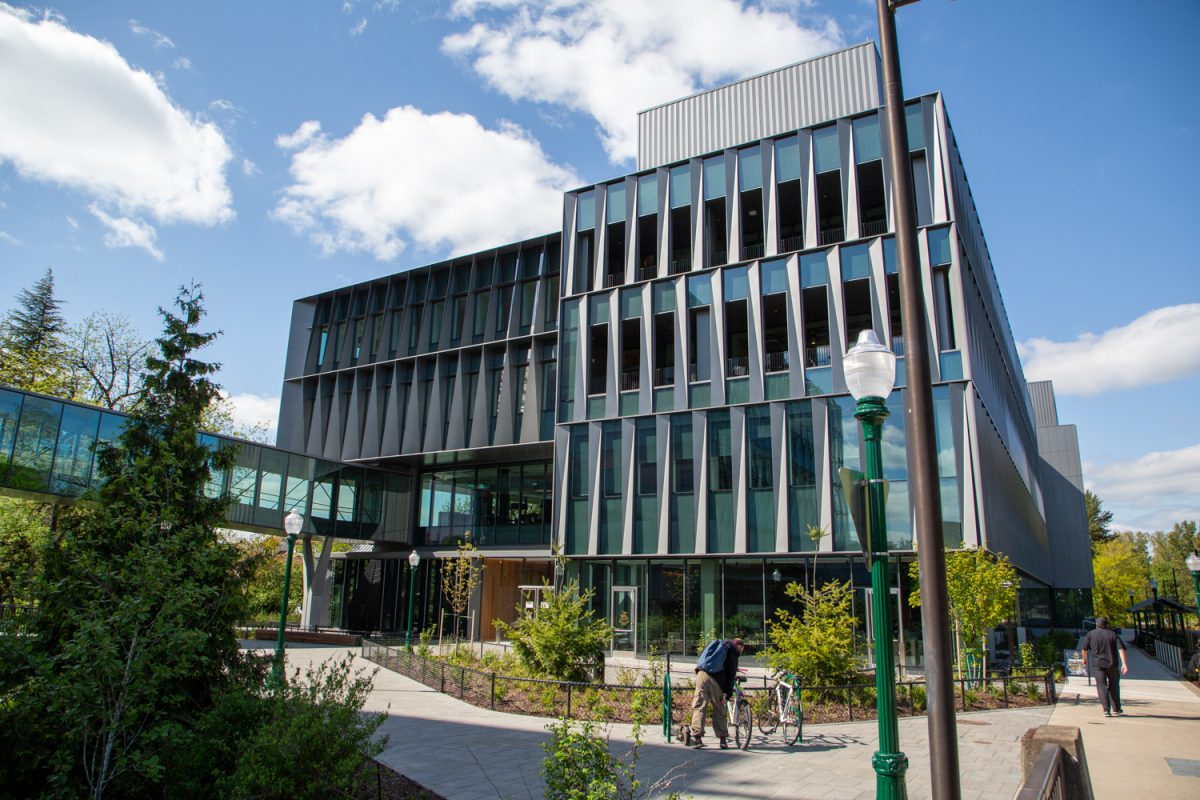
The University of Oregon’s Phil and Penny Knight Campus for Accelerating Scientific Impact Building 2 is the new home of state-of-the-art facilities for research in bioengineering, neuroscience, data science and innovation.
The building opened to the public on March 30. Construction began in 2022 after the UO Board of Trustees formally approved the construction phase on Dec. 6, 2022. The project was partially funded by a $500 million donation from Penny and Phil Knight, in addition to $10 million in state funding.
“The goal of Knight Campus is to leverage the science strengths that existed at the University of Oregon in basic science areas, which is neuroscience, material science, and the best way to do that was to build a bioengineering program and an applied science program,” Lewis Taylor, communications director for Knight Campus, said.
The building, which is 185,000 square feet, is on track to receive a Gold Leadership in Energy and Environmental Design certification, which recognizes sustainability efforts in construction, planning, material use and maintenance.
When full, the building can house between 17-20 research labs.
The main core facility housed in Building 2 is the biofoundry facility, which supports “the culturing of cells, the manipulation of cells and the characterization of cells and cellular materials,” Kurt Langworthy, senior director for shared equipment and core facilities, said.
Langworthy said they are investing roughly $4 million to outfit the facility, which is open to all Knight Campus researchers. The lab and equipment is also available for outside companies, other universities and other UO departments to rent.
The idea behind sharing the facility, Langworthy said, is to minimize the cost. Research will get a subsidized user fee, while commercial users pay an unsubsidized user fee. Those fees then go back to the facility and are used to sustain the equipment, some of which costs up to $30,000 per year to maintain.
“This is really for the community and the biosciences to come and study growth, manipulation and characterization of biological and biomaterial things,” Langworthy said.
Another facility in Building 2 is the Papé Family Innovation Center which functions as an “incubator space” for startup companies looking to translate scientific discoveries into “practical applications,” according to Terra Hiebert, lab manager for the center.
The center includes labs, wet labs and office spaces in both Building 1 and 2. Lab space in Building 2, Hiebert said, is specifically designed for larger companies and companies that “need a bigger footprint” as they look to expand more rapidly.
Building 1 currently houses five companies researching everything from environmental contamination testing to microbiome source therapeutics.
Like the biofoundry facility, several of the labs in the Papé Family Innovation Center are shareable, giving startups access to equipment they otherwise wouldn’t be able to afford.
“To be able to have a space where (companies) can do their proof of principle experiments, work on getting other startup investing while they’re doing those experiments is really a great asset,” Rachel Bedford, research associate for science communication, said. “They also get to automatically be situated within the UO innovation community. Not only the Knight Campus, but (the) business school, lots of students that are excited about new ideas and projects.”
The building will also house a computational suite for researchers and UO faculty who are using computers to understand bioengineering, biological sciences, data science, and artificial intelligence. The suite will also house the Center for Biomedical Data Science, which is collaborating with Oregon Health and Science University to collect data for cancer treatments.
David Peeler, assistant professor of bioengineering and founder of the Peeler Lab, which began operations in Building 2 in March, said getting to work in the new space is “an incredible opportunity.”
“There’s a strong foundation in materials (research), but not a whole lot in drug delivery here, so there was a really clear niche, especially for RNA delivery and immunoengineering,” Peeler said. “(At) the research level, there are a lot of people that I could very easily collaborate with and an appreciation of immunology and interest in it, but not a very crowded landscape, like joining a much more established department, where you kind of have to carve out a much smaller niche.”
Peeler said there has been a lot of interest in his lab, despite it not yet running at full capacity. He said he expects to have one principal investigator, one postdoctoral researcher, two Ph.D. students and two undergraduate students in the fall.
The building, which also houses the brewing innovation minor and the bioengineering minor, will have a dedicated makerspace and instructional lab space for graduate and undergraduate students.
Peter Chien, a postdoctoral scholar and lab manager in the Peeler Lab, said getting to work with undergraduates is a very “rewarding” experience and that everyone who works in Building 2 collaborates and builds off each other.
“The flow of ideas (is) always really rewarding. I feel like it makes me a better scientist,” Chien said.
Editor’s note: This article has been updated with a corrected version of a quote from Langworthy.