

The stretch from Eugene’s Roosevelt Boulevard to the Randy Papé Beltline houses a bowling alley, coffee shops, hotels, bars and restaurants. As the sun goes down, the lack of lights along the roadway makes it easy to see the stars. My view of the sky is quickly interrupted by the loud rumble of a huge truck racing by. The driver looks down, with the light of his phone illuminating his face, now in the distance. Suddenly, I remember that I’m standing along a highway: Highway 99.
A former barbecue restaurant now stands as an abandoned building covered in vivid and detailed graffiti. Makeshift tarp shelters are somewhat concealed by fences and street signs. There’s a real sense of history and culture around this area, even if it may not be a glamorous one.
As I walked up to the 7-Eleven on Roosevelt, I began chatting with a man named John. Appearing to be in his late 60s, John was accompanied by his three small dogs: Rambo, Ruckus and Rosie. They sat in a large cart atop all of his belongings as John explained that he has been living on the streets for the past nine years, with most of that time spent along Highway 99.
To John, this area is home. It’s where his friends live, where he finds his meals and where he tries to get a good night’s sleep, often unsuccessfully.
This isn’t an unusual story along Highway 99, as the roadway makes up Eugene’s densest area of resources for homeless members of the community.
St. Vincent de Paul has two shelters located in the area. The Schlies Resource Center and the Lindholm Social Service Center both provide food, showers, clothing and stabilization assistance. There are other community-supported shelters serving those who need medical recuperation housing, women-only and veteran housing. ShelterCare and Carry it Forward provide extensive support resources to the unhoused, and Sponsors Inc. is an affordable housing non-profit.
Because there are so many resources located in this small stretch, there’s a large population of people sleeping, walking and living along the highway.
John explained that there have been high rates of displacement from regular sweeps done by law enforcement, as the area is usually bustling at night. This has made it significantly harder for people to get back to the resource centers located near the highway.
The same stretch that often provides people a place to stay and an occasional warm meal, also places a vulnerable population right next to high-speed traffic. The combination of a 55 mph speed limit, with late-night traffic from the abundance of bars on this road and the large unhoused population living here, is a catastrophe waiting to happen — and it already has.
The Eugene Fatal Crash Report states that “88% of fatal crashes between 2022-2024 involved arterial streets, such as Highway 99.”
Back in 2022, Amber Mark, a beloved community member experiencing homelessness, was killed on impact when a driver recklessly tore through her tent. A large cross now marks the spot where she was killed, honoring her life and memory.
Merle Dean Sheffield was killed in a hit-and-run while riding his bike through a crosswalk on the Highway in January of this year. As another homeless Eugenian, Sheffield’s life is now honored by a ghost bike chained to the fence outside of the Lindholm Center.
To John, Sheffield’s death was personal. The two spent time living together along nearby train tracks and quickly became close friends. “He was quite a character,” John said with a chuckle, as though reminiscing on an old memory.
These deaths are not isolated incidents, but part of a larger pattern of hostility from drivers.
John recalled one occasion when a car targeted a group he was walking with on the sidewalk. The driver attempted to hit them and went as far as following the group to the train tracks, where they had to slip through a fence to avoid being struck.
John explained that he sees reckless driving and speeding along the highway daily. “It’s always been like that around here,” he said. Another issue with incidents like these is the lack of accessibility in reporting.
Local homelessness advocate, Sarah Koski, explained that unhoused people frequently receive trespassing citations or other minor infractions simply because they have nowhere else to go. As a result, many fear interacting with law enforcement, let alone feeling safe enough to report an incident or targeted attack.
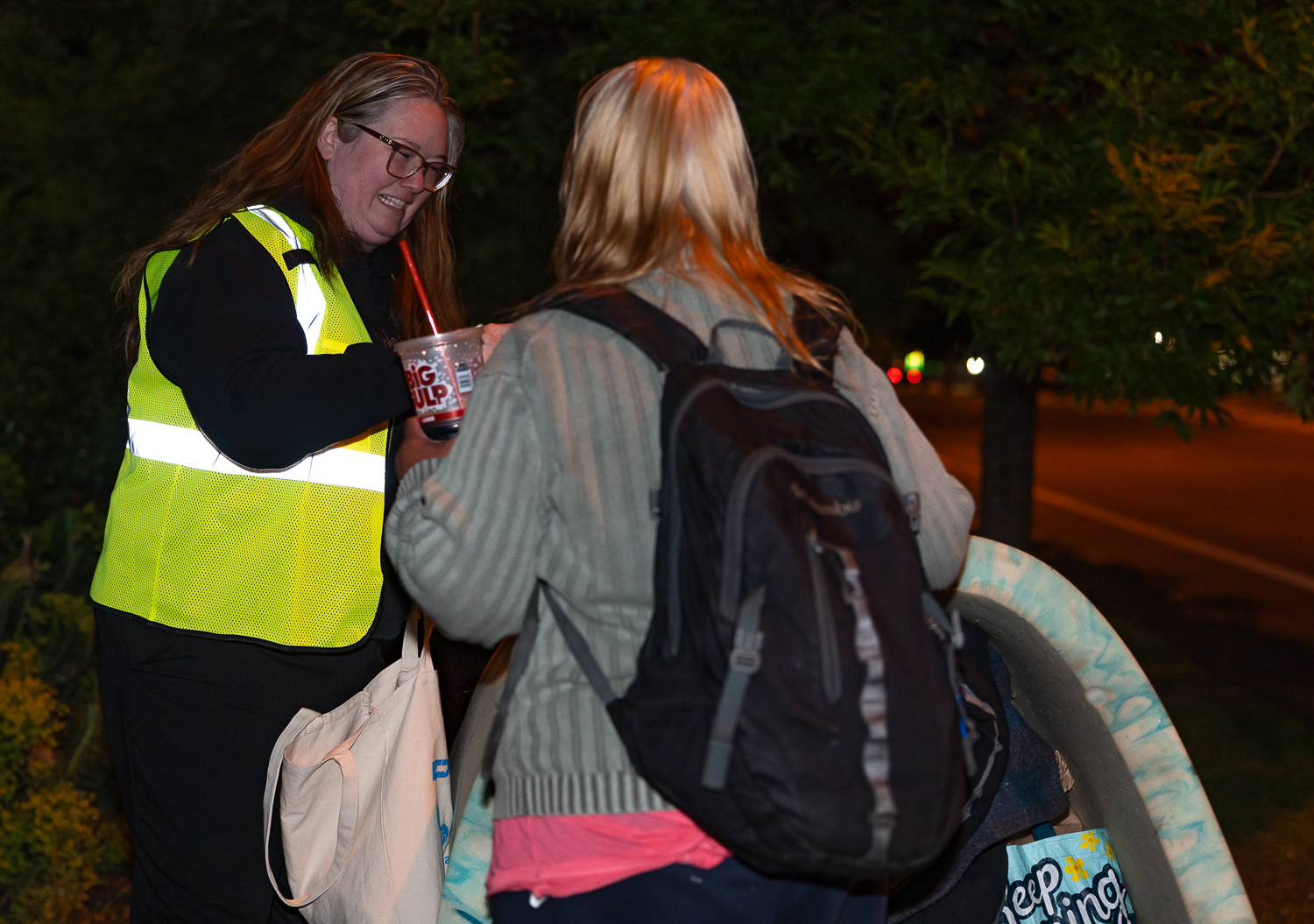
In a 2019 study conducted by the National Coalition for the Homeless, the Bureau of Justice found that “less than half (44%) of violent victimizations (of people experiencing homelessness) are reported to police.”
While incidents go unreported for many reasons, the danger unhoused people face along Highway 99 should be hard to ignore.
Koski also pointed out that people tend to jaywalk on the highway as there’s a lack of crosswalks and that sidewalks abruptly end in certain areas, which is “bad for mobility.”
Many of the dedicated crosswalks also don’t feel safe. Koski said that with the deaths of Mark, Sheffield and others, the community is forced to choose between unsafely jaywalking or using the same crosswalks where people they know have been killed.
The danger of Eugene’s streets isn’t a secret to city leaders, as Eugene’s mayor and police chief both recently spoke at a community event and press conference on transportation and bicycle safety. Here, Eugene Police Department Chief Chris Skinner emphasized the importance of community reporting.
“We need to hear from you,” Skinner said after he explained that in his 35 years of service, the most aggressive driving he had “ever seen is in Eugene.”
While the city encourages the community to report in order to help make change, many of those being impacted by the accidents on Highway 99 face significant barriers in doing so. This often includes not having access to a phone or the internet in order to make reports.
The possibility of a low reporting rate doesn’t mean that incidents and attacks on this road are rare. What it indicates is that violence against unhoused people is overlooked.
This is where highway safety corridors come into play. Safety corridors are specific stretches of state highways where people are encouraged to drive more carefully and are often located where there are high rates of serious and fatal injury.
Typically, there is more action taken in these corridors to improve safety through enforcement, engineering progress, increased awareness efforts and enhancing coordination of emergency medical services.
Logan Telles, a transportation planner with the city, explained some of the upcoming plans for making the highway safer. He shared that there will soon be an increase in brighter street lights added, as well as sidewalk infill being done in 2027.
While these are important efforts, infrastructure alone won’t fully address the risks many face. A safety corridor designation would acknowledge the highway as a place where vulnerable people are looking to survive, while also helping to prevent further unnecessary deaths.
Lane County just recently designated portions of Marcola Road and Clear Lake Road as Safety Corridors, and beginning in May, traffic fines have doubled for speeding violations.
So why wouldn’t the city of Eugene consider this same designation for a portion of Highway 99? One particular stretch was already determined to be one of Eugene’s most dangerous roads for cyclists and pedestrians by LookOut Eugene in 2025.
This area simply doesn’t function as just a highway anymore. Highway 99 is a busy traffic route with high pedestrian activity, a wide range of businesses and is a central point for homelessness resources. Pair this with frequent car crashes, attacks on the homeless and driving under the influence, it’s a recipe for disaster, and we’ve already seen the effects.
In a recent Facebook post, the Lane County Government said that it “previously participated in a state pilot program on London Road that demonstrated safety corridors, combined with signage and public outreach, can significantly reduce deadly and serious crashes.” So by the county’s own reasoning, Highway 99 would likely see substantial improvements in safety from this kind of action and corridor designation.
We continue to treat Highway 99 as only a major roadway when it acts as more of a neighborhood. People commute, live, work, walk, eat and sleep here. They deserve to feel safe doing so.
There’s a serious safety concern here that the city can no longer overlook. While it may be an inconvenience for drivers to have to slow down on Highway 99, a highway safety corridor designation can help to save lives.






Staci Clegg • Jun 1, 2026 at 1:11 pm
Thank you Sarah Kioski, for this amazing piece and being the voice for the ones who are no longer with us, and thank you for all the amazing work you do. It is a blessing to not only be the advocate for the unhoused but to call you my friend.