
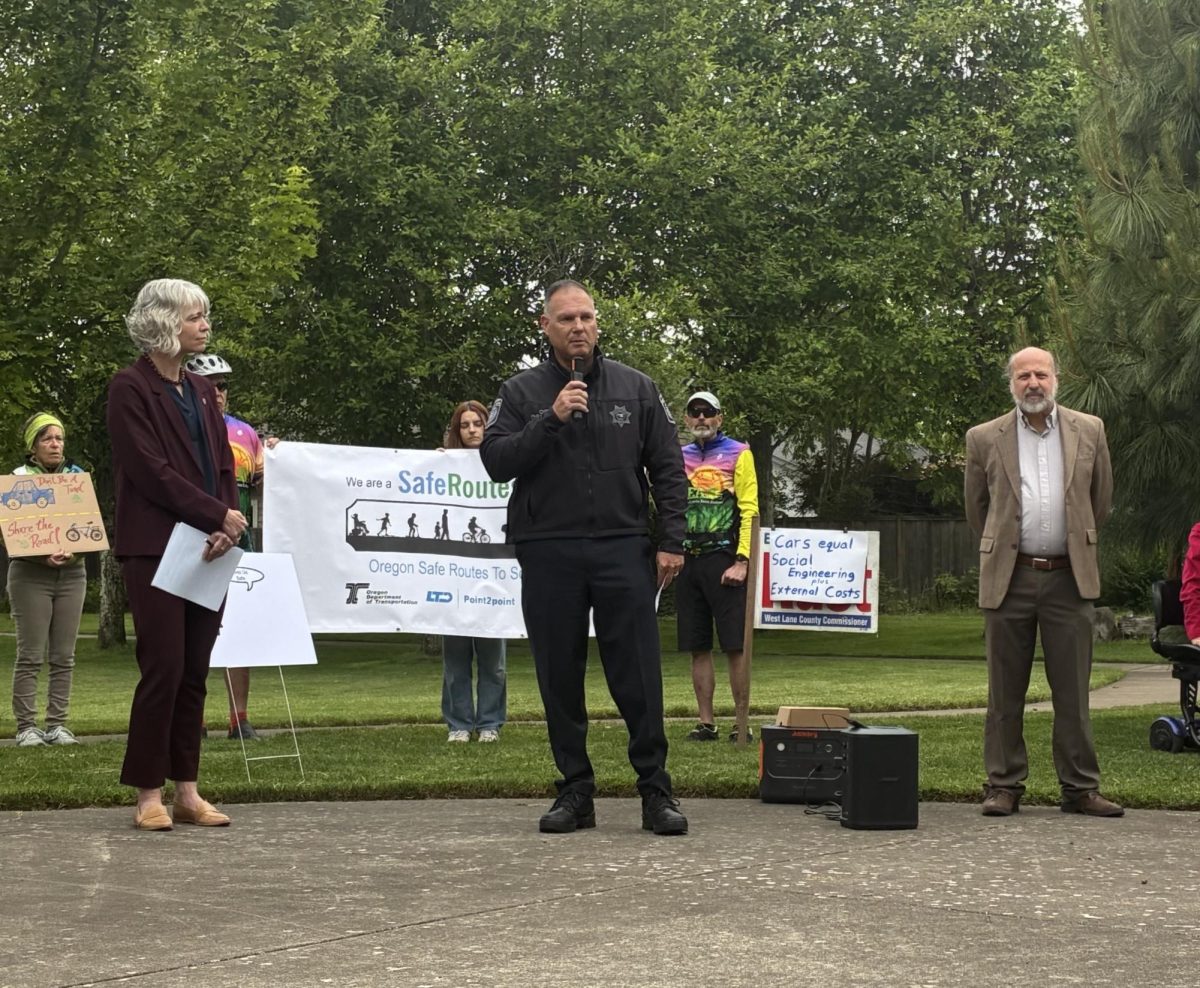
At 9 a.m. in the Rosetta Place Park, community leaders and Eugene residents mourned lives lost to recent traffic collisions and discussed how to build and fund safer streets. Earlier this month, David Winston Morris had been killed in a crash that shut down River Road just one block from the park.
“Today, I wanted to bring our community together to focus our collective attention on proclamations but also on our partnerships and the work that we could do to make the important progress that we need in our community,” Eugene Mayor Kaarin Knudson said.
Daniel Appiah Gyekye, a University of Oregon student and co-organizer of the gathering, described the broad effect of investing in safe and accessible transportation.
“Our streets are more than pathways, they are spaces where families connect and where everyday life happens,” Appiah Gyekye said. “The way we design the streets and use these spaces reflect how much we value one another.”
Appiah Gyekye said that residents cannot “fully participate in community life” without safe streets.
Logan Telles, a transportation planner with the city, discussed the importance of the city’s goal toward fewer injuries and deaths on the road.
“We are also community members that have compassion for our neighbors and we also feel concerned for the safety of ourselves and our families,” Telles said. “The City of Eugene remains committed to the goal of zero traffic deaths on our roadway network.”
Telles said that city staff “understands the sense of grief” rising from recent crashes and fatalities and pointed to improvement projects for bicycling on River Road, sidewalk and lighting improvements on Highway 99 and intersection evaluations.
Eugene Police Department Chief Chris Skinner said EPD would increase enforcement of distracted drivers and drivers under the influence because of a recent grant funding overtime work.
Skinner also encouraged residents to submit reports to the police department when they feel unsafe on a roadway.
“We do really want to hear from you. So much of what we do is predicated on hearing from our community members on where they are having the issues. We can’t just rely on data alone,” Skinner said.
Telles said that money for improvements of River Road came from bond funding, but the city has not had the same funding opportunities to improve Hillyard Road and Patterson Road, where safety concerns came to a head earlier this year when Erick Njue, a UO Ph.D. student, was killed while bicycling.
This winter, Knudson said the city was expecting a grant from the Oregon Department of Transportation through the Safe Routes to School program, but ODOT recently cut Safe Routes to School by $17 million and will not approve new construction projects for the time being, citing a budget gap.
“The grant funding program that we were looking at for that is no longer available and so we’re trying to reorganize and think about how we would realistically fund something,” Telles said.
Sarah Mazze, the coordinator for Eugene 4J’s Safe Routes to School program, also spoke at the event, opening with a story of a family friend who had been killed crossing River Road several years ago.
Now, Mazze is an advocate for safe transportation planning and design and encourages schoolchildren to use active transportation along safe routes.
Mazze said that accessible active transportation can “be the difference between making it to school or not” for vulnerable students.
“We have plenty of data for particular streets, particular types of streets where we can expect more serious crashes, and we know what contributes to this and what helps and we don’t have to wait for the crashes to happen in order to act,” Mazze said. “Let’s do this for each other. Let’s do this for the kids.”







Marc Schlossberg • May 21, 2026 at 8:21 am
Thank you for continuing to cover transportation issues and how this community can do better so that all of us can get around, not only safely, but hopefully full of joy and life as ell.