
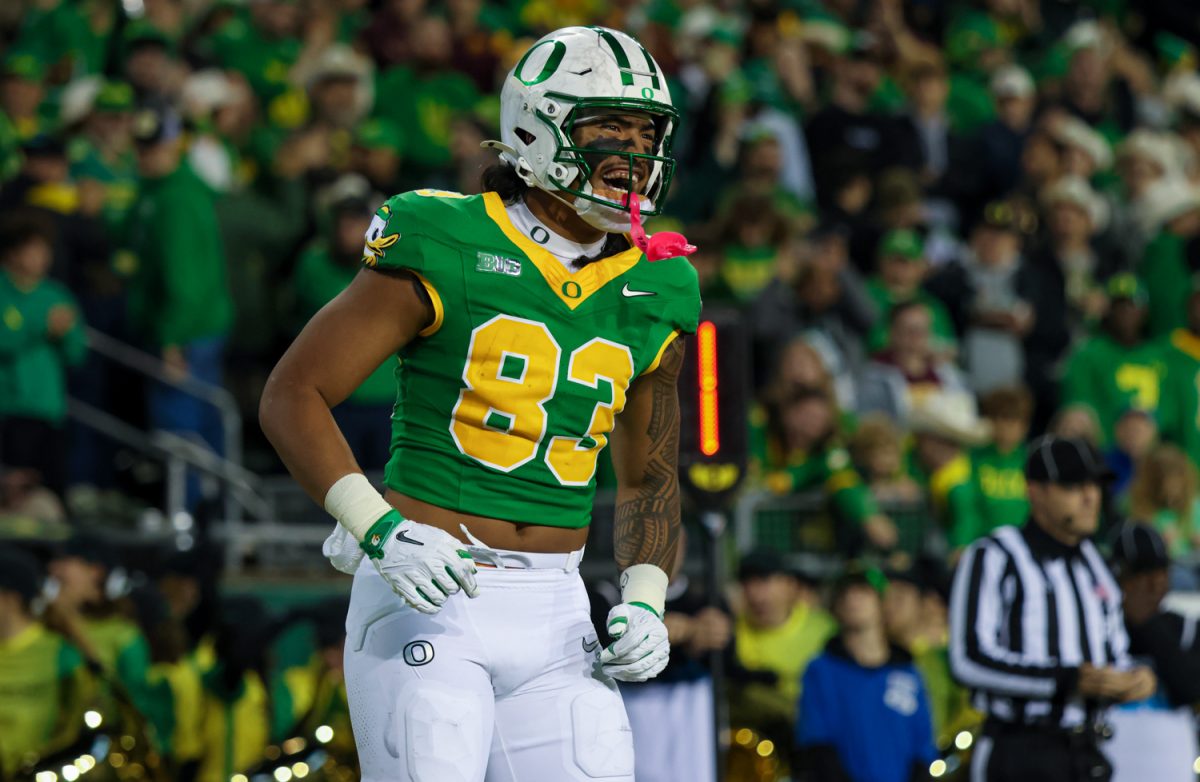
Games under the lights at Autzen Stadium are prone to explosion through the air. Last time Oregon played a true home night game, a 7:30 p.m. kickoff against USC in 2023, wide receivers Troy Franklin and Tez Johnson scored 83-yard and 77-yard touchdowns, respectively.
Last weekend, the Ducks’ aerial outlets looked a little bit bigger.
Saturday, for the first time under head coach Dan Lanning, Oregon’s two leaders in receiving yards in a game were both tight ends. The reasons are multifold — the Ducks were missing their top three wideouts, but their tight ends have become legitimate receiving options in multiple spots.
Against Minnesota, Kenyon Sadiq (career-high eight receptions, career-high 96 yards, touchdown) and Jamari Johnson (four receptions, career-high 57 yards) shone. Sophomore Roger Saleapaga snagged two receptions, too, and the group anchored the No. 7 Ducks’ 42-13 win.
“A lot of times, when tight ends come into the game, it’s to run the ball,” Lanning said afterward. “Our tight ends are like having wideouts on the field, and all three of those guys did an unbelievable job.”
They’re not just exceptional blockers. They’re aerial mismatches for defenders.
Sadiq has garnered praise this season — as have many of the Oregon wideouts — for his blocking. Johnson’s snaps were limited when Oregon had a healthier roster, and he mostly saw action as an inline blocker.
That wasn’t the case Saturday. Oregon sent a 12-personnel (one running back, two tight ends) set out for its first drive — notable because the Ducks’ depth at wide receiver leads them to play mostly in 11.
Offensive coordinator Will Stein used Johnson in motion on that drive, where he moved pre-snap wide and flattened his route to the sideline before turning a 4-yard completion into eight. The 23-yard completion to Sadiq on the same drive, which set Oregon up at the 1-yard line, had the junior on a wheel route from the left end of the offensive line.
“Even if we’re in 21, 12, 13 (personnel), we still have the ability to play open sets,” Sadiq said. That opens a lot for everyone, so everyone knowing what to do and just being versatile is huge.”
Versatility in 12 personnel allows for tempo offense with variety.
In Oregon’s two-minute offense at the end of the first half, where it’s been supremely successful in 2025, four of eight plays from scrimmage were targeted at a tight end. On the others (Oregon was in 12 personnel for the drive), Sadiq and Johnson were used both to block and run routes.
Johnson, attached to the left side of the offensive line, beat zone coverage with a double-move route on second-and-10 from the Gophers’ 42-yard line to set the Ducks up on the Minnesota 18-yard line. Two plays later, Sadiq, lined up in the slot, ran an in-breaking route defended by a defensive back whom he had five inches and 55 pounds on.
Dante Moore paid that completion, down to the 3-yard line, off with a cross-hash throw on the next play that found Sadiq (from the slot, again) open against man coverage from a linebacker in the back right corner of the endzone. Dante Moore’s ball placement — high and away from the defender — took advantage of Sadiq’s size. He went up and got the ball and got his feet down, too.
Oregon will get healthier — the Ducks didn’t have Dakorien Moore, Evan Stewart or Gary Bryant Jr. against the Gophers last weekend. It’ll look closer to the 11 personnel group that had the potential to take the top off college football over the past two seasons. Here’s what matters, though: Oregon’s tight ends don’t limit those possibilities; they expand them. That’s not going away.




![Oregon third baseman Drew Smith (17) talks to pitcher Will Sanford (28) during the first inning. On April 24, 2026, The Oregon Ducks defeated the Penn State Nittany Lions [5-4], at PK Park, at University of Oregon, Based in Eugene, Ore. (Fred Hall/Emerald)](https://dailyemerald.com/wp-content/uploads/2026/04/2026.4.24.EMG_.FJH_.BaseballVsPennSt-4-1200x800.jpg)
