Oregon’s juvenile justice system has emphasized rehabilitation over punishment across three decades of reform, beginning with the establishment of the Oregon Youth Authority in 1996. But those reforms have not eliminated significant racial and ethnic disparities, a Daily Emerald analysis of population and youth detention data shows.
Although Oregon sets statewide criteria for when youth can be held in detention, counties interpret and apply those standards very differently. The result is a system where a young person’s chances of being detained depend not only on their behavior, but also on the county where they’re arrested — a difference that disproportionately affects minority youth.
“Juvenile justice is like politics; it’s local,” said Douglas Thomas, a policy and implementation manager for the OYA’s Juvenile Justice Information System — which publishes the state’s detention data each year.
Even as youth detentions statewide have fallen by about 60% since 2014, racial and ethnic disparities persist across Oregon’s 36 counties, with youth facing significantly different odds of detention based on where they live. But State Sen. Floyd Prozanski, D-Eugene, said consistency across Oregon’s juvenile justice system is important.
“We need to ensure that people — in this case youth — are treated equally across county lines,” Prozanski, who’s the chair of the Oregon Senate Judiciary Committee, said.
However, in Lane, Marion, Clackamas and Multnomah counties — some of Oregon’s largest counties by population — youth face vastly different detention outcomes, and the deepest divides fall along racial and ethnic lines.
The analysis
The Emerald analyzed youth detention data from the OYA’s Juvenile Justice Information System and population data provided by Portland State University Population Research Center. Youth detention is the temporary confinement of a minor who has been accused or convicted of a crime.
To compare counties with different population sizes, The Emerald calculated detention rates per 1,000 youth in each racial or ethnic group. Rather than using overall county detention counts, which may be higher in larger counties, this rate-based approach enables county-to-county comparisons by youth groups.
Marion County: High detention rates
The Emerald’s analysis found that Marion County — the state’s fifth largest county by population — detained Hispanic youth at a rate of 14.26 per 1,000 Hispanic youth last year. That’s the highest rate among the five largest counties in Oregon and 62% higher than the statewide rate.

The analysis also showed that Marion County detained Black youth at a rate of 41.19 per 1,000 Black youth — nearly double the statewide rate.
Troy Gregg, Marion County’s juvenile department director, confirmed the numbers in an interview. He said minority youth are “overrepresented,” and that it’s higher than he would like.
Gregg noted that finding alternatives to detention for youth with mental health issues is a challenge, saying those youth are often held in detention longer than they should be.
Gregg cited rising gang activity as contributing to Marion County’s higher rates.
“We have had a blast off of gang-related activity in the Salem area in the last two years,” he said.
Gregg said the county has about 20 electronic ankle monitors and other types of monitoring, which are used when there are community safety concerns about releasing youth back into the community. He said it helps reduce the time youth spend in detention.
On the racial and ethnic disparities in Marion County, State Rep. Kevin L. Mannix, R-Salem, asked, “What else can we do with social services?” He also said there’s a need for more intervention and prevention in Oregon.
“I think we’re getting better, but we’re not doing enough” for at-risk youth at an early age, Mannix, who’s on the Oregon House Judiciary Committee, said.
Directly north of Marion, the bordering county of Clackamas — Oregon’s third largest county — had much lower detention rates for minority youth last year.
Clackamas County: Lowest detention rates
According to The Emerald’s analysis, Clackamas County detained Hispanic youth at a rate of 2.00 per 1,000 Hispanic youth in 2024 — the lowest rate among the five largest counties in Oregon. The county also detained Black youth at a rate of 10.37 per 1,000 Black youth, which is also the lowest rate, according to the analysis.

A possible reason for Clackamas’s lower detention rates is that Clackamas requires a supervisor’s approval before a youth is detained for more than five hours, but Marion does not. Multnomah and Lane counties, the other counties The Emerald interviewed, do not require that either.
Another difference between Clackamas and Marion is in how the counties use electronic monitoring.
Clackamas County officials say their community monitoring program — which includes electronic ankle monitoring and other types of monitoring — is used as an alternative to detention. Juvenile Department Director Christina McMahan said it helps the county lower detention rates, noting that it has had about 16 youth a month participating in the program this year and last year.
“These are youth who would have likely been placed in detention or stayed in detention longer if we did not have this program,” McMahan said, adding that the program helps youth maintain connection with their community and support systems.
A few miles away in Multnomah County — Oregon’s largest county — detention rates for Black and Hispanic youth were also lower than the statewide rates last year, but higher than in Clackamas.
Multnomah County: A county that uses detention sparingly
The Emerald’s analysis showed that Multnomah County detained Hispanic youth at a rate of 5.65 per 1,000 Hispanic youth in 2024 — the second lowest rate among the five largest counties in Oregon. The county also detained Black youth at a rate of 17.54 per 1,000 Black youth, which is also the second lowest rate, according to the analysis.
Kyla Armstrong-Romero, Multnomah County’s juvenile services director, said the county aims to use detention sparingly.
“We try to only hold youth who have charges that require them to be in detention,” she said, adding that those charges primarily include felony charges.
Like Clackamas, Multnomah County officials credit their community monitoring program for their lower detention rates, saying the program — which includes electronic monitoring and other types of monitoring — is used as an alternative to detention. Armstrong-Romero said numerous youth programs and community partnerships with nonprofits also contribute to the county’s lower rates.
One of those programs, the Lutheran Community Services Northwest’s Restorative Justice program, is also used by the county as an alternative to detention for youth who can safely remain in the community, Armstrong-Romero said. Lutheran Community Services Northwest officials said the program is a voluntary program for youth who “want to correct their mistakes.” Through the program, trained facilitators lead conversations that allow young people to take accountability for their actions, LCSNW officials also said.
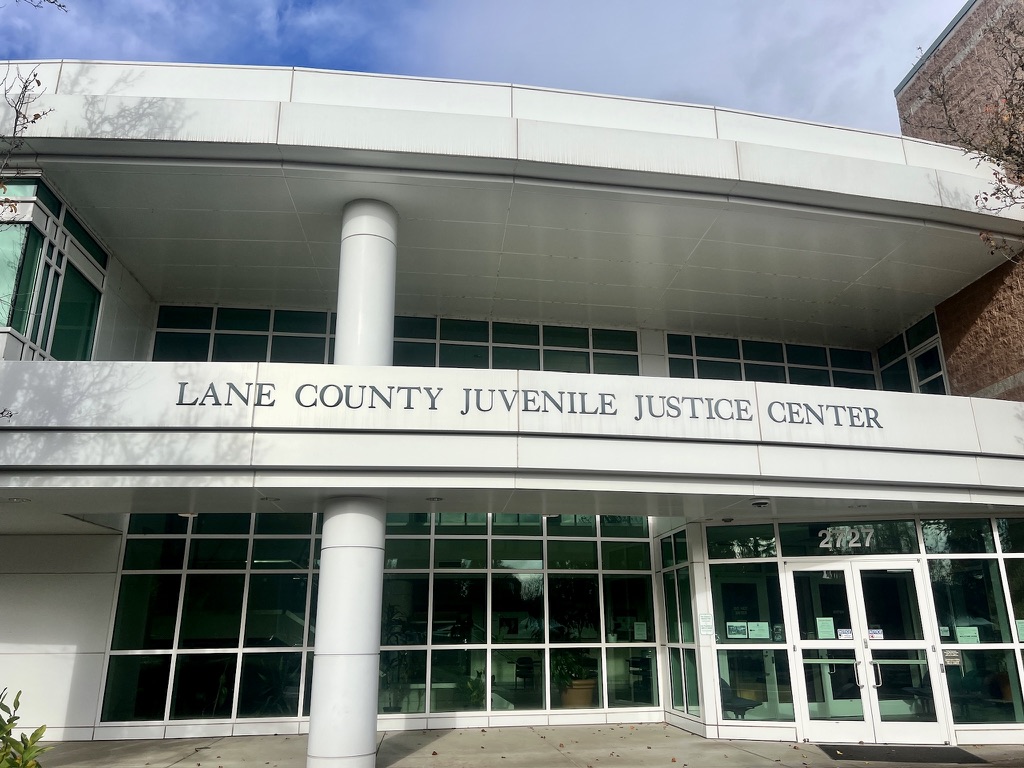
About 100 miles away in Lane County — the state’s fourth largest county — Black youth were detained at the highest rate among the five largest counties in Oregon last year.
Lane County: High detention rates for Black youth
The Emerald’s analysis found that the county detained Black youth at a rate of 53.37 per 1,000 Black youth in 2024 — more than twice the statewide rate.
Patti Robb, Lane County’s juvenile department director, confirmed the numbers with The Emerald. She said the disparity among Black youth “has existed for a very long time,” and that the county doesn’t “have any control over what youth” are brought to detention.
“The law’s very clear. If youth are arrested for specific crimes, they can be detained,” Robb said. “If it’s safe for them to come into custody, we detain them.”
Robb said Lane County has no electronic monitoring available for youth — a tool that Marion, Clackamas and Multnomah use. She said she’s not sure there’s a need to use it because parents and guardians can “often serve as the ankle bracelet.”
She also said the county is working to reduce detentions and racial disparities. Robb noted that the county has applied for a grant to establish a deflection program that would allow schools or police officers to refer at-risk youth for a clinical evaluation instead of charging them with a crime.
What the research shows about juvenile justice
Robb criticized those who believe juvenile justice is “not trauma-informed.”
“I wish people understood that youth see the safety and security” in detention as a way to “regulate behavior, to stabilize,” she said.
But Alice Perry, the assistant director of Clackamas’ juvenile department, said detention overall is “harmful to youth,” and that “youth are not mini adults.”
“Youth are going to make mistakes — it’s part of the developmental process,” Perry said. “Normally, youth make the mistakes in the context of a family that can help guide them.”
Perry’s comments about the harms of juvenile detention echo research and data that suggest incarceration can potentially impact a young person’s life. They say youth who spend time in detention are more likely to end up in the criminal justice system as adults and less likely to graduate from high school.
In Oregon, currently or formerly incarcerated youth who started high school in 2020 had a four-year graduation rate of 39%, according to data from the Oregon Department of Education. That’s far below the statewide average of nearly 82%.
Why some counties may have higher detention rates
It’s not clear why some counties detain Black and Hispanic youth at higher rates. However, 2024 detention data from the OYA shows that some counties detained youth for violating the rules of probation more often than other counties that had much lower detention rates.
In 2024, nearly 20% of Marion County’s detentions were technical probation violations, which didn’t involve violating new laws. And in Lane County, the share was about 17% of detentions, while Clackamas County was below 10%. In Multnomah County, it was less than 1% of detentions.

Rep. Mannix said the numbers require further investigation, and that state agencies may need to provide more guidance for counties. But he said there’s no need for additional statewide standards on when counties can detain youth for technical violations, stating that a “rigid standard” won’t work well in Oregon because the state has urban and rural counties.
“In a lower population rural community, most people know each other. You could be relying more on work programs and community service to help young people get back on track,” Mannix said. “In a large, heavily populated urban area, the connectivity is not as strong, and they may have to take a different approach.”
Sen. Prozanski agreed with Mannix on the need for more guidance and further investigation. He suggested that new laws may be needed to address the issue, but said there may be scenarios where “you can’t legislate everything to be perfect and not have discrepancies.”
Lawmakers consider a closer look
Prozanski said the racial and ethnic disparities in Lane and Marion counties that The Emerald’s analysis identified warrant a “deeper look” by the Oregon Legislature. He said the Senate’s judiciary committee could hold an informational hearing with officials from Marion and Lane counties.
Mannix said he’d encourage House leadership to also hold hearings.
Emphasizing the need for informational hearings, Prozanski said, “It’s wise for us to understand” why the disparities are occurring. “Is there something that we need to do to adjust that? And does that need to happen through legislation or rulemaking? Or at a more local level?”






![Oregon outfielder Angel Laya (53) greets outfielder Jax Gimenez (7) before the first pitch. On May 30, 2026, The Oregon Ducks defeated the Washington State Cougars [4-0] in game 4 of the NCAA D1 Baseball Regionals at PK Park, at University of Oregon, based in Eugene, Ore. (Fred Hall/Emerald)](https://dailyemerald.com/wp-content/uploads/2026/05/2026.5.30.EMG_.FJH_.BSBLvsWashingtonStNCAA-1-1200x800.jpg)