Students and faculty members packed seats in the Ford Alumni Center’s Giustina Ballroom for the second day of the University of Oregon Board of Trustees meeting, preparing to speak during public comment or support those who did.
Public comment made up the majority of the June 2 meeting’s agenda and began at 9 a.m. Following Monday’s financial updates and discussion of the recently announced budget cuts, many speakers raised concerns about the looming effects these cuts will have on students and faculty.
Members of labor unions including United Academics, UO’s faculty union; Service Employees International Union, which represents classified staff at the university; UO Student Workers; and the Graduate Teaching Fellows Federation were among those who spoke during public comment.
Maram Epstein, vice president of UA, said the announcement of new budget cuts only “heightened distress” after last year’s cuts were “devastating for morale, liberal arts, value of tenure and upholding the principles of shared governance.”
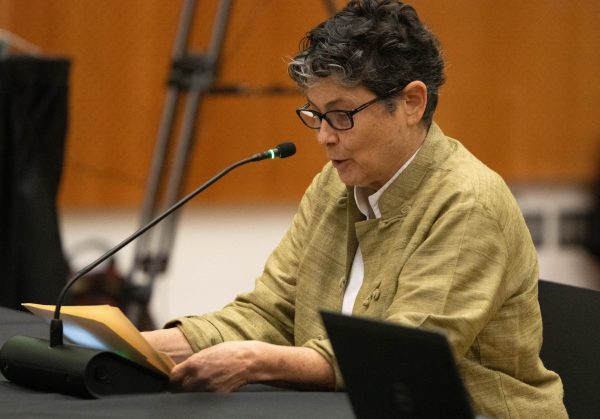
Jennifer Smith, president of SEIU and recently elected Eugene Ward 3 city councilor, questioned budget planning and said it was coming at the cost of workers at the university.
“(Trustees and presidents) are supposed to plan for the future we all knew was coming. They’re supposed to protect the mission of higher education and not undermine it,” Smith said. “Instead of leading, I see doubling down on strategies that are not working, and workers are paying the price.”
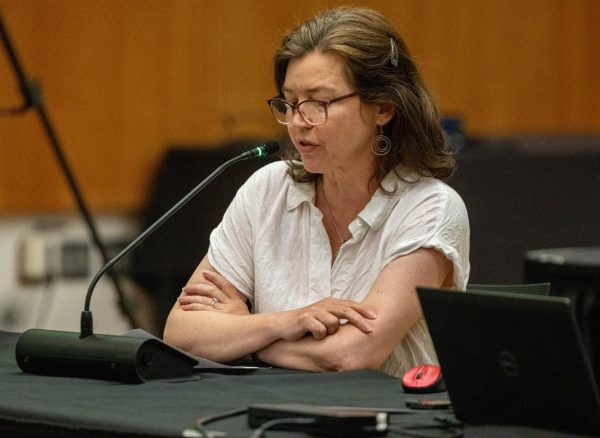
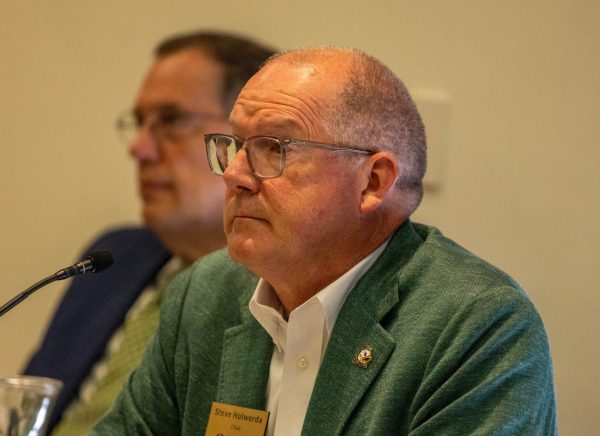
Between comments, Board Chair Steve Holwerda noted that the reason for the “more significant” cuts this year was the university’s decision not to adjust projected enrollment numbers last year.
“Had we made that change, we would have had to have made more significant cuts last year. We felt it was the right thing to do because we were hoping the decline was temporary,” Holwerda said.
GTFF Co-President and Vice President for Equity and Inclusion Sanjula Rajat and Vice President for External Relations Jacob Schmidt advocated against the burden of cuts falling on educators and workers, pointing to how staff reductions will increase workloads for graduate employees and faculty due to larger class sizes.
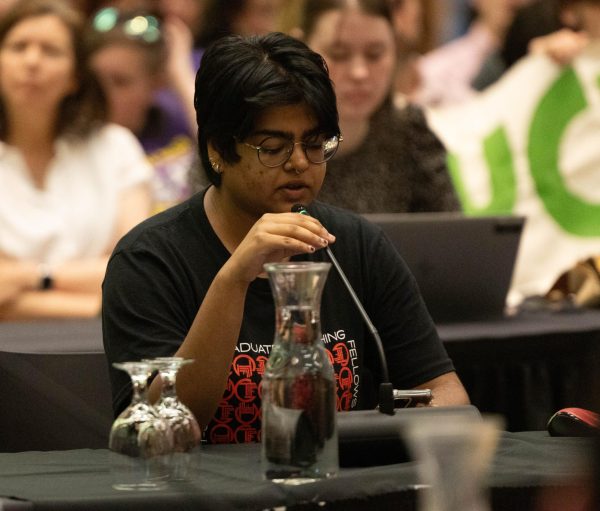
“We need to reconsider how we should organize our fiscal structure to prioritize the heart and blood of this university, its students and workers,” Schmidt said.
Schmidt also urged administrators to anticipate increased costs and staffing needs over time in the same way they “anticipate increased costs in the salaries of administrators and others over time,” rather than “pushing faculty and classified staff to the brink of strike” every bargaining cycle.
Several students also used public comment to advocate for a transition to cleaner energy on campus. Jack Dodson, a member of Climate Justice League, urged administrators to transition to an electric boiler system on campus.
Former ASUO President Prisilla Moreno, alongside Skyla Bird and Morgan Clemmer, members of the Student Planning and Construction Committee, presented a recommendation that the university use SPCC building fee funds to pay for the installation of an electric boiler system, which SPCC estimates will cost approximately $15 million.
Clemmer said SPCC funds could also be used to offset annual electric costs, which are estimated at $10.2 million annually. If immediate installation is not feasible, the money from the building fee would be placed in a separate account until installation can occur, effectively earmarking the funds specifically for the project.
The motion to use building fee funds was not approved by the board, but the resolution will move to a special meeting with administrators to further amend the proposal and revisit the issue at a later date. Holwerda said the administration will “try” to hold the special meeting before June 30.
The 2027 operating and capital budget expenditure authorization, first presented during Monday’s meeting, requested approval of the university’s anticipated business expenses.
The fiscal year 2027 capital budget is projected at $211 million and includes several major projects across campus, from residence halls to academic buildings. Most of the funding for these projects comes from state bonds, grants and gifts.
Currently, expected revenue for 2027 is not projected to fully cover operating expenses. Moffitt said the financial office expects to adjust spending, subject to board approval, once actions such as budget cuts are taken to address the deficit in December.
An amendment was made to the expenditure authorization requiring UO leadership to develop a budget reduction plan, report that plan to the board and bring a revised 2027 operating expenditure authorization for a vote by Dec. 15, the second day of December’s board meeting. The amendment passed unanimously.
The motion for the capital budget expenditure authorization, including the new amendment, also passed unanimously.