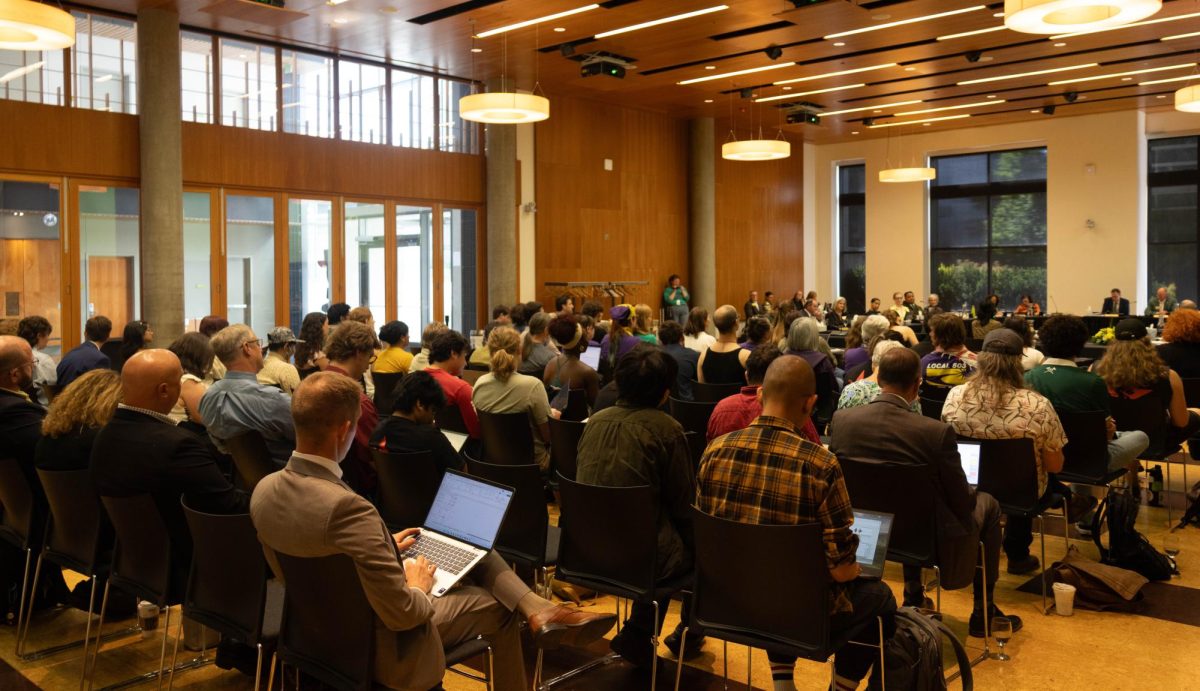
Eugene Mayor Kaarin Knudson delivered her second State of the City Address on Jan. 12 at the Hult Center. The focus of Knudson’s speech was one looking back on the past year while drawing attention to the goals she aims to accomplish in 2026.
Partnership
Knudson recalled when she was sworn into office last January, when the city was struggling with an $11.5 million budget shortfall. Knudson emphasized utilizing partnerships with the community and institutions within it to heal that budget gap, something she wishes to continue in 2026.
“Over that first six months in office, we worked intensively to negotiate a balanced budget that maintained access to core community services, reduced our costs and created the time we need to engage more partners with the challenge of long-term budget stability,” Knudson said.
Knudson said the Eugene City Council plans to focus on developing a sustainable budget, collaborating with finance and economic advisors to deliver a Phase One report in the next month.
The mayor recently met with the presidents of the University of Oregon and Oregon State University, as well as other business leaders, to discuss the Southern Willamette Valley Innovation Corridor, a new association connecting the top research institutions in the Eugene-Springfield and Corvallis area.
“Through this framework, we’re working toward a future in which new jobs, advanced manufacturing and local business expansion are part of what our community routinely plans for,” Knudson said.
Follow throughs
Among new policies and projects, the city also oversaw the completion of previous goals set by Knudson and her team.
“We completed $10 million in street improvements in 2025, improving transportation options, pedestrian infrastructure, traffic flow and surface conditions throughout Eugene,” Knudson said.
One of these street improvement projects began in June 2025 and ended in October, with East Broadway seeing the paving and widening of sidewalks, new planting strips for trees and upgraded stormwater infrastructure.
In 2025, Knudson also won funding for the expansion of Eugene Airport and a FEMA grant to continue the Amazon Creek Restoration. Eugene has seen the renovation and development of three new public parks, as well as a playground in Downtown Riverfront.
Housing
During her State of the City address last year, Knudson set a goal of creating 1,000 new affordable housing units downtown in the next five years. In her address today Knudson said the city has built over 400 units.
“We permitted 413 units of new affordable housing — 293 of which had support from Eugene’s Affordable Housing Trust Fund,” Knudson said. “We also invested $7.5 million in the creation of 75 new units of affordable housing at Fourth and Mill (street), a project that will be completed in partnership with Homes for Good.”
The momentum for more affordable housing in downtown Eugene will continue into 2026, with Knudson focusing on three new programs from the Downtown Core Housing Initiative.
“This year, we’ll be focused on how cross-sector collaboration can drive new approaches to downtown housing and revitalization, and you’ll hear more about the recommendations from this work in the fall,” Knudson said.
Safety
Knudson spoke of prioritizing safety in downtown Eugene, with the launching of several programs that partner with institutions downtown, the Eugene Police Department and community members.
“Overall calls for police service are down,” Knudson said. “And in every area of violent crime, our numbers have improved by double digits, from 10-54%. Calls related to quality of life are down between 25-52%.”
After the closing of the CAHOOTS program from White Bird Clinic, a local mental health nonprofit, Knudson said the city saw a major shift in safety resources for the vulnerable.
“Lane County Mobile Crisis stepped in to meet high acuity needs — with a model of service only possible because CAHOOTS paved the way,” Knudson said. “Our community creativity is known nationwide, and we are at the beginning of a new chapter in the work to address gaps between our public safety and health and human services system.”
This month, the Eugene Police Department and Ideal Option launched the Peer Navigation Initiative, a program that will emulate the work of CAHOOTS by connecting community members with resources outside of police officers.
“We are issuing an RFP to provide a higher level of support services and case management — a ‘2.0’ chapter of work to connect people with the appropriate support, which is oftentimes not a police office,” Knudson said. “Both pilot programs are partially funded by the Community Safety Payroll Tax and demonstrate our commitment to innovation and collaboration.”
In 2026, Knudson hopes to create a conversation surrounding Highway 99, making it a community conduit rather than just a highway.
The future
Looking forward, Knudson hopes to continue investing in Eugene’s future. Three different ways of investment, Knudson said, are continuing to push for mixed-income housing, renewing the city’s library levy and determining the future of Eugene-Springfield Fire.
“With council, staff and partners, I will do all I can to help us navigate the year ahead, to seize the opportunities and meet the challenges,” Knudson said. “We will stick together, and I will stand with you and for you in our work.”