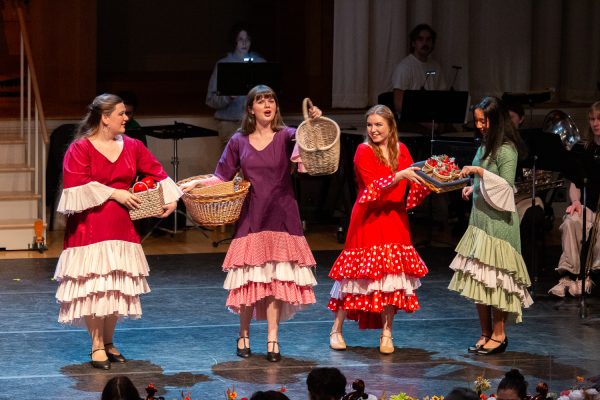
The lights dim. The curtains begin to draw back. The stage lights flicker on. The crowd quiets down. Anticipation builds in the concert hall as over 100 musicians pile on stage. The show is ready to begin.
The art of the opera will be on full display when the University of Oregon’s School of Music and Dance presents “La Vida Breve” at Beall Concert Hall on Feb. 13 at 7 p.m. and Feb. 15 at 3 p.m. UO Opera has worked endlessly to fill the 520-seat venue with vibrant and authentic sights and sounds, filled with passionate energy and love on the stage.
Background and preparation
“La Vida Breve,” which translates to “life is short” or “the brief life,” was originally composed in 1904 by Manuel de Falla and is one of the most important operas that Spanish composers have produced. The show reflects the Spanish Nationalist Movement and its musical language reflects Flamenco culture.
The show takes place in Granada at the beginning of the 20th century. Understanding how people expressed emotions during that time and recognizing the social, cultural and emotional contexts were crucial to the musicians’ preparation.
Gianna Alberico is a UO music student who will be cast as the abuela in the show. Off the stage, she is an aspiring UO SOMD student at 20 years of age. On the stage, she will be transformed with face paint and maneuver with the movements of a 65-year-old.
The story will incorporate a reflection that things happen really fast and that life is simply unfair for some people. Alberico described how the opera’s storyline is tragic, yet powerful.
“I’d say (the sounds and imagery are) vibrant, even though this is a tragedy,” Alberico said. “It’s exciting because you don’t really know what’s going to happen next, and since it’s a short opera, a lot happens in a short amount of time; just the orchestra itself is exhilarating to hear. You’re drawn into it, hopefully, and it’s something that you’re like, ‘Wow, this is so beautiful.’”
Gustavo Castro works as the opera music director and vocal coach at UO and has worked on the music of this show since September 2025. He said the singers have had to memorize the whole opera in another language, which he has been helping them prepare for.
The opera will be sung in Spanish with an Andalusian accent and will project English translation supertitles for the audience to follow along. The singers had to consistently train themselves to pronounce the words correctly, and getting the right sound and high notes proved to be a challenge.
In addition, none of the singers will have a microphone during the performance, so they have developed techniques to project their voices over the orchestra’s sound without hurting themselves.
“I think the point of operas, even if you don’t understand what they’re saying, is that it’s a beautiful story and it’s good acting that is universal and anybody can enjoy it,” Alberico said. “So I hope that is what people will see when they watch it.”
Castro works alongside David Jacobs, the orchestra conductor, who has been preparing with the orchestra’s instrumentalists. They have trained the orchestra to follow the baton, which Jacobs will be using to conduct throughout the performance.
But the challenging aspect of performing at the Beall Concert Hall is getting it all to work in the space they have, which, according to Castro, is smaller than desired.
“What happens acoustically in the theater is a whole experience,” Castro said. “Of course, I wish we had a better theater, but we do what we can with what we have, and we’re very grateful because we have a wonderful concert home, but it was not designed for opera.”
Additional challenges in the preparation leading up to the show include nailing down the little details, since this music is unusual for their orchestra. The rhythms, intervals and text are all challenging and easy to forget, even if the performers know the piece by heart, so working on improving the staging and precision of each aspect of the opera has been key.
For Alberico, the greatest difficulty over the last five months has been learning to trust herself and having the confidence to perform at the highest level. But on the flipside, the most enjoyable part has been building the community with her friends in the opera and enjoying the preparation time spent together.
“I really love spending time with them and having the opportunity to bond over our love of music and singing,” Alberico said. “But also working through hard times together, getting their advice on things and building friendships with them; it’s really fun.”
For the love of the art
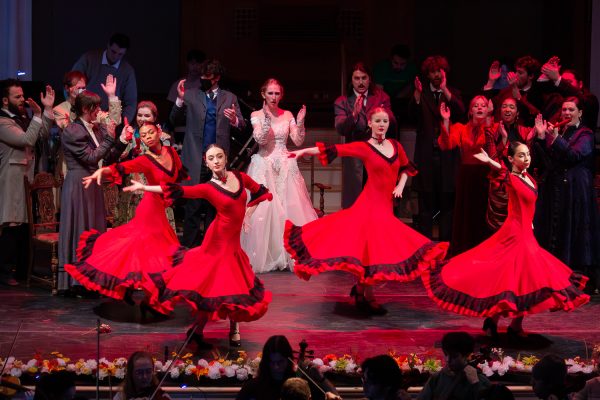
As their coach and teacher, Castro has enjoyed seeing the singers’ growth. He enjoys how they have come together with the orchestra and dancers to combine their skill sets and create the elegant art form of the opera.
“The most rewarding thing for me is to see them grow, to see them enjoying doing it together, to see them passionate about putting a good show out there and also see them dreaming about what they can do in the future with what they’re learning,” Castro said.
Alberico, a junior at UO, eventually wants to go to graduate school and continue performing, with hopes of going professional someday. Whether it be in operas, concerts or in another form, Alberico looks to continue building her self-discipline, a skill she feels she has improved the most and will continue to learn from.
“I think that it can be really hard to discipline yourself sometimes when you’re kind of in an ‘off’ stage, where you can get frustrated with yourself,” Alberico said. “I think as a musician, and specifically a singer where my instrument is myself, I can get in moments where I struggle to remind myself that I love this and that I do want to do this.”
The opera will consist of continuous singing with orchestral music throughout the entire show, performed by 104 performers. Those include four dancers, 16 singers and 84 instrumentalists. Roughly 40 of the instrumentalists will be string players in front of the stage and the other 44 playing percussion, brass and woodwind instruments will be on the stage.
As Alberico and the other performers approach the final days leading up to the show, they hope to continue complementing one another as they’ve done over the past five months and put on a show to remember.
“I think that the outcome of all of this is that I want to feel proud of myself as a musician and as a person, that I put in that work and that I think it’s the best of what I could produce at that time,” Alberico said.