
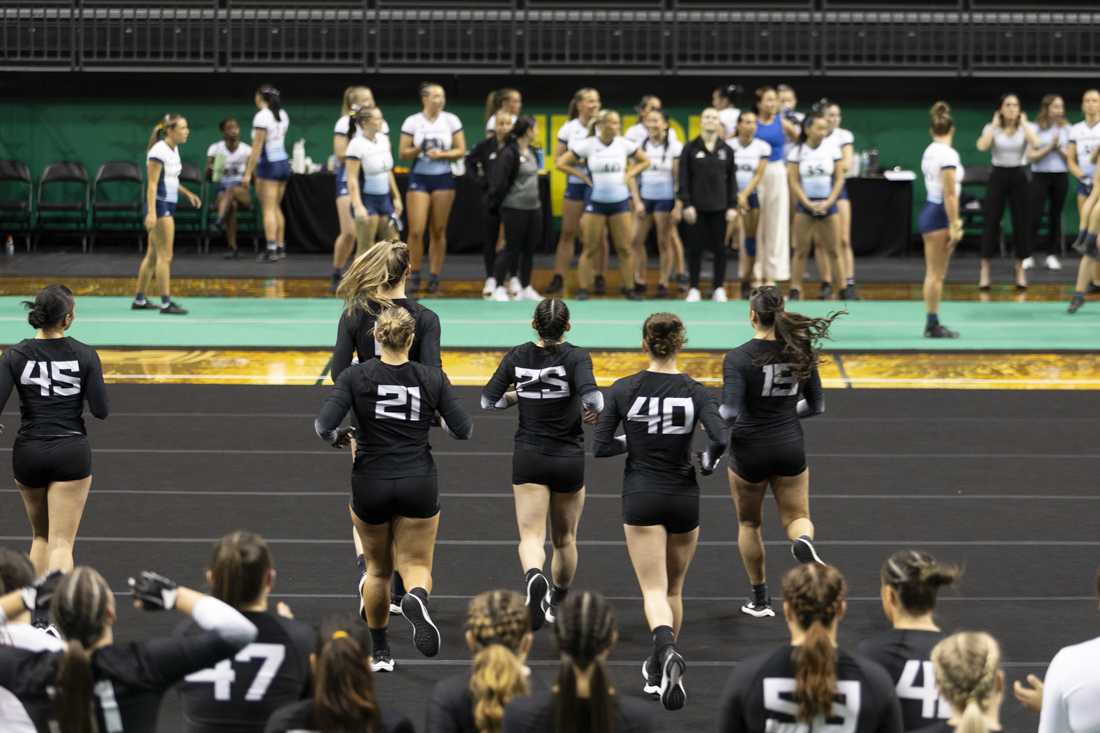
For No. 2 Oregon acrobatics and tumbling (1-0) and its second opponent of the 2026 season, the hurdle has looked similar for years. Neither the Ducks nor No. 3 Quinnipiac University (1-0) have broken through with a national title since Oregon’s last win in 2014, and they’ve had plenty of chances to do so. Both are at the forefront of the sport with new skill implementation and transfer portal usage, but success hasn’t come with a ring in Eugene or Hamden, Connecticut, for more than a decade.
They’ve often been in each other’s way, including in last year’s semifinal round of the NCATA National Championships, where Oregon pulled out a win after leading the Bobcats by less than a point before the team event. They’re going head-to-head for the first time this year earlier than that, with what would be either’s biggest win of the season so far on the line.
The Daily Emerald’s Owen Murray and Q30 Sports acrobatics and tumbling beat reporter Katie Valutkevich traded questions ahead of the Feb. 21 meet between the two programs in Eugene.
Owen Murray: Katie, I saw you talked about the transfer additions that Quinnipiac made in the offseason a little bit ago. Oregon has a few transfer athletes; but it has a huge focus on developing (especially freshmen), and I’m curious how coach Powers has made that work. How important have Madysen Bradley, Genesis Carson and A’Lycia Moore been, and how has that balanced with getting new recruits integrated?
Katie Valutkevich: Head coach Mary Ann Powers has utilized Bradley, Carson and Moore in a big way: She has incorporated at least one of them in the lineup for every event. Powers, after the meet against Gannon, said that she is grateful for the offseason and acquiring the three of them, as well as Bradley and Carson collectively carrying 18 rounds. Meanwhile, Moore is in the trio tumbling and competing in three other heats, including pyramid.
The Bobcats have 13 freshmen on the team, and they have been put in the lineup for only six heats throughout the meet. One of the freshmen, Liberty Zamudio, is in three heats for the Bobcats (compulsory pyramid, synchronized pyramid and the team event). Powers has balanced out the transfers and the new recruits by preferring the experienced transfers, who have earned a 9.9 twice and a 9.5 in the first competition, over the newcomers, who are in their first year of competition.
KV: Owen, with the new season underway we see many new faces across the NCATA and within Oregon’s program. Oregon has 11 freshmen on the team this year, along with the sophomore class stepping up as veterans on the team, such as sophomore Morgan Willingham making an impact in the acro six-element heat. What area do you think this Oregon team will make the biggest strides in this year — and will events such as acro and toss continue to be the strongest events for this team?
OM: The Ducks have a couple of freshmen to keep an eye on this year — Nyla Lassiter (who was an honorable mention for freshman of the week in Week 1) and Nya Womack have both been strong tumblers already who contribute to Oregon’s really consistent performances there.
That sophomore class that you mentioned, though, is looking like the base of this program for the next couple of years. Willingham was one of two athletes (Briya Alvarado) with a solo pass as a freshman last year, and Angelica Martin, Cassidy Cu (base-top pair) and Carly Garcia (another tumbler) have become regular starters, too. Tumbling is where this team can really take the top off of opponents, but keep an eye on pyramid, too, to take steps forward. It’s the only event where Oregon has put up a 10.0 score over the last two years, and they put together a strong performance against Missouri State University despite having to swap some athletes in that 10.0 open pyramid heat.
OM: There’s not a whole lot of big meets on Quinnipiac’s schedule this season — it only faces three preseason ranked teams. How does the meaning of a meet like this weekend’s change for Quinnipiac when it’s one of only a few opportunities to get a ranked win, instead of one in a line of chances to make a statement?
KV: This meet gives us a preview of another potential NCATA National Championship matchup — so far we have seen the Bobcats and the Ducks face off in the NCATA postseason four times, with the Bobcats defeating the Ducks once. A win against the No. 2 Ducks would help the Bobcats gain confidence, give a preview into the postseason and see any areas that might need fine tuning.
Oregon is the team where the Bobcats have come so close to beating, but fall short in the end. This meet means a great deal to this Bobcats team as they come in with the mindset of wanting to win this big meet. While a ranked win against many ranked teams in one season is a statement, a meet like this means they need to prove how great of a team they are within this league, and having fewer opportunities to do so adds to the pressure. A meet like this means so much more to the Bobcats.
KV: Both Quinnipiac and Oregon are part of the original teams that helped create the NCATA back in 2010. Over a decade later, acrobatics and tumbling has now been approved as an NCAA sport with the first championship in 2027. The team here was ecstatic to hearing they would be part of the NCAA; what was the atmosphere like around the program as the news came out?
OM: They were really excited — just like Quinnipiac, I’m sure. Oregon head coach Taylor Susnara talked about how when she started, there were maybe a dozen schools, and how watching it grow has been “amazing.” We heard from Martin, Briya Alvarado and Blessyn McMorris this week, too, and they all had great things to say. McMorris, a fifth-year senior, said they’d been talking about it since her freshman year. Alvarado talked about how she was drawn to Oregon because of the help it provided to other programs, and that other athletes on campus are noticing and congratulating them, too. Martin called it “completely awesome,” and said that before she knew about the sport, she just figured her acrobatic gymnastics career would end with college. They’re all focused on what it means for the next generation — which is, I think, a common theme across the programs I’ve heard from.
OM: What does success really look like for Quinnipiac this year? It’s been one of the best programs in the NCATA for a while, especially in the regular season, but hasn’t made it to the championship meet since 2018 despite making the semifinal round in all five complete seasons since then. Is a great year measured in postseason progression, or in event titles — or in something else?
KV: The team has had successful seasons, however improving on the team event this year will help the Bobcats this year. Last year Quinnipiac struggled in that event to stay consistent and had falls or bigger deductions in their routine at almost each meet. Powers had mentioned that they needed to really work on that event and make sure they are staying calm during such a high energy routine. The same goes to competing at the championship, while they don’t give up big leads and make it to semifinals, even finals, the nerves and giving up the little details make a difference.
While a great year is often measured in event titles or postseason progression, for Quinnipiac, a great season is measured in consistency, and potentially advancing to the finals. The team, in many events, are able to put up scores of a 9.8, even a 9.9 in multiple meets. The scores in each event and overall continuing to increase throughout the season showcase the talent and work that the team puts in. As mentioned earlier with the team event, improving on that event as well as consistently hitting that routine will make a huge difference in their success.
Quinnipiac has not advanced to the finals since 2018, as you previously mentioned. Each time Quinnipiac falls to either Oregon or another team in the postseason, they lose by less than 10 points. It’s been a theme for a couple of years and getting over that bump would help the idea of “a great year.”
KV: While Oregon has been a powerhouse throughout the history of the NCATA, creating a big matchup with Quinnipiac, the biggest thorn in its side has been Baylor. Oregon is 14-25 against the Bears in both the regular season and postseason since 2011. Many of those losses came from the NCATA semifinals and championship meet with Oregon falling short by between 4 and 10 points. Do you think Oregon has what it takes to take down this Baylor dynasty, and if so, how and why?
OM: That’s the big question, right? Oregon hasn’t beaten Baylor since 2021, and it’s mostly been because the Bears rarely make mistakes. Their superpower is consistency, both inside meets (against Oregon in Waco, Texas, last year, they had three heats below 9.70, and one below 9.00) and as a program (they went straight from 2024 All-American base Bayley Humphrey to 2025 Freshman of the Year base Leavy McDonald). Oregon has essentially needed to put together a flawless meet to beat Baylor, and even when they do — the Ducks posted a season-high in points, an open pyramid 10.0 and a season high in team event in that meet in Waco — there’s still a shot they lose, like they did last season.
In most of their meets, the Ducks have an inherent advantage between talent and start value. They often capitalize on those strengths, too, but when they face a team that is just as talented and can match their start values in every heat, they struggle to match. An Oregon win in the regular season, where the two match up twice, would be significant. They’d likely have to beat them again in the postseason to secure a national title.
This Oregon team, especially with that sophomore class and 10.0-plus difficulties that raise the possibility for perfect scores, has the potential to beat a Baylor team that remains stacked with Payton Washington, Emily Bott and McDonald. They’ll have two, maybe three, chances to make it count. To answer your question: I think it’s possible, but it’ll take an Oregon perfect meet and maybe a Baylor mistake.
Oregon faces Quinnipiac Feb. 21 at Matthew Knight Arena. The meet is scheduled for 1 p.m.
![Oregon outfielder Angel Laya (53) greets outfielder Jax Gimenez (7) before the first pitch. On May 30, 2026, The Oregon Ducks defeated the Washington State Cougars [4-0] in game 4 of the NCAA D1 Baseball Regionals at PK Park, at University of Oregon, based in Eugene, Ore. (Fred Hall/Emerald)](https://dailyemerald.com/wp-content/uploads/2026/05/2026.5.30.EMG_.FJH_.BSBLvsWashingtonStNCAA-1-1200x800.jpg)


![Oregon players celebrate on home plate with infielder Naulivou Lauaki Jr. (18) as he rounds home after his home run. On May 30, 2026, The Oregon Ducks defeated the Washington State Cougars [4-0] in game 4 of the NCAA D1 Baseball Regionals at PK Park, at University of Oregon, based in Eugene, Ore. (Fred Hall/Emerald)](https://dailyemerald.com/wp-content/uploads/2026/05/2026.5.30.EMG_.FJH_.BSBLvsWashingtonStNCAA-13-1-1200x800.jpg)
![Oregon third baseman Drew Smith (17) looks to the mound as he comes up to the plate. On April 24, 2026, The Oregon Ducks defeated the Penn State Nittany Lions [5-4], at PK Park, at University of Oregon, Based in Eugene, Ore. (Fred Hall/Emerald)](https://dailyemerald.com/wp-content/uploads/2026/04/2026.4.24.EMG_.FJH_.BaseballVsPennSt-10-1200x800.jpg)
