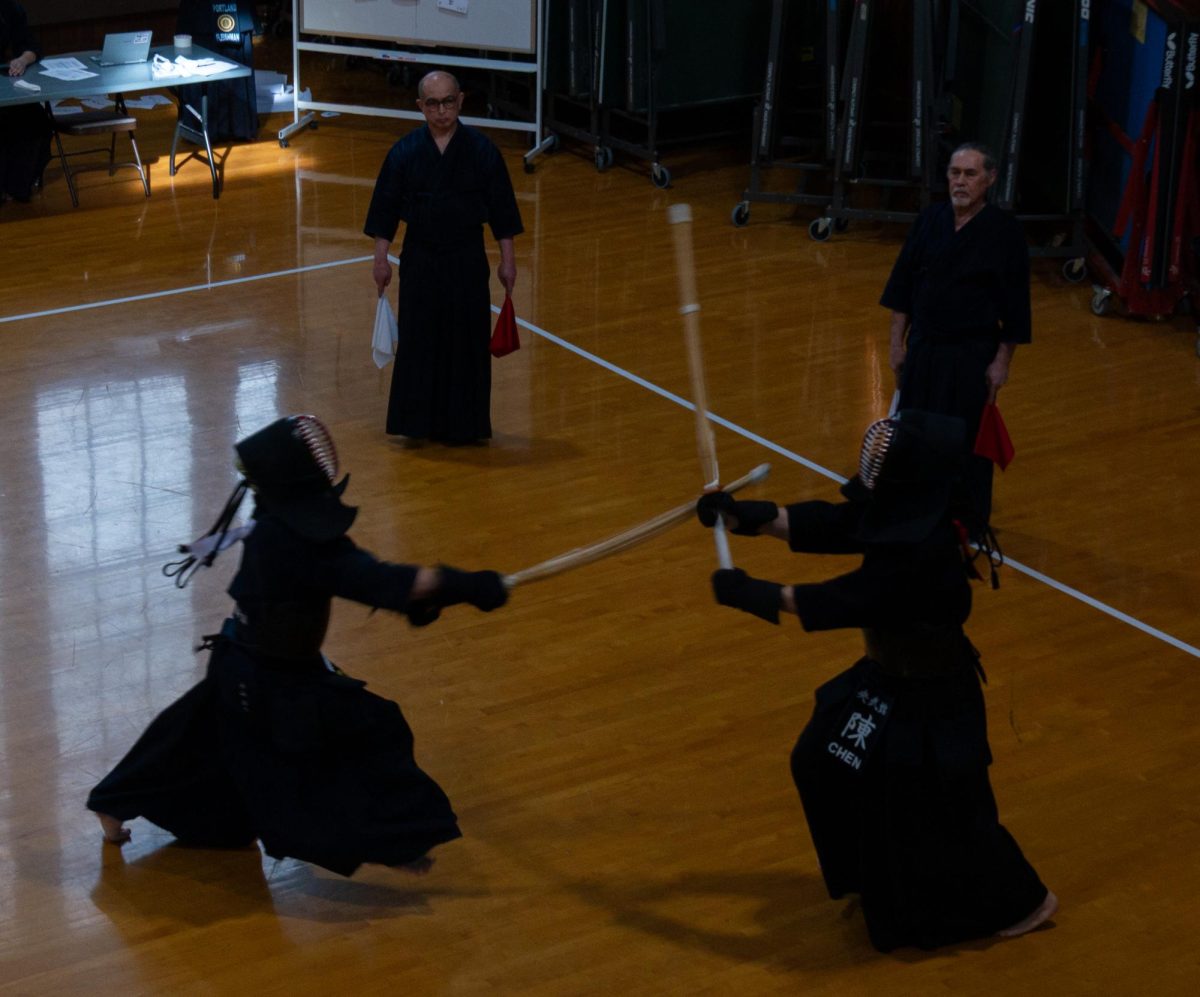
The University of Oregon houses various clubs, including some involving culturally traditional martial arts, such as kendo. 剣道, ken-do, means “way of the sword” in direct translation in Japanese. It is a sport that involves a bamboo-made sword called shi-nai.
In a match, players face each other and try to hit a certain spot with the right form and spirit within three minutes, or until they make a good hit and call it ippon, like “KO” in boxing.
The UO Kendo Club hosted the third annual Civil War Taikai on Feb. 21 at Gerlinger Hall, featuring a Civil War team match against Oregon State and other schools in Oregon.
The Ducks had a strong win against OSU in the Civil War game.
Across the gym, the sound of bamboo sticks hitting and scratching each other mixed with the players’ kiai voice. 気合 ki-a-i means “strong motivation” in Japanese, and in kendo, it is treasured as part of the performance to show the spirit. “Each motion has meaning,” Masayori Itome, a UO Kendo Club member and an exchange student from Japan, said.
For example, Itome said that kendo players always sit from left to right because it makes it easier to draw a sword from the waist when the opponent starts attacking.
Itome said he sees people in America play kendo with more of an enjoyment to learn Japanese culture, as it is opposed with how many Japanese kendo players focus on competition. “Here, everyone enjoys kendo,” Itome said. “This is a huge difference.”
However, practicing in Japan was not the easiest thing for Itome, as it was for many kendo players. The level of competition and the teachers’ strong discipline sometimes made him not want to continue.
Sandor Cseh, a second-year student at UO, joined the kendo club after meeting its president. One of Cseh’s favorite things about kendo is sportsmanship, he said. Many Japanese martial arts value respect for the opponent, but also to teammates and teachers.
Before the team begins practice, they always bow toward the front of the gym to respect the space and teacher, and also bow to each other to show that respect.
Itome often leads practice in the club as he has experience in kendo. “We are really happy to have you (Itome),” Cseh and other teammates said.
Itome said he is glad to have found joy in kendo again after quitting several years ago. Although he does not think he would continue kendo in Japan in a competitive setting, he hopes to focus on his remaining time at the UO Kendo Club.
The club will go to the University of Washington in April for another competition, and Itome hopes to win as a team there, as well.
The UO Kendo Club is actively recruiting interested members; more information is available on their website or by email.