
The team that allows its opponent to score on every trip to the red zone in Week 7 would probably be regarded by many as a bottom feeder in the Power Four.
That team may have gotten unlucky and could be an underperforming, middle of the pack squad that has yet to hit its stride midway through the season. There’s no way that team would be ranked in the top 10 — No. 3 just last week — and considered one of the nation’s primary championship contenders, right?
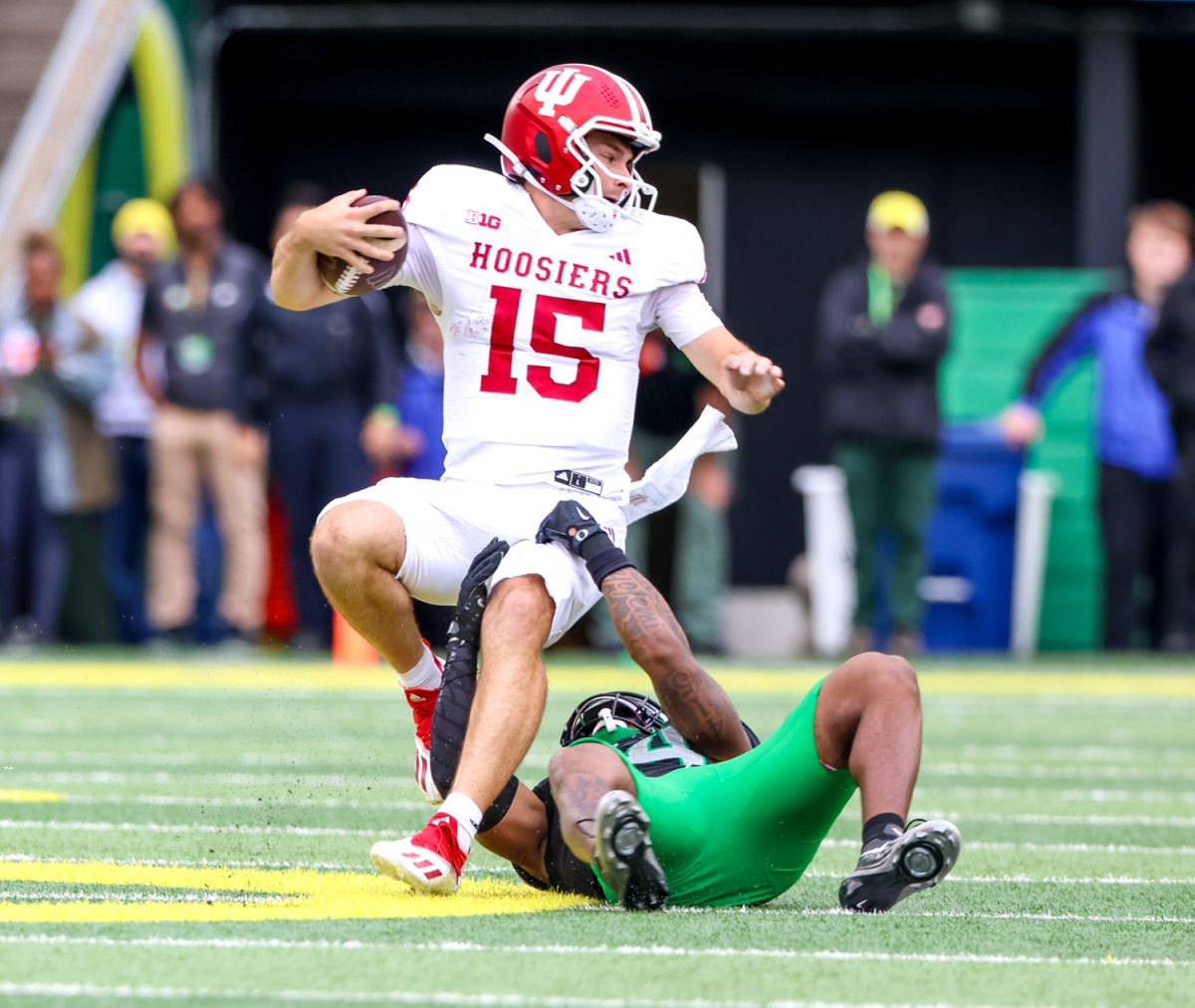
Unfortunately for the No. 8 Oregon Ducks, they’re one of six FBS teams (one of three Power-4 programs) that have allowed a touchdown or field goal every time their opponent has reached the red zone this season.The culmination of this became the Ducks 30-20 upset loss to now-No. 3 Indiana, where Oregon allowed four trips to the red zone for a combined 24 points.
“At times we played well defensively. We had some short fields, but ultimately we didn’t stop the run when it mattered most. We’ve got to have a better plan to stop the run there at the end of the game. (We) didn’t do a good job contesting balls,” head coach Dan Lanning said after the game.
On top of the red zone stats, the Hoosiers were able to hold the ball for just over 13 minutes and outgained Oregon in yards, 104-15, in the fourth quarter, which left the Ducks no chance to get themselves back into the game. Through the third quarter, the Ducks had 30 more total yards than the Hoosiers and simply lacked that spark to convert in the big moments. That also bled into the defense, who seemed unable to get a stop on third down and get themselves off the field.
“We didn’t do a good job of having responsibility for the quarterback on a couple of those plays where we thought we did, but it’s something we’ll go back and evaluate,” Lanning said.
The Ducks were able to get the Hoosiers to six third downs in the fourth quarter, but they allowed Indiana and quarterback Fernando Mendoza to convert on three of them even with an average distance of 6.8 yards.
This doesn’t include the touchdown the Hoosiers scored on third-and-goal, and it doesn’t account for one of the attempts being a kneel down at the end of the game, so the numbers really end up being four out of six.
“I thought their quarterback did a good job of getting from one to three (in his progressions) and finding the open guy. On one of them we slipped and fell down,” Lanning said. “We had to be clean on substitutions –– we weren’t. Then they were able to run the ball and control the clock.”
Mendoza completed four passes for 30 yards on third down in the final quarter, which ended up being the marginal difference that his team needed to pull out a victory on the road.
For Oregon’s defense, this spells out a separate issue that could compound into a much larger headache if the team isn’t careful. Not being able to get crucial, late-game stops kills a team’s ability to spark any swing of momentum or play from behind like the Ducks had to do against Indiana.
“There’s some moments where we didn’t make the play that was necessary and the play we’re supposed to make. So, those will be opportunities for us to tag,” Lanning said.
Oregon will have a much-needed opportunity to work out those kinks against a relatively weaker opponent in the Rutgers Scarlet Knights.
The Scarlet Knights are 105th in the country in red zone percentage and 42nd on third down offensively, which doesn’t pose as significant of a threat as the Hoosiers did on Saturday.
The Ducks find themselves in a situation similar to last week where they will seemingly need to shoot themselves in the foot continuously in order to lose at Rutgers. They did that at home against Indiana, and failing to get stops on third downs and allowing the Scarlet Knights into the red zone are easy ways to ensure defeat in New Jersey.



![Oregon third baseman Drew Smith (17) talks to pitcher Will Sanford (28) during the first inning. On April 24, 2026, The Oregon Ducks defeated the Penn State Nittany Lions [5-4], at PK Park, at University of Oregon, Based in Eugene, Ore. (Fred Hall/Emerald)](https://dailyemerald.com/wp-content/uploads/2026/04/2026.4.24.EMG_.FJH_.BaseballVsPennSt-4-1200x800.jpg)
