
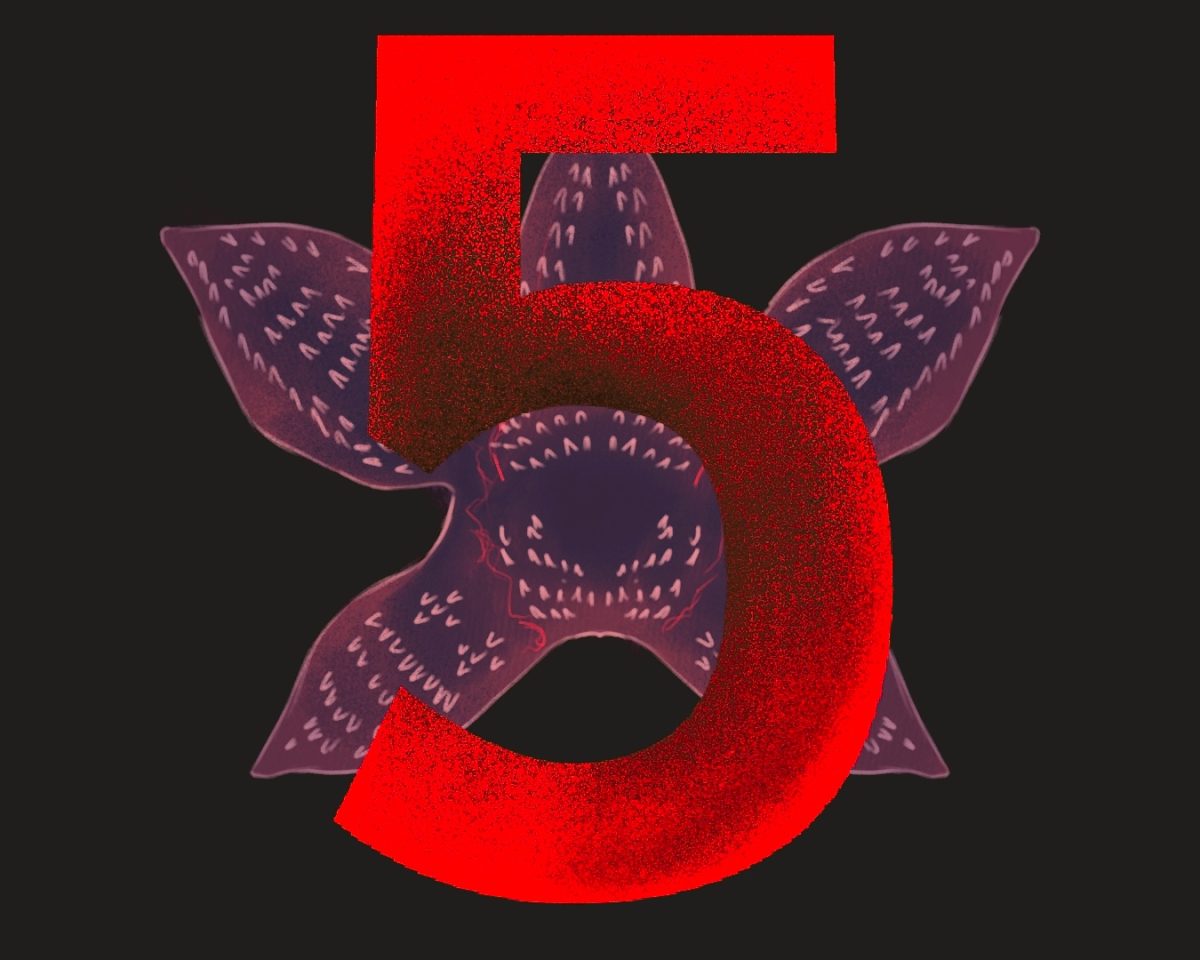
After a promising first couple of episodes, “Stranger Things” Season Five limped to the finish line with a disappointing finale. Unanswered questions, poor visuals and a baffling misunderstanding of what made the series great in the first place all combined to form a disappointing end to the series that has captivated audiences since 2016. Episode eight of season five, entitled “The Rightside Up” sees the party come face to face with Vecna in a final showdown that leaves this reviewer feeling disappointed in the once great show.
The episodes preceding “The Rightside Up” spent an excruciating amount of time explaining the intimate details of The Upside Down as well as the newly defined Dimension X. Going into the finale, the series set a clear precedent that even the most minor of questions would be explained. Throughout season 5, the questions of “Why can’t Vecna enter the cave in his mind that Max Mayfield (Sadie Sink) spent two years hiding in?,” “What’s in the briefcase of the man that Henry killed as a child?,” and “What is the Mind Flayer?” were begging to be answered.
Unfortunately, the answers to all these questions are unsatisfying. Vecna can enter the cave if he tries hard enough, the briefcase contains a magic stone with a connection to the Mind Flayer that is given absolutely no explanation, and the Mind Flayer is still just a mysterious floating dust being that Vecna only likes because he is evil.
Beyond the unsatisfying plot reveals, the finale is littered with moments that feel completely out of place for a show as renowned as Stranger Things. 20 minutes into the episode, Steve Harrington (Joe Keery) falls off a radio tower. Instead of showing Jonathan Byers (Charlie Heaton) diving to save him, the show cuts to black for ten seconds, completely misleading the audience in the cheapest way possible. A cut to black as a character falls is more reminiscent of something one would see in a trailer, not a high-budget television finale.
The episode fails on the action front, too, with the final battle opting to turn the Mind Flayer into a flesh monster with easily accessible “hit points” that can be damaged with guns, fire, and spears. The party fights the monster with little difficulty, and seem overall unfazed by the great evil in front of them. Within the monster, the fight scene with Elle and Vecna is just as disappointing. They both wave their hands at each other for a few minutes, and then proceed to get jostled around until Elle can impale Vecna with a conveniently placed spike.
The rest of the crew then proceeds to blow up The Upside Down to the sounds of Prince’s “Purple Rain,” a fitting track for the end of the ill fated world. Elle sacrifices herself so the horrors of Vecna can finally cease to hold a grasp over the fate of Earth, and an exciting compilation of recognizable locations from The Upside Down are shown getting sucked into space.
Ultimately, the finale leaves the military feeling like more of a threat than the Mind Flayer and Vecna. The military, of course, seemingly leaves the party alone after Elle fakes her death. Why Dr. Kay (Linda Hamilton) would stop pursuing the gang is unclear. In fact, who Dr. Kay even is remains unclear. While her white hair and general attitude set her up to be some sort of protege or partner of Dr. Brenner, she ultimately just acts as another generic military villain.
The visuals also looked rushed and, oftentimes, ugly. The entire battle in Dimension X looks nothing like they are on another planet, and the gross yellow hue over the whole sequence just adds to the unrealistic and generally unpleasant look of the battle. Even when shooting in real locations, nearly everything behind the main characters’ heads are thrown out of focus, making the scene look like it was shot in front of a green screen instead of a practical set.
The last act of the episode does have some redeeming qualities, fortunately. The main cast gets to graduate in style, most of the characters are all given proper goodbyes, we get a glimpse at the lives of the college-aged characters, and the last scene successfully tugs on the heartstrings of anyone who’s stuck around long enough to see this series out.
“The Rightside Up,” in its attempt to shoehorn in a huge “be all end all” finale battle, completely forgoes what made the series so endearing when it first premiered. It felt empty, like something whipped up to appeal to a sense of spectacle instead of the artists’ creative desires. Stranger Things did not always need to stay the same, but if it had to get more grandiose each season, it could at least do a good job at it.


