
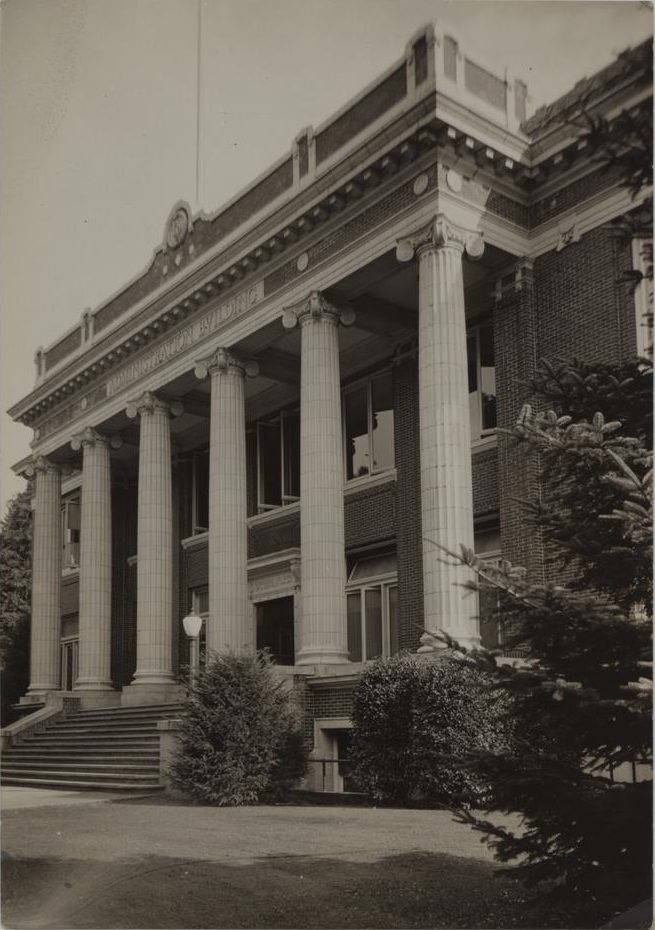
For many students at the University of Oregon, Johnson Hall is likely the least memorable of the university’s many buildings. As the administration center, many people will never set foot inside it. Unless, of course, it becomes the site of another student occupation.
Since the 1960s, Johnson Hall has been the center of campus activism, a beacon of social change and resistance to university leadership. It has been occupied, demonstrated on and even chained to, by students speaking their minds on everything from the Vietnam War to the actions of ICE. Not only have these actions been foundational to the dialogue and governance of UO, but they have also been expressions of unity that help bring these critical issues to the forefront of the national consciousness.
The beginning of Johnson Hall’s illustrious protest history was in 1968. UO had struggled the entire decade with intense disagreement over student autonomy, and despite seeing some success with the aid of President Arthur Flemming, it wasn’t enough.
The conflicts culminated in April of 1968 with a “sleep-in” at Johnson Hall, the administrative heart. Fifty students held out for an astonishing three days, refusing to leave the hall until they were given equal representation on the Presidential Search Committee, which selects the university’s next president. On the third day of occupation, joint negotiations resulted in a deal to add three student representatives to the committee, a tremendous win for student power at the university, giving them a say over the organization’s future.
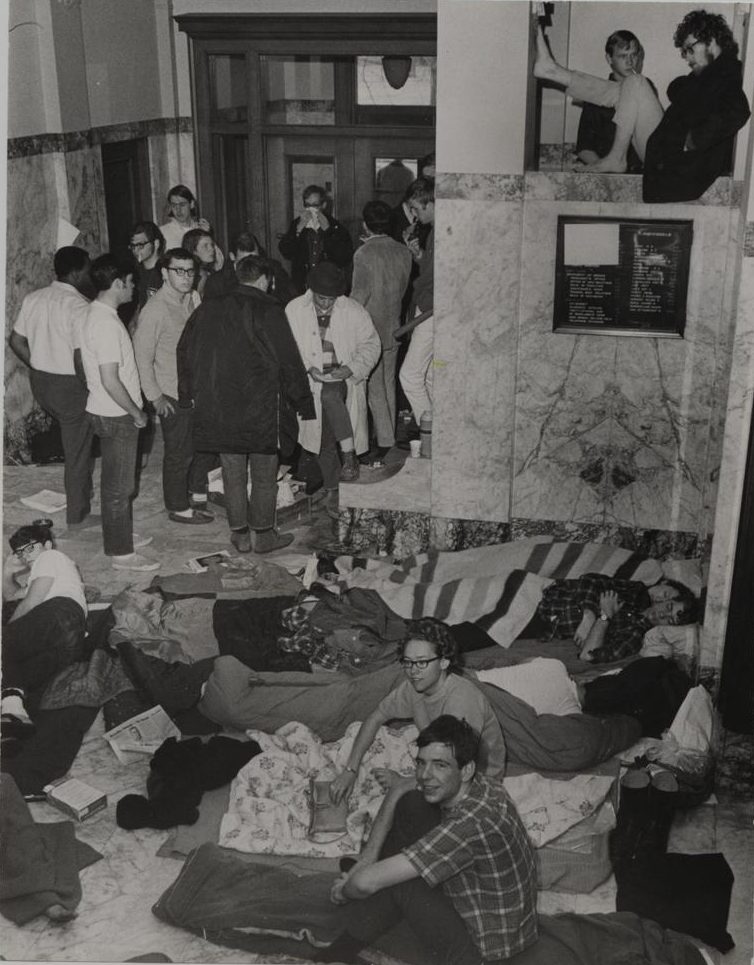
The 1968 sleep-in was only the beginning for Johnson Hall. Just two years later, 300 students descended on Johnson Hall to give their opinions on an issue that had made national headlines: the Vietnam War. The University of Oregon was one of the epicenters of the student antiwar movement, with protests turning violent, including the burning of the Eugene ROTC.
As part of the protests, 300 UO students camped out for two days in the lobby of Johnson, and on the final day, a small cohort of disruptive protesters went into the president’s office. The situation only escalated from there, with Eugene police swooping in to arrest 61 students. Then, despite the protest quieting down, the National Guard was called in. They launched tear gas at students congregating outside Johnson, in one of the most violent scenes of the antiwar movement. Thousands more protesters later came out in opposition to the National Guard’s actions. According to Benjamin Murphy, University of Oregon archivist, “one permanent (impact of the protests) was the closing of East 13th Street to traffic,” as students took to the street.
Even in modern times, Johnson Hall has remained the center of discourse on campus; in fact, on May 4, 2025, 60 members of the University of Oregon Student Workers Union occupied the hall overnight as part of a larger strike for better pay and other grievances. Robin Bailey, communications committee chair, said, “Johnson Hall is a site symbolic of administrative power. To occupy it is to challenge that power.” These efforts resulted in a historic deal between the university and UOSW.
The list of protests that have occurred in this single building is long, including the Israeli-Palestinian conflict and the recent actions of ICE. While these later protests have had a less obvious impact, they are still important: social movements are primarily grassroots, and only work if a large number of people come out and protest, bringing the issue to the public eye (which is increasingly fragmented thanks to social media). If it weren’t for individuals such as those who have picketed the Johnson Hall steps, there would be less incentive for state and local governments to address grievances and less pressure on national politicians to seek meaningful change.
Johnson Hall is far more than a building; it is a symbol of the power of the student voice at the University of Oregon.





Stephen Rust • Mar 12, 2026 at 12:04 pm
Great historical research and links to current issues. I enjoy how you frame the building as amplying student voice when we typically think of it as representing just the adminstration. When those voices of students and administrators can join in harmony, real change is possible.