
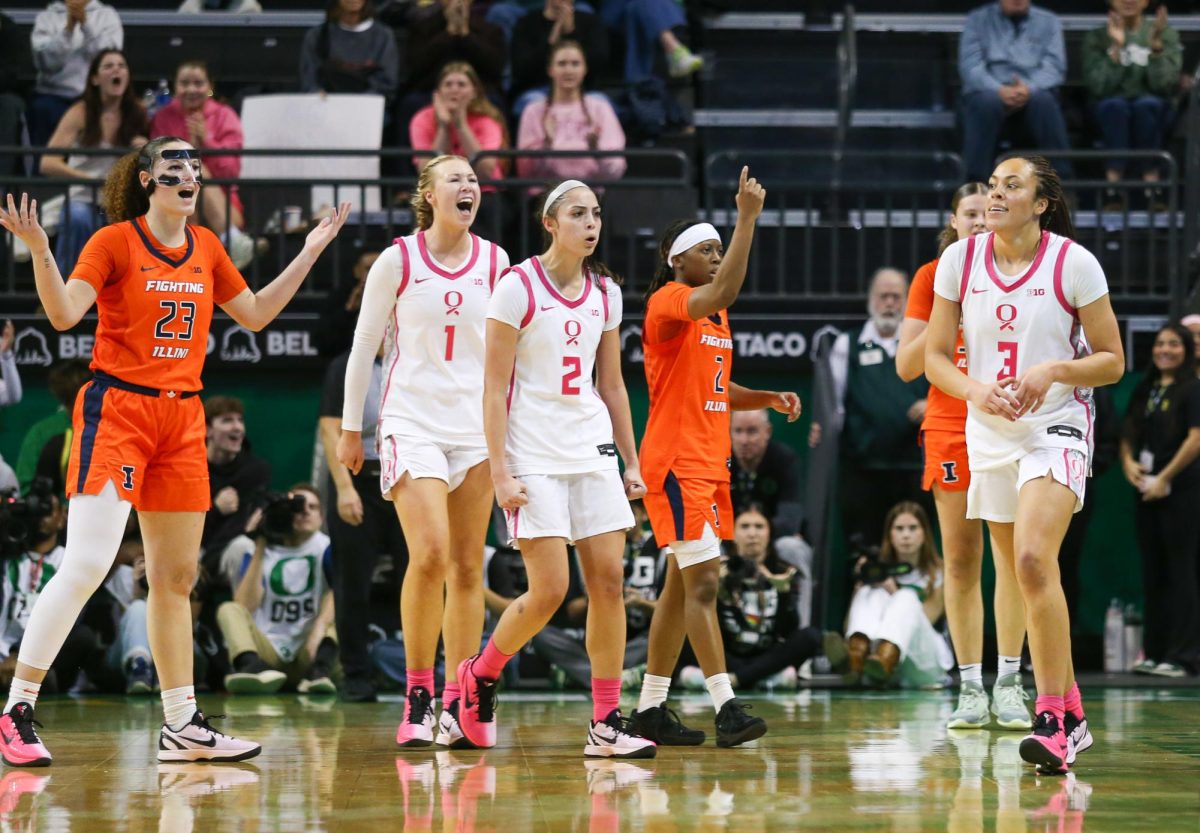
Katie Fiso jumped and let out a celebratory scream after being intentionally fouled with 1.2 seconds left to seal a 76-73 comeback win for Oregon. The 16-point, nine-assist performance to beat Illinois for the Ducks’ fourth straight win should have been a high point in the sophomore’s career, but she knew a brutal film session awaited.
Fiso and the Ducks showed their ceiling while building a 45-24 halftime lead, but Illinois’ 27-6 third quarter served as a reminder of why the talented roster has amounted to a streaky Big Ten season and a 6-6 conference record.
In her second year running head coach Kelly Graves’ offense, Fiso knew what he would take away from the win.
“(The way we) faltered in the third for sure. That was kind of outrageous,” Fiso said. “Coming into these halves, we’ve got to come in with the mindset to kill until the last buzzer sounds. If we want to be this great team, we’ve got to stay consistent and stay disciplined in all quarters.”
While Graves and the Ducks will find plenty to work on in the third-quarter collapse and eight-point comeback in the fourth quarter, the first half gave Oregon a target for how great it can be.
The peak
From Oregon’s opening possession, the Illini looked a step behind its ball movement, and it resulted in an easy inside pass and three-point play by recent breakout Ehis Etute. When Etute is scoring to the tune of 26 points against Maryland and 20 against Illinois, she brings a new dimension to a Ducks offense that could be trapped on the perimeter earlier in the season.
The ball movement also got the best out of Mia Jacobs, who looks comfortable moving the ball 25 games into her Oregon career, and even more comfortable driving downhill and drawing free throws. Despite often missing the 3-point shot that truly unlocks her game, Jacobs led all scorers with 23 points.
On the defensive end, the Ducks patiently established a zone look that threw off the Illini, and aggressively closed out on the perimeter whenever a pass was made. The buy-in to Graves’ defensive game plan left the Illini 1-8 on 3-point attempts and 9-26 from the field in the first half, while forcing six turnovers.
Although Graves’ press conference mainly focused on the chaos of the second half, he found time to praise the Ducks’ commitment to his game plan in the first half.
“We had (two) goals coming in, and one was to limit transition points. That’s how they won the other night at Washington. They had zero transition points at half. The other was blocking out, no second chances, and they had zero second-chance points in the first half,” Graves said.
The collapse
While Oregon’s first half showcased its ceiling 25 games into the season, its second half featured weaknesses that won’t be survivable in March.
The most glaring issue is a lack of depth. Early in Illinois’ run, Graves dipped into his bench, and the methodical ball movement in the first half subsided to rushed shots and drives to nonthreatening areas on the floor.
Fiso, Jacobs, Sofia Bell and Ari Long all played over 30 minutes for the Ducks, and when more than one of those players was on the bench, Oregon looked like a different team.
While the Ducks shot 6-14 from 3-point range on the night, Jacobs and Bell, who are shooting 38 and 39 percent on the season, respectively, struggled to spark the offense. Jacobs finished the second half 1-5, and Bell finished 1-3, with both makes coming in the fourth quarter.
While Etute’s recent form is a massive development for the Ducks, Graves will need to manage her fouls to sustain it, after her fourth foul and subsequent absence fed Illinois’ run. The 6;0’’ forward outrebounded 6’7’’ center Lety Vasconcelos 9-6, but the mismatch contributed to her foul trouble.
The outlook
Oregon’s big three of Fiso, Jacobs and Etute have proven capable of carrying its offense, while Long, Bell and Avary Cain pair excellent defense with steady 3-point shooting. If those pieces come together down the stretch, Oregon could play well above ESPN’s projected No. 9 seed in March.
On both ends of the floor, the buy-in to Graves’ game plan is exceptional, allowing Oregon to compete with teams within and above its range. The issues, both in terms of playstyle and roster construction, are lingering at a point in the season when they are difficult to address.
Whether this Oregon team can be the first to venture past the second round of the NCAA Tournament since 2021 will come down to the adjustments it makes in its final six games, starting with No. 9 Ohio State at home on Feb. 8.





![Oregon third baseman Drew Smith (17) talks to pitcher Will Sanford (28) during the first inning. On April 24, 2026, The Oregon Ducks defeated the Penn State Nittany Lions [5-4], at PK Park, at University of Oregon, Based in Eugene, Ore. (Fred Hall/Emerald)](https://dailyemerald.com/wp-content/uploads/2026/04/2026.4.24.EMG_.FJH_.BaseballVsPennSt-4-1200x800.jpg)
