
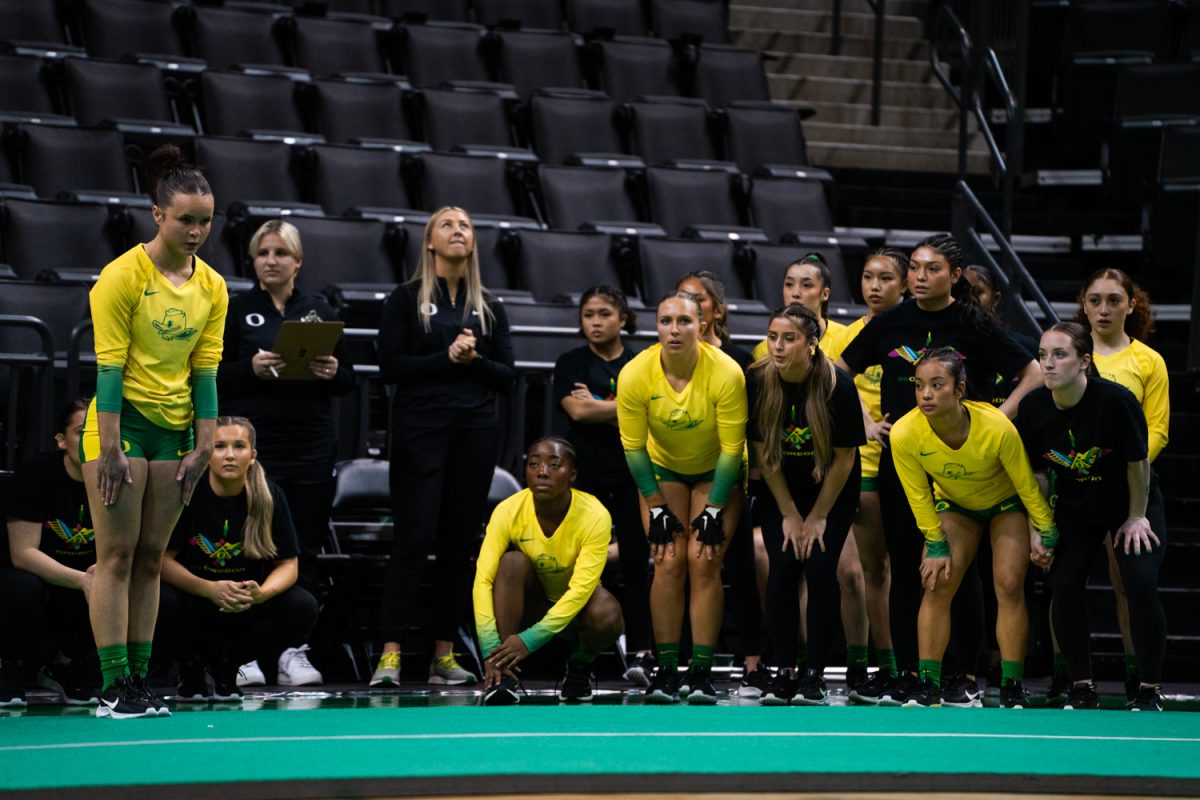
A 24.445-point victory would likely be close to what No. 2 Oregon acrobatics and tumbling (1-0) drew up for their opening meet. Sunday’s eventual easy road win over Missouri State University was ripe with promise, even if it didn’t start completely cleanly.
Don’t worry: the Ducks are still elite, especially in the staple spots where they won national event titles last season. Their sophomores look to have built on a strong 2025 season, and it was all enough to keep limited issues from punching holes in the curtain-raiser. The Daily Emerald breaks down three things to notice from Oregon’s win over the Bears.
Oregon’s pyramid event is still top-of-the-line
After two events in which two strong showings in five and seven-element acro belied instability, the Ducks’ pyramid event was their first throw-down of the gauntlet in 2026. The Bears, of course, couldn’t respond. A 29.700-point event total that included two 9.900-plus scores extended Oregon’s lead to five points at the half, and set them up to capitalize on heats where they typically have major start value advantages.
It didn’t come without change. The Ducks had to replace the mid-base who anchored their 2025 national event title-winning open pyramid, Bella Swarthout, due to a season-long injury. In her place was junior base/tumbler Ashlyn Parlett, who competed in the inversion and synchronized pyramids in 2025 after not touching the mat in her freshman season. Selah Bell returned as the top, and 2025 All American base Blessyn McMorris held it all together.
The event scored 9.950.
It’ll be tough to match the 9.898 that the Ducks averaged en route to that event title last season, which included a pair of perfect scores, but Sunday’s performance set them well on their way. It’s a crucial event, too; that salvo of high scores (both last season and against Missouri State) boosted the Ducks into a strong second half full of near-full start values. The toss event was less than perfect (we’ll get into that later), but it never really felt like the win was in doubt after the pyramid.
Last year’s freshman class has taken the next step
A year ago, Oregon’s run to the national championship featured four freshmen in star roles. Angelica Martin and Cassidy Cu’s five-element acro skill was complemented by Morgan Willingham and Briya Alvarado’s solo passes in the tumbling. All four played major roles in the team event, too.
Against Missouri State, they continued their rise. Martin and Cu competed a different five-element acro to the skill that dominated many of Oregon’s meets last season, but then replaced the Swarthout-Bethany Glick duo from last season in seven-element acro with one of their own. They added an extra skill to the reverse-planche combination to reach the skill threshold, and looked comfortable doing it.
They did drop a skill in the team event similar to that five or seven-element look, but put one together later in the heat that helped to secure the Ducks’ win. It’ll be one that the Ducks continue to lean on, especially if (as they did Sunday) the early events don’t come together.
Willingham and Alvarado, meanwhile, stunned with their solo passes. Alvarado is in the open pass, where she is able to garner speed that allows the three-whip pass she competed in Missouri; Willingham’s six-element was extremely clean, too, at an event-high 9.800. They’re joined by Carly Garcia, another sophomore, who was a regular in the quad tumbling heat and stepped up into the aerial heat against the Bears. Her 9.500 total is a great start that gives the Ducks a base to build on.
When it comes to the heavyweights (of which Oregon will see many in a schedule that features exclusively ranked opponents from now on), better start values won’t be enough. Few programs are able to match the 60-point tumbling total that the Ducks declare, but in order to win a national title, the Ducks will need to combine elite talent with consistent execution. Both flashed in their first meet, and the ceiling looks even higher.
Oregon has more imperfection than it’s used to, even at this point
Part of the reason the Ducks shone in some places is that others needed obvious polish.
The fall in six-element acro between Mari Fukutomi and Charlotte Lippa was the major mistake on the day, but the balance between two 9.850s in compulsory pyramid and toss and a 9.3 in acro wasn’t what the Ducks are used to, either. The 2025 group scored less than 9.3 in four of 10 meets, but actually trended downward after starting the season with two 9.650-plus scores.
Toss was the other event with room for improvement — especially an open toss heat that scored 9.050 after not hitting less than 9.300 and averaging 9.590 last season. The Ducks get 13 days between meets to work out the kinks, but they came in spots where Oregon typically succeeds early and often. Heats that rely on synchronization or high skill difficulty are ones that develop over the course of the season, but keep an eye on the compulsories and the toss when the Ducks return to the mat Feb. 21 against Quinnipiac University.
Correction: Mari Fukutomi was the top involved in the Ducks’ six-element acro heat fall, not Kamryn Horiuchi. The story has been updated to reflect this change. The Emerald regrets this error.


![Oregon third baseman Drew Smith (17) talks to pitcher Will Sanford (28) during the first inning. On April 24, 2026, The Oregon Ducks defeated the Penn State Nittany Lions [5-4], at PK Park, at University of Oregon, Based in Eugene, Ore. (Fred Hall/Emerald)](https://dailyemerald.com/wp-content/uploads/2026/04/2026.4.24.EMG_.FJH_.BaseballVsPennSt-4-1200x800.jpg)
![Oregon players celebrate and scream in Naulivou Lauaki Jr.’s (18) face in the dugout after hitting a home run. On May 30, 2026, The Oregon Ducks defeated the Washington State Cougars [4-0] in game 4 of the NCAA D1 Baseball Regionals at PK Park, at University of Oregon, based in Eugene, Ore. (Fred Hall/Emerald)](https://dailyemerald.com/wp-content/uploads/2026/05/2026.5.30.EMG_.FJH_.BSBLvsWashingtonStNCAA-14-1-1200x800.jpg)

