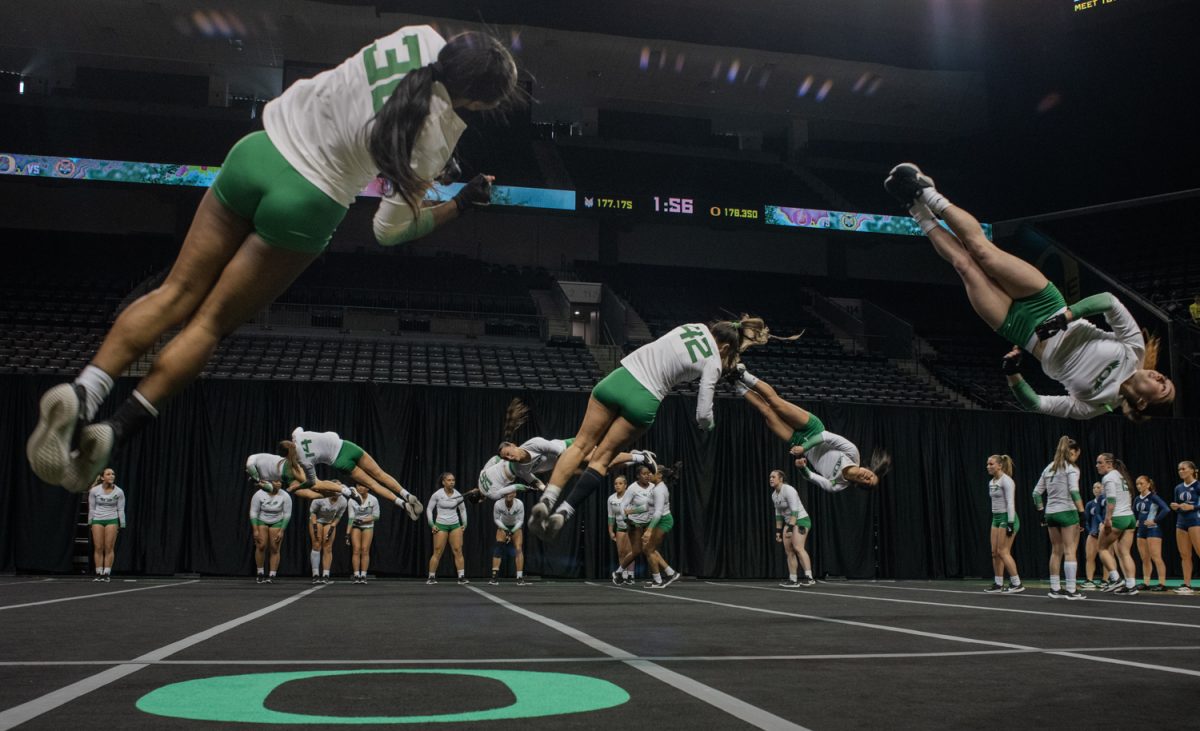
The door was open.
As No. 2 Oregon acrobatics and tumbling watched from the sideline in Waco, Texas, No. 1 Baylor’s double slide-to-split pyramid crashed to the ground. A “risk,” as Bears head coach Felecia Mulkey called it on the halftime broadcast minutes later, didn’t pay off.
A 0.250-point deficit, then, was about as close as it could get — and as close as they would get — for the Ducks.
Oregon (2-1) fell to the Bears (4-0), 278.050-272.530, in a meet where it took advantage of a slip-up and still couldn’t take home a win. The Ducks thrived in pyramid, where Baylor risked its seven-element heat on a difficult skill and fell, but a combination of start value deficiencies and inability to out-execute the nation’s best meant that a win wasn’t in the cards. It came down to the team event, of course, but the Ducks racked up multiple mistakes. The Bears had close to none.
This likely wasn’t the meeting that mattered the most — that could come in the final week of the regular season, or in a potential postseason matchup. It’s more proof, though, that Oregon isn’t on Baylor’s level yet, and that it has more steps to take.
Meets between the nation’s two best programs typically come down to the team event. Saturday was no different. Oregon trailed by 0.450 after a compulsory event where it turned in a pair of 9.850-plus heats — so did Baylor. It trailed by 1.100 after an acro event where it did the same.
In that acro event, where the Ducks had struggled earlier in the season with a pair of sub-8.000 scores in their first two heats, they scored 9.000. The left group in the synchronized heat included top Maya Khauv, who competed for the first time last week, and reigning NCATA Athlete of the Week Ashlyn Parlett. It suffered from a bobble and an extra step, and scored a flat 9.000.
While the total was more than a full point better than their previous season high, it was also 0.700 less than the Bears’ 9.700 heat. Cassidy Cu and Angelica Martin turned in a 9.950 and 9.850 in their five and seven-element heats, which kept the Ducks close.
These two teams don’t make mistakes often, though, and almost never in the pyramid event. A year ago in Waco, they combined for four 10.0 scores in the event. On Saturday, the Bears matched the Ducks’ 9.950 and 9.900 initial heats, but dropped to an 8.950 with the fall in open pyramid. Oregon scored 9.800 in the same heat, where it won a national event title in 2025, and cut the lead to 0.250 at the half.
Out of the break, after Susnara said she was pleased with the performance on the broadcast, the Ducks turned in a 9.600-point 450 Salto toss. It would end up bettering the Bears’ outing by a tenth, but the lead came surging back when Baylor took advantage of the most notable start value differential.
In the open toss, Baylor declared a 10.0 heat. Oregon declared just 9.500, and it showed when the Bears’ 9.700 bettered the Ducks’ 9.050 by enough to push the lead back to a full point. It’s one of the only places where they have that major differential, and it meant that Baylor headed into the penultimate event with a full point lead.
In tumbling, again, the Ducks opted not to change their sub-10.0 start values (in trio, quad and aerial), while the Bears stuck with their 60.0-point total. It meant that even Oregon’s exceptional solo heats, where they scored 29.200 of a 29.950 possible points, couldn’t make up for a 26.700 of a 29.300 possible in the group heats. In the front three, Baylor totaled 57.150 overall, and matched the Ducks’ solo passes with a 29.400-point total. It led by 2.250.
That’s all it would need.
Oregon stuck its foot back in the door with a team event, which, while imperfect, could’ve been good enough. The Ducks had just two notable mistakes — an extra step in a skill that included Selah Bell, Blessyn McMorris and Emily Rezner, and a Sophia Wing tumbling pass that ended up off the mat completely.
Even with the deductions, the Ducks posted a season-high 92.530-point total. Baylor, though, was mistake-free in a team event that had a multi-point start value advantage on the Ducks. It’s been the story of this rivalry: Oregon gets up for their meets, but Baylor gets up just a little bit more.
Maybe this is just a stubbed toe for the Ducks, who fall for the first time this season, with the emphasis now on the April 6 meet between the two in Eugene. Oregon’s mountain to climb is just a little bit higher now, though, and the Bears’ winning streak over the Ducks and the rest of the nation — four years, 11 months and 23 days long — is now another week extended.
Oregon returns to Matthew Knight Arena to face No. 9 Gannon (3-1) on March 6.


![Oregon third baseman Drew Smith (17) talks to pitcher Will Sanford (28) during the first inning. On April 24, 2026, The Oregon Ducks defeated the Penn State Nittany Lions [5-4], at PK Park, at University of Oregon, Based in Eugene, Ore. (Fred Hall/Emerald)](https://dailyemerald.com/wp-content/uploads/2026/04/2026.4.24.EMG_.FJH_.BaseballVsPennSt-4-1200x800.jpg)
![Oregon players celebrate and scream in Naulivou Lauaki Jr.’s (18) face in the dugout after hitting a home run. On May 30, 2026, The Oregon Ducks defeated the Washington State Cougars [4-0] in game 4 of the NCAA D1 Baseball Regionals at PK Park, at University of Oregon, based in Eugene, Ore. (Fred Hall/Emerald)](https://dailyemerald.com/wp-content/uploads/2026/05/2026.5.30.EMG_.FJH_.BSBLvsWashingtonStNCAA-14-1-1200x800.jpg)