Have you ever walked into a thrift store, found something that perfectly fit your style, then checked the price tag to your immediate dismay?
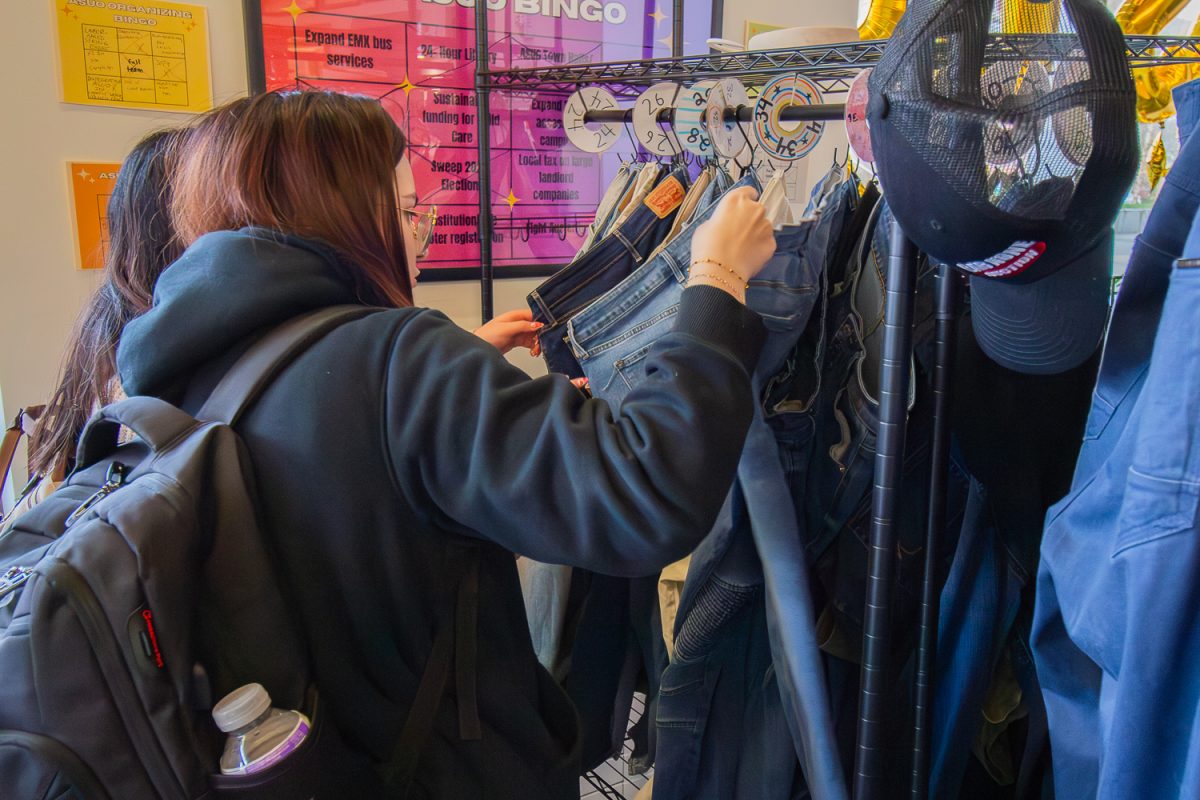
The Rose Room believes that sustainability shouldn’t be so financially risky, which is why they paired up with ASUO to host a free thrifting pop-up. On Feb. 26 from 2 to 5 p.m., the ASUO office opened its doors to those who wanted to donate or thrift for free. An eager crowd showed up and showed out on both fronts.
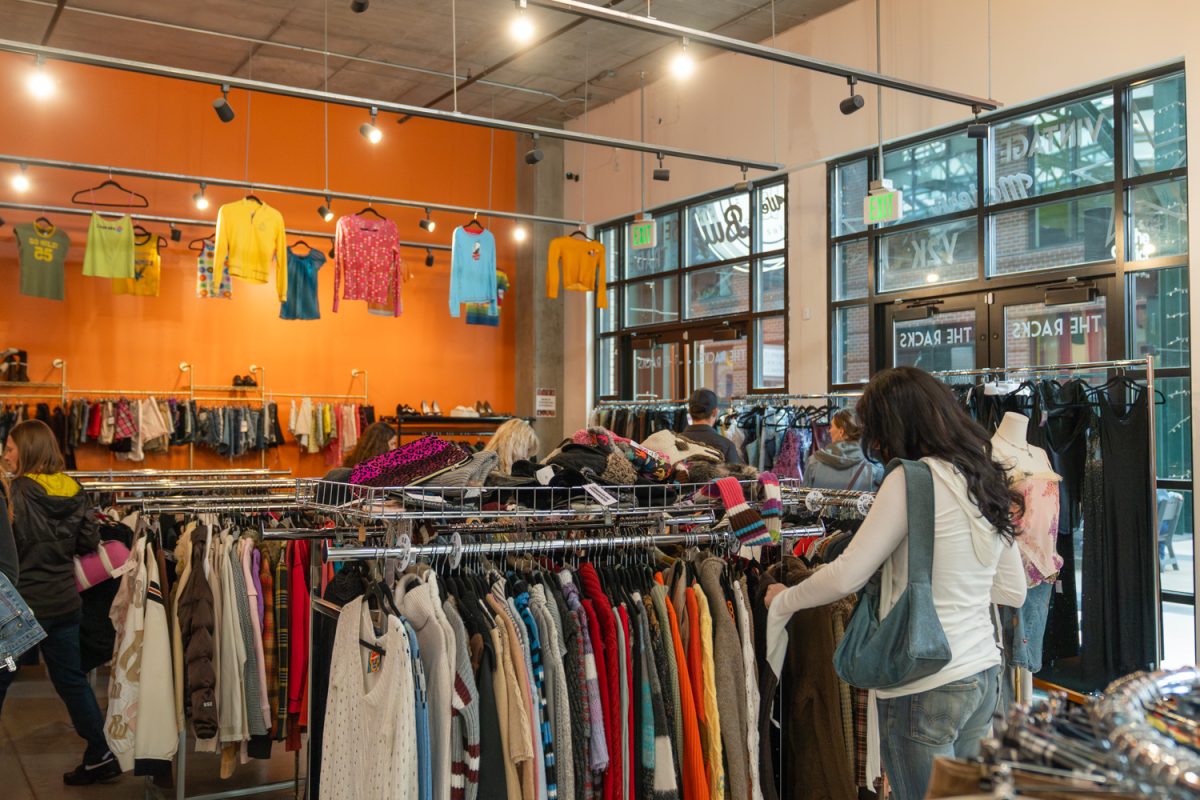
According to the SSC Reusables team, an estimated 300 students were in attendance. The room held an ensemble of different styles, colors and designs, composed partially of items already in the Rose Room’s possession alongside student-provided donations.
The event was a unique collaboration between the Student Sustainability Center and ASUO, pairing the two for something entirely fresh. “I think this is the first time in recent memory that the Student Sustainability Center has collaborated with ASUO in this way,” Dori Vaughan, an organizer of the event and a coordinator for the Student Sustainability Center’s Waste Production and Reusables Program, said.
The Rose Room, a component of the SSC, currently functions as a “free thrift store for students on campus,” and is open on Mondays and Wednesdays from 12 to 2 p.m. in PLC 182 all term. The program initially acted as a resource for staff members to secure free office supplies, but the SSC expanded the mission to include clothing to better accommodate the needs of students.
Nathaniel Pratt, an ASUO executive advocacy intern, introduced the concept as part of a larger effort to promote sustainability within the student body. “I had to present to my director and the president something new, and I wanted to do it on circular clothing models. We talked about it, and we kind of both came up with the idea of having a pop-up,” Pratt said.

According to data from Capital One Shopping Research, approximately 1/3 of clothing and apparel items purchased in the United States over the past year were secondhand. A circular clothing model is one meant to keep clothes in use as long as possible to eliminate waste and fast fashion. Thrifting, an example of this, has resonated vastly with young adults, and the UO campus is no exception.
“We’ve seen a huge rise in thrifting culture in the last 10 years, and there are a lot of resale stores that have popped up,” Vaughan said. “We’re trying to capture an audience with people who would go to those resale stores and convince them to instead give their items back to students under the assumption that they will find things that are of equal or higher quality by engaging in these programs.”
Vaughan emphasized the importance of accessibility in order to properly introduce a circular clothing system on campus, and that the “free” part of the “free thrifting pop-up” was integral in catching the attention of students.
“Being able to just tell people it’s free — that’s really exciting, especially in college when it seems like everything is turning you upside down and shaking your lunch money out of your pockets,” Vaughan said. “(It’s exciting) to have opportunities to engage with movements and programs on campus where you just get stuff, and you don’t have to think about your wallet at all. And so that was something we tried to outline on our posters was this slogan of thrift for free.”
While financially appealing to most, Pratt recognizes the wariness some students may have about engaging in an ASUO-sponsored event. He assures the elected campaign, Student Power, is ready to engage directly with students and prioritize their needs.
“There’s kind of a stigma of ASUO taking over stuff and like not really assessing the right needs of organizations and partners. I think Student Power is doing a really good job of understanding what the needs of the university are, and what the students actually really want to see,” Pratt said. “And I really want to see more collaboration, and I hope that through events like this, we can show that we are trustworthy, and that we can help you and that what we do really does matter.”
Amber Geiger, a junior, attended the event because the Rose Room had previously sparked her interest in recycling on campus. “I appreciate that events like this get put on for community building, but also for people who need resources,” they said. Geiger is hoping to attend an event like this again, “definitely earlier too,” as the racks that initially held hundreds of items had been whittled down to only a few dozen after only an hour into the event.
“I love the way sharing economies work, and I think, especially in college, it’s so valuable to be part of a larger community that shares things instead of outsourcing everything,” Vaughan said. “I think there’s just so much for everyone. Like, we’ve had such a diverse group of people. Anyone can come, and it doesn’t really matter your income bracket.”
As for the future of the Rose Room, Vaughan hopes the mission continues to expand. “There is talk of someday having sort of a basic needs center on campus, which is after both of our times here, but we are trying to legitimize the Rose Room and its services so that if something like that were to happen, we wouldn’t get left out of the conversation,” Vaughan said.
Anyone can donate clothing to the Rose Room, either by handing it to someone working at the SSC, dropping it in the donation bin at the EMU or bringing it directly to the Rose Room. You can find a map of current donation locations on their Instagram.