
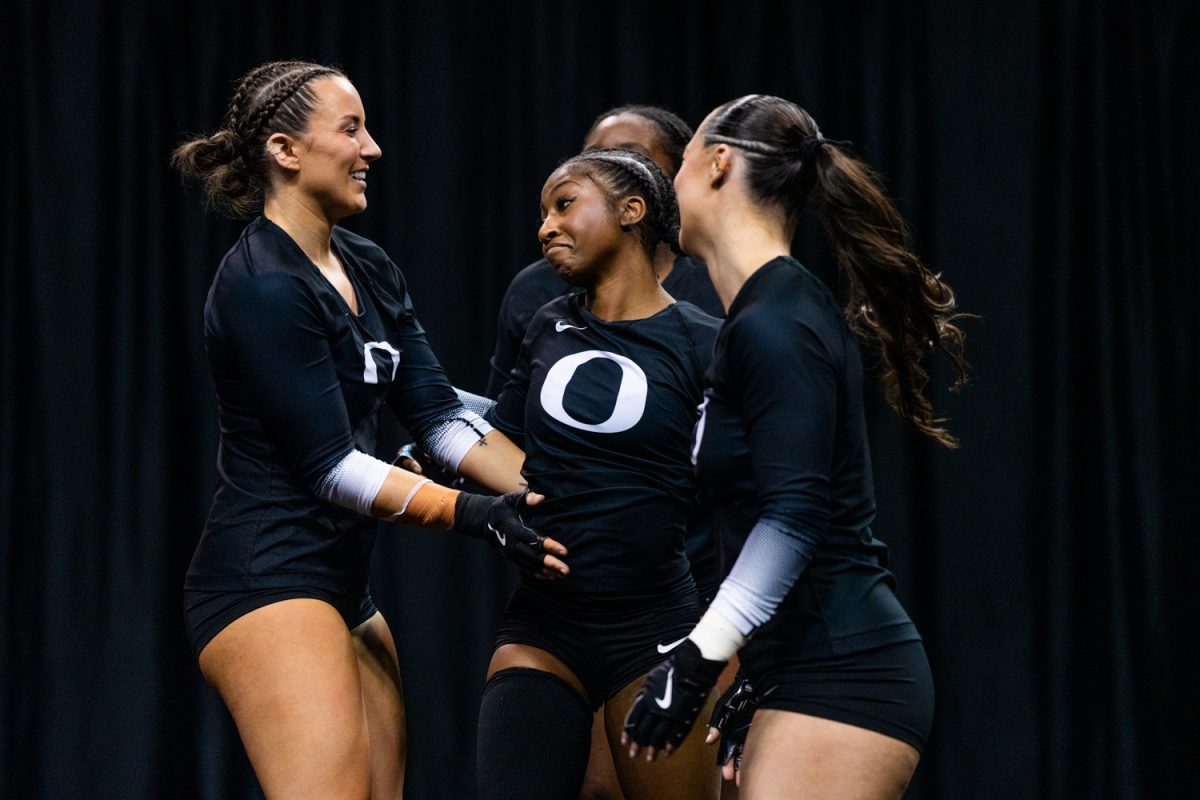
In the end, it didn’t matter that Hawaii Pacific University made the first mistake — it didn’t matter to Oregon acrobatics and tumbling that its opponent had made one at all.
It took the Sharks somewhere around two-thirds of a heat to do it. But Oregon wasn’t going to win because of its opponent’s mistakes. It had made that goal clear 10 days ago, when it won because it did so. It made it count in its 275.355-263.375 victory 10 days later, when it took a first-event lead and never let go.
After the Ducks’ comeback win over Iona University on March 15, Oregon head coach Taylor Susnara said that they’d had “way too many times” where they won because the other side failed, not because they succeeded. In that meet, despite Oregon’s high scores in tumbling, the spotlight was on the Gaels’ pair of low scores in the same event.
That wasn’t the story in Hawaii.
The No. 15 Sharks (3-2) stumbled and fell, but the Ducks sprinted past them in an 11.98-point victory that would’ve been obvious even without a trip out of the starting blocks. No. 2 Oregon (5-1) recovered its six-element acro heat after a season of struggles, continued to dominate pyramid and turned in a pair of season-high scores in toss. The road toward a national title won’t be this simple again — No. 1 Baylor waits on the other side of their flight home, then the postseason — but Oregon leaves Hawaii with a meet handily won.
The Sharks fell in their first heat of the night, compulsory acro, near the end of the timer. A top went backward during a transition to an inverted skill, and Hawaii Pacific dropped to a season-low 7.300 score.
Oregon’s later acro improvement, meanwhile, was foreshadowed by a season-high 9.550 in the compulsory heat. The Ducks’ lead after the first event was built off a pair of 9.85-plus pyramid and toss scores, but the acro score took advantage of that Hawaii Pacific fall in the same heat to create the advantage that wouldn’t go away.
An event later, Cassidy Cu and Angelica Martin posted a score of 9.900 or higher in five-element acro for the fourth-straight meet, and added a 9.700 in seven-element. Struggles in six-element went from a fall against Iona to a wobble and a save against the Sharks, and their improved-if-not-perfect score (9.150) reflected it.
Against the Gaels, the Ducks were hamstrung through four events by that acro fall, but recovered the deficit with a strong tumbling heat to take that win. That wouldn’t be the script for the Sharks, who struggled to compensate for their early fall and scored sub-9.000 in seven-element acro for the second time this season. Instead, Oregon’s lead grew as it approached its best events. A 9.950 in open pyramid, where the Ducks posted a 10.0 the last time they visited Hawaii, cemented a 3.800-point lead before the half.
A fourth-straight event win, in toss, overcame one of the Ducks’ few non-regularly-10.0 start value heats. They scored 9.55 in synchronized toss and 9.75 in open toss, both season-highs, in heats where already-difficult skills are often more challenging than other events to push toward that 10.0 start value cap. Exceptional scores look lower, and those two were more proof that the Ducks were pushing for, not coasting toward a win.
Tumbling, instead of a must-hit, became the cherry on top of an already-strong night. Carly Garcia entered the aerial tumbling pass in place of regular starter Nya Womack, who still competed in the trio pass, and turned in a 9.775. Morgan Willingham’s 9.875 was another piece of her consistent dominance of the heat, too. By the time the Ducks rolled into the team event, the lead was 8.700.
Of course, the meet ended as it started. Hawaii Pacific made mistakes early in its team event: a pair of tumbling pass step offs. The Ducks had a wobble — this time a dropped acro skill — and raced through the rest of their skills.
Oregon won, but not because the Sharks lost. Its six event wins and second-best total score of the season are testaments to its viability as a potential contender. Its road to a national title is as difficult as ever, but this puts them back in their regular realm, with just one challenger.
That rival, of course, comes to Eugene next.



![Oregon third baseman Drew Smith (17) talks to pitcher Will Sanford (28) during the first inning. On April 24, 2026, The Oregon Ducks defeated the Penn State Nittany Lions [5-4], at PK Park, at University of Oregon, Based in Eugene, Ore. (Fred Hall/Emerald)](https://dailyemerald.com/wp-content/uploads/2026/04/2026.4.24.EMG_.FJH_.BaseballVsPennSt-4-1200x800.jpg)
