
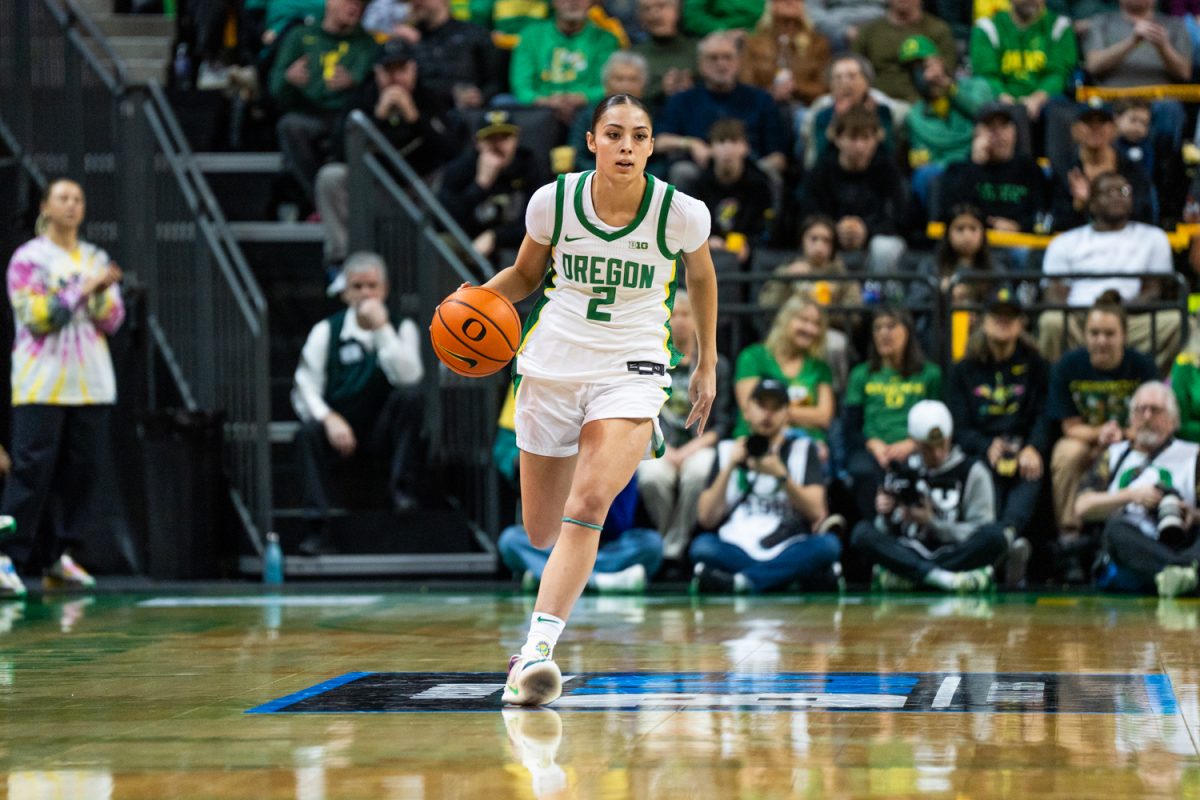
The right point guard makes everything on a team tick. The right passes at the right times, getting an offense into its sets and ensuring every player gets a touch at least once every few possessions.
Every team wants an elite ball handler, but Oregon women’s basketball’s Katie Fiso emerged as one of the best in the conference in 2025, being voted to the all-Big Ten second team and leading the Ducks to a win in the NCAA Tournament for the second consecutive year.
Fiso averaged a team-best 15.5 points and 6.2 assists per game while shooting 49% from the floor during the season. Over her last 10 games, Fiso saw her average go up to 17.8 points as she played the best stretch of basketball in her young career. Still, the questions remain: How many more levels can Fiso go up in ability? And, more importantly, what does the best possible version of an Oregon team look like around Fiso?
Fiso increased her scoring by 11.9 points a game from her freshman year and, in part due to injuries, was routinely Oregon’s primary ballhandler for close to 40 minutes a night. Being able to shoot 3-pointers more effectively is a huge piece of her development going forward. She made just 12 of her 43 attempts and was often not a factor from beyond the arc.
Aside from the obvious spacing and scoring impact that an improved shot would help with, it would also make her inside game — where she thrived, shooting nearly 50% from the field — even more dangerous. If on-ball defenders have to account for her 3-point shot, it opens up the inside, where she’s most comfortable in the mid-range.
It’s also worth noting that Fiso came in scorching hot and dropped 16 efficient points in a game that the Ducks lost to No. 1 seeded
Texas by 42 points. Head coach Kelly Graves will absolutely need to prioritize size and bigger wings outside of Sofia Bell if he aims to unlock his program’s capabilities during Fiso and Ehis Etute’s final two years.
“I think there can be improvements, certainly, coming back, but we’ve got to find people that look like (Texas),” Graves said. “We’ve got to get stronger. We’ve got to live in the weight room, OK. That’s what we’ve got to start looking like. They were bigger and more physical than us at every position… We were running our offense 40 feet away from the hoop. You can’t win games that way.”
Prioritizing an athletic center will be necessary for Oregon and would help Fiso in the pick-and-roll game. Fiso would also benefit from having a reliable secondary ball-handler to make life a little easier for her as well. One option in that department, senior Elisa Mevius, reportedly entered the transfer portal on March 24.
“Especially in the conference that we play in, there’s no night off,” Graves said. “So we need more playmakers.”
Regardless, the problems that emerged against Texas and the true elite of the elite are relatively minimal when you consider the overall context of Oregon’s season. The Ducks won two Big Ten Tournament games, upset a few teams still playing in the Sweet 16 and won a tournament game against a Power Four team. That, coupled with the youth of Fiso and Etute, means the arrow is absolutely pointing up for Graves’ program.



![Oregon third baseman Drew Smith (17) talks to pitcher Will Sanford (28) during the first inning. On April 24, 2026, The Oregon Ducks defeated the Penn State Nittany Lions [5-4], at PK Park, at University of Oregon, Based in Eugene, Ore. (Fred Hall/Emerald)](https://dailyemerald.com/wp-content/uploads/2026/04/2026.4.24.EMG_.FJH_.BaseballVsPennSt-4-1200x800.jpg)
