Violence. Destruction. Absolute chaos.
That’s what many people think of when they hear the word “anarchy.” But Zack, co-founder of the Neighborhood Anarchist Collective, believes that while rage certainly has its place, anarchism ultimately demands compassion above all else.
Zack, who requested to only be referred to by first name for privacy reasons, has a layered history in the local activism scene. While studying at the University of Oregon, he established the Climate Justice League, a group that focuses on environmental protection alongside “dismantling systems that encourage oppression and extraction.”
But that’s easier said than done, and policy change seemed practically impossible with the legal hoops they’d have to jump through. “The political will is not there to do what needs to be done to stop climate change,” Zack said. “And so I thought, ‘Okay, well, then what?’” Ultimately, it was reading CrimethInc’s “Recipes for Disaster” that drew Zack from futile environmentalism to anarchism. There were no established anarchy-based groups in Eugene, so he founded his own.
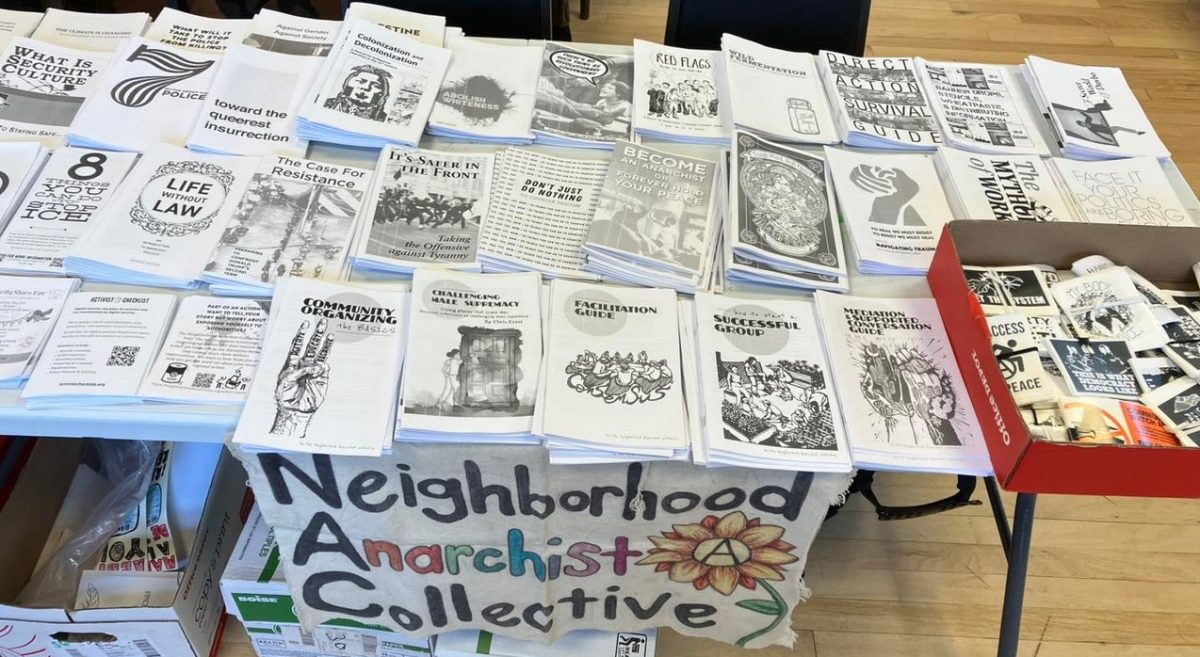
Naturally, NAC doesn’t subscribe to a hierarchy system, so Zack’s role is labeled as “co-convener,” someone who organizes behind the scenes and “makes things happen.” He often oversees community outreach events as a way to spread NAC’s message throughout Eugene by handing out zines and answering questions from anyone interested. People often stop by to argue, questioning how an anarchist organization is even possible when the ideology itself calls for individualism and a lack of organized structure.
But to Zack, those passerbys simply don’t know the full picture. His organization relies on coordination and mutual aid, something they believe is much more natural to humans than an every-man-for-himself society.
“I think people see anarchists as really angry and uncaring people. But really, it’s completely the opposite,” he said. “Anarchists are angry, but it’s because we care so much, and we see so much suffering in the world and we know that that suffering is not necessary. There are people homeless when there are empty homes. There are people hungry when there’s plenty of food. We live in a world of abundance, but we have systems that are set up to create scarcity.”
To address resource insecurity here in Eugene, NAC created the seasonal Solidarity Share Fair, a social event that offers attendees hundreds of donated items. Items range from food and clothes to camping gear, and the fair often offers free services like haircuts and massages. Most of their guests are unhoused and often have no other place to both secure resources and feel welcomed.
The group hosts a variety of other events and programs geared toward supporting marginalized or otherwise vulnerable communities. Free brake light clinics are frequent, as broken taillights can result in police stops that can pose added danger for immigrants. For May Day, an “anarchist holiday” that celebrates workers’ rights movements, NAC will host an “anti-competitive” 5K fundraiser for political prisoners.
Riots and punk rock are certainly avenues of anarchy, but Zack and anarchists like him ultimately hope for a better future, one where people can work together and help each other. He hopes people can recognize NAC and anarchy for what they are, because they may end up fitting right in.
“Despite having a system that rewards competition, people still work together, people still volunteer and people still donate, even though society does not reward that,” he said. “That shows how embedded in our nature it is to cooperate.”