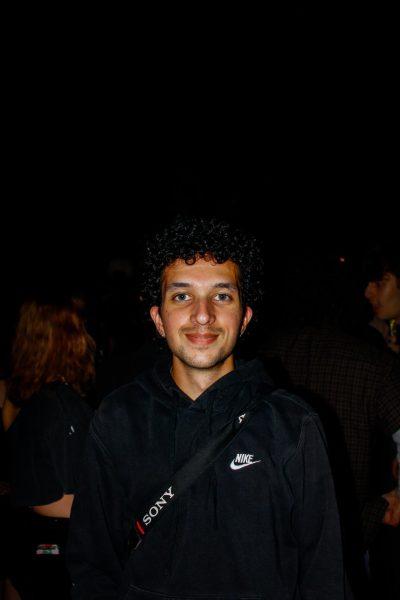
Someone had to cool off Simeon Birnbaum.
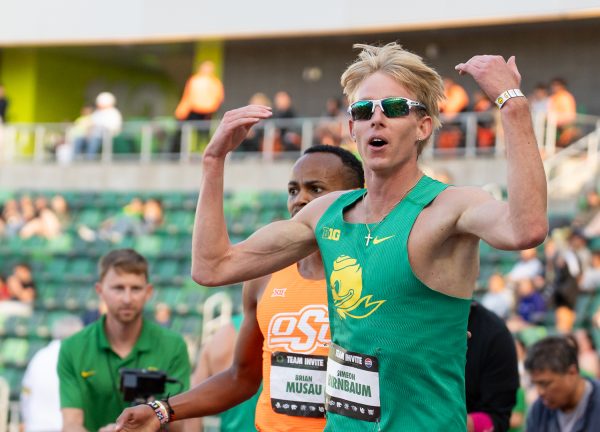
Oregon’s 1500-meter weapon was telling his pacer, teammate Tomas Palfrey, to go faster. He peeked at the clock at the bell, then negative-split his final lap by 4.54 seconds en route to an NCAA-record 3:31.69 clock-stopper. It’s only April, but he’s already hot. The water he dumped on himself afterward was the only thing that could cool down the fastest 1500m runner in collegiate history.
“It feels incredible,” Birnbaum said. “During the race, my pacer, Tom (Palfrey) and I were running pretty quick, maybe a tiny bit slow at one point, and I told him, ‘Faster.’ I was that confident that I could handle a little bit faster, and I said that two or three times. It’s like, you’re doing something really, really hard and it doesn’t feel that hard, and it’s one of the best feelings ever.”
The Ducks won the women’s side of their first home meet of the 2026 outdoor season, and placed third on the men’s side on the back of Birnbaum’s record-breaking, Oregon No. 2 all-time race. The Big Ten Outdoor Championships move away from Hayward Field this year, to Lincoln, Nebraska, but Oregon took advantage of its local outing to secure season openers for contenders and set up the next weeks of competition before May’s Oregon Twilight meet in Eugene.
Birnbaum, a junior, ran nearly his entire final lap alone after Palfrey dropped out and Birnbaum pulled away from Oklahoma State University runner Brian Musau, who trailed him closely through 1100m. Three of his teammates, Tayson Echohawk, James Harding and Anthony Fasthorse, finished third, fourth and fifth, all in personal-best times, while Palfrey stood on the side with arms raised as his teammate crossed the line.
Fasthorse has known Birnbaum was fit, but maybe not this fit. Birnbaum has had his eye on the NCAA record “for a while now,” too, but hasn’t run for a full year in two or three. These past 12 months, he has. On April 3, at the Stanford Invitational, he flashed his 5K speed in a 13:19.73 personal-best win. That, it turns out, was just a setup.
Before Saturday’s race, he told his teammates that he was going for the record. Fasthorse had the confidence in him, but Oregon head coach Jerry Schumacher needed a night to sleep on it before the meet.
Schumacher told Birnbaum initially that he wanted to “leave everything still in the bottle,” around a 3:40 pacer with Saturday’s race. Birnbaum came back and asked his coach if he thought he could “run fast,” Schumacher said. They went back and forth — Birnbaum argued that the volume of tactical races that he foresees this season meant the Team Invite was the moment to uncork that bottle. On Friday, Schumacher told Birnbaum that he’d make the call in the morning.
When he woke up on Saturday, Schumacher checked his phone, saw the “perfect temperature,” and dialed Birnbaum.
“Let’s be ready to go tonight,” Schumacher told Birnbaum.
“Seriously?” Birnbaum asked. “I’m so excited.”
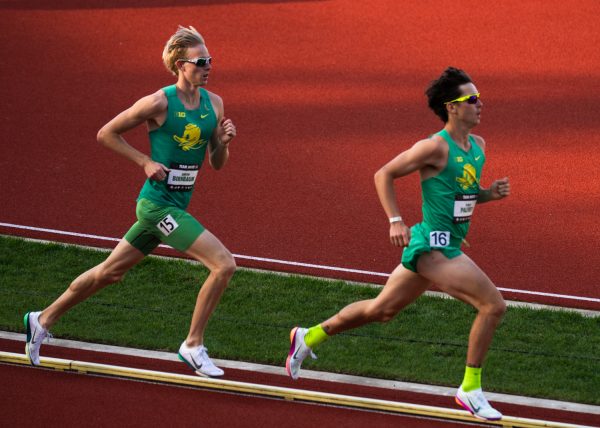
Birnbaum estimated 20% of his success comes from the endurance work he’s undergone at Oregon, to which he gave, “pretty much the whole credit to being able to run that fast.” That, plus the 5K speed that he thinks is worth somewhere around 80% of his late-race energy, equals record-breaking potential for an inimitable pace.
“You kind of get a feel for what type of shape you’re in, and you can’t always know when you’re going to feel this good,” Birnbaum said. “I’ve been feeling really, really good this past month, and when you’re feeling that good, you don’t want to waste it.”
He saw a 70-degree, sunny day at Hayward Field. He felt no wind. Through 300m, he peeked at the clock — on pace. From there, he waited to feel the pain. Through 800m, he knew he was going to run fast (“Maybe not that fast, but I knew I was in for a good one,” he said). With 400m left, he still felt gas in the tank. Afterward, that gas expelled, he sauntered through hugs and high-fives with the record resting on his shoulders.
“I mean, I knew he was going to run well,” Schumacher said. “You never know exactly what the performance is going to look like, but obviously 3:31 is rare air in collegiate 1500m running. I’m excited for him — it couldn’t happen to a better kid. He works hard, and there’s more to go, too.”
In two years at Oregon, before which he entered as one of the top high school recruits in the nation, Birnbaum has fought to earn his place near the top of the collegiate game despite missing significant time.
He opened at Hayward Field as a freshman with a 3:45.27 1500m finish before missing the rest of that year with an injury. As a sophomore, he rode a new wave to a seventh-place finish at the NCAA Outdoor Championships on the same track and a 5000-meter win at the Big Ten Championships. In 2026, he claimed indoor conference wins over 3000 and 5000m, with a runner-up time at the NCAA meet.
This doesn’t change anything this season, in Schumacher’s eyes. Birnbaum will still have to win those tactical races that he’s projecting — ”Sometimes, you have to be really good at racing the race that’s given to you. That’s the first thing they talked about after the race,” Schumacher said.
But he’s the outdoor standard with a full season ahead, and he’s laid down the mark to prove it.
“I’m coming for everything,” Birnbaum said.
This, too, might just be a setup.
In the women’s 1500m invite, Silan Ayyildiz, who won the 800-meter open race on Friday, returned to claim victory in the race she qualified for World Championships in last year. Samantha McDonnell, wearing one of Ayyildiz’s Turkey kits, paced the senior to a 4:07.13 win and the new Division I #6 mark. Ayyildiz ran a 1:05.34 first full lap before finishing her last two both in 1:06.46, coming through the bell in 3:00.67.
“Today, I kind of felt off, because it was really hard to run alone — especially the last lap; I really slowed down a lot. But for this weekend, I’m just here with no big expectations, just part of workouts, so it’s been really fun so far,”Ayyildiz said.
Juliet Cherubet, an Oregon junior, finished third in that 1500m in 4:10.41 after finishing fourth in the 800m open yesterday.
Benjamin Balazs closed out a 3000-meter steeplechase win in 8:34.92. A junior, Balazs won the conference outdoor title a year ago in Eugene and finished third at the NCAA Outdoor Championships before finishing sixth over 3000m at the 2026 NCAA Indoor Championships.
“I kind of wanted to see how quick I could run a little bit — we set the pace for about 80 — and I was going to close off that if I could,” Balazs said. “I didn’t really have much more today, so kind of was like, ‘Let’s just try to run it in.’”
His final time came 12.34 seconds off his 8:22.58 personal-best, set at the 2025 USATF Outdoor Championships. Some “pretty big goals” are on the line for this season, he said, namely an 8:15.00 steeplechase time, though he’s not sure when that’ll come with his weeks before Oregon’s next home meet not yet scheduled.
Elsewhere, Oregon’s sprints largely dominated. Both 4×100-meter relays cruised on the front end of the evening’s work, with anchors Lily Jones and Jaelon Barbarin carrying leads to the finish line, while the Ducks took seventh in the women’s 4×400-meter in 3:49.27.
Amirah Shaheed won the women’s 100-meter in 11.50, with teammates Brazil Neal (second, 11.63), Jones (fourth, 11.70) and Niya Clayton (fifth, 11.81) also finishing. PJ Ize-Iyamu won the men’s 100m in 10.21, with freshman Grant Valley (fourth, 10.44) and Jaelon Barbarin (sixth, 10.57) in the mix. Kai Graves-Blanks won the 110-meter hurdles in a personal-best 13.42, the No. 3 time in Oregon history.
The Ducks now head away from home, with a middle-distance contingent targeting next week’s Penn Relays, before returning to Hayward Field for the Oregon Twilight on May 8.



![Oregon third baseman Drew Smith (17) talks to pitcher Will Sanford (28) during the first inning. On April 24, 2026, The Oregon Ducks defeated the Penn State Nittany Lions [5-4], at PK Park, at University of Oregon, Based in Eugene, Ore. (Fred Hall/Emerald)](https://dailyemerald.com/wp-content/uploads/2026/04/2026.4.24.EMG_.FJH_.BaseballVsPennSt-4-1200x800.jpg)