

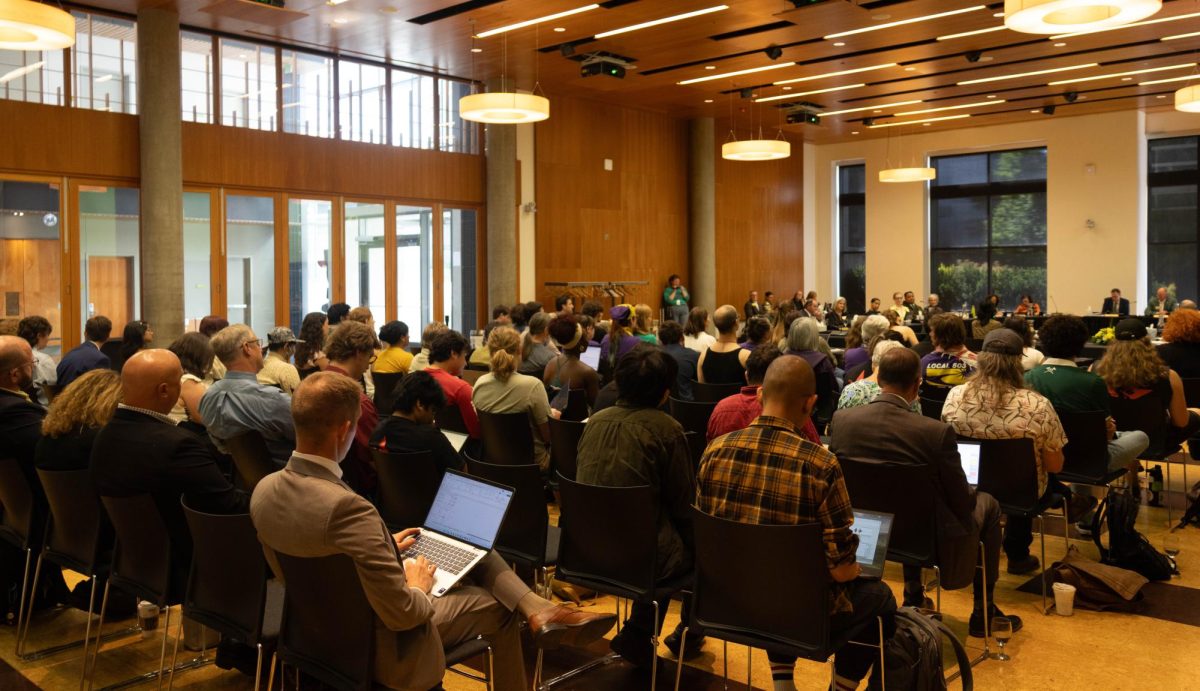
The University of Oregon’s spring Board of Trustees meeting is being held June 1 and 2, in addition to meetings of the executive, audit and governance, and finance and facilities committees.
President John Karl Scholz and Senior Vice President for Finance and Administration Jamie Moffitt fielded questions about uncertainty surrounding the recently announced $65 million in budget cuts that will occur at the university over the next several years, notably not ruling out potential cuts to tenured faculty.
The meeting began at 9 a.m. with updates on internal audit projects and treasury reports before the primary Board of Trustees meeting started at 11 a.m.
Administration remarks
In his opening remarks, Scholz discussed low nonresident enrollment and the reality of consistently decreasing out-of-state tuition revenue.
“We truly want to avoid having to cut budgets, and in light of the factors I mentioned earlier, there’s no reason we can assume that the environment next year will jump back to prior levels. We need to assume the recruiting environment for nonresident students has changed,” Scholz said.
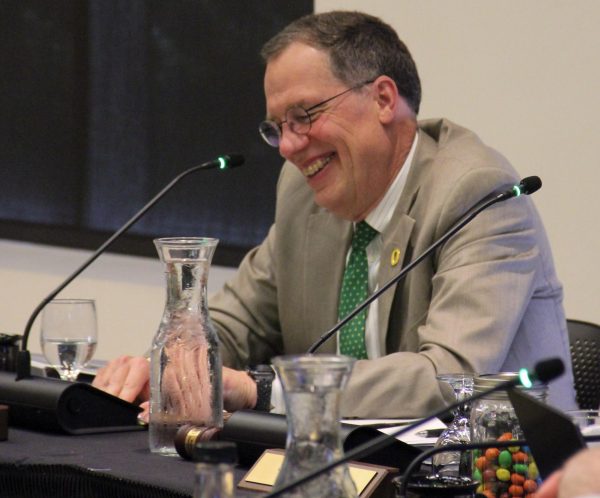
When asked whether tenure-track positions are at risk during this round of cuts, Scholz said it would be “premature to rule out anything off the table.” He said the public phase of the Academic Modification Advisory Committee process will occur in the fall and provide enough time for collaboration and consultation across campus before final decisions are made in December.
Provost Christopher P. Long urged “real and enduring solidarity” among campus leaders as decisions about cuts are made and commented on the AMAC process.
“However imperfect, the AMAC process builds on the formative efforts we made last summer to create the conditions for the senate to provide meaningful feedback on the difficult decisions we need to make,” Long said. “New habits, especially those that depend on trust, take time to develop.”
Long also spoke about the essential nature of universities and why changes must be made to further advance the institution and create a more compelling undergraduate experience.
Executive, Audit and Governance Committee update
Chief Auditor Anta Coulibaly provided an update on the activities of the Office of Internal Audit from March 1 through May 31. The report included an overview of completed and ongoing projects, as well as the status of corrective action plans being implemented across academic units.
One completed audit engagement involved the School of Journalism and Communication, where OIA identified two key areas for improvement. One finding was that travel expenses were not consistently documented, approved or compliant with university policy.
The SOJC audit came amid public controversy in spring 2025 over then-Dean Juan-Carlos Molleda’s travel spending and other issues. Molleda resigned in July 2025 following the controversy.
Additionally, Coulibaly said OIA identified gaps in authentication controls. OIA provided recommendations to SOJC management and is currently monitoring implementation of corrective action plans, though she did not elaborate on specific details.
In a completed audit of the College of Design, OIA identified three primary areas for improvement: financial oversight gaps, administrative control inconsistencies and compliance monitoring.
Because travel expenses were identified as an area of concern, Long noted during the meeting that all dean-level travel requests now go through the provost’s office.
The proposed 2027 audit plan prioritizes departments based on strategic alignment, time since the last audit, management concerns and risk level. Priorities will be identified through meetings with stakeholders across campus and discussions with the board.
Finance and Facilities Committee update
Moffitt, Brian Fox and Jeff Schumacher presented the quarterly financial report, treasury report and a budget and expenditure authorization that will require board approval.
Fox highlighted a projected $3 million reduction in net tuition and fee revenue and a $7.5 million reduction in personnel services costs due to decreased payroll expenses.
Moffitt noted that the budget had already incorporated approximately $17 million of last year’s $30 million in budget cuts. She said the additional decrease in spending reflects further reductions across departments. Service and supply expenditures are also expected to decline because of reduced departmental spending.
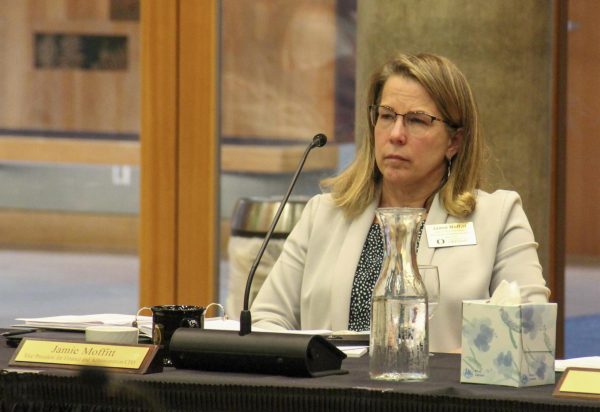
The third-quarter projection currently forecasts a year-end gain of $4.5 million, compared with the second-quarter projection of $500,000.
The finance and facilities department projects the university’s fiscal year 2027 operating budget at approximately $1.55 billion. The projected capital budget is approximately $200 million.
Currently, expected operating revenue for UO’s education and general fund — the university’s primary operating fund — is not expected to fully cover expenses. Fox said that as actions are taken to address the budget deficit, including anticipated cuts, the finance office has the authority to adjust spending within the budget approved by the board.
Salary expenditures are expected to increase, primarily because of pay raises required under union contracts. Fox said reductions implemented last year that will fully annualize this year are expected to offset those increases. Spending on supplies and services is also expected to increase by 2.9%.
State appropriations are expected to increase by 5.5%, while tuition revenue is projected to decrease by 1.7%. Indirect cost recovery revenue generated through sponsored grants is expected to decrease by 6.1%.
The fiscal year 2027 capital budget is projected at $211 million and includes several major projects across campus, including next-generation residence halls, continued construction on Friendly Hall and the UO Portland Child Behavioral Health Building. Most of the funding for these projects comes from state bonds, grants and gifts.
Approval of the fiscal year 2027 budget will be brought before the full board during Tuesday’s continuation of the meeting.
The UO Board of Trustees will reconvene Tuesday at 9 a.m. in the Giustina Ballroom at the Ford Alumni Center.







Bernadette Marie Calafell, PhD • Jun 3, 2026 at 6:50 pm
Can we do away with the administrative bloat and quit blaming faculty and faculty salaries.
Charlie • Jun 2, 2026 at 1:08 pm
UOwe’s solution isn’t to get rid of massive administrative bloat, nor to stop construction of useless buildings Oregonians can’t afford to patronize. Nope, their solution is to degrade academic quality.
When are debt saddled students finally gonna realize they’re being scammed? Growing numbers of outta state students realize the obvious, but what does it say of homegrown undergrads that enrolled in record numbers??
Paying far more, getting far less is no way to go through life, son…