

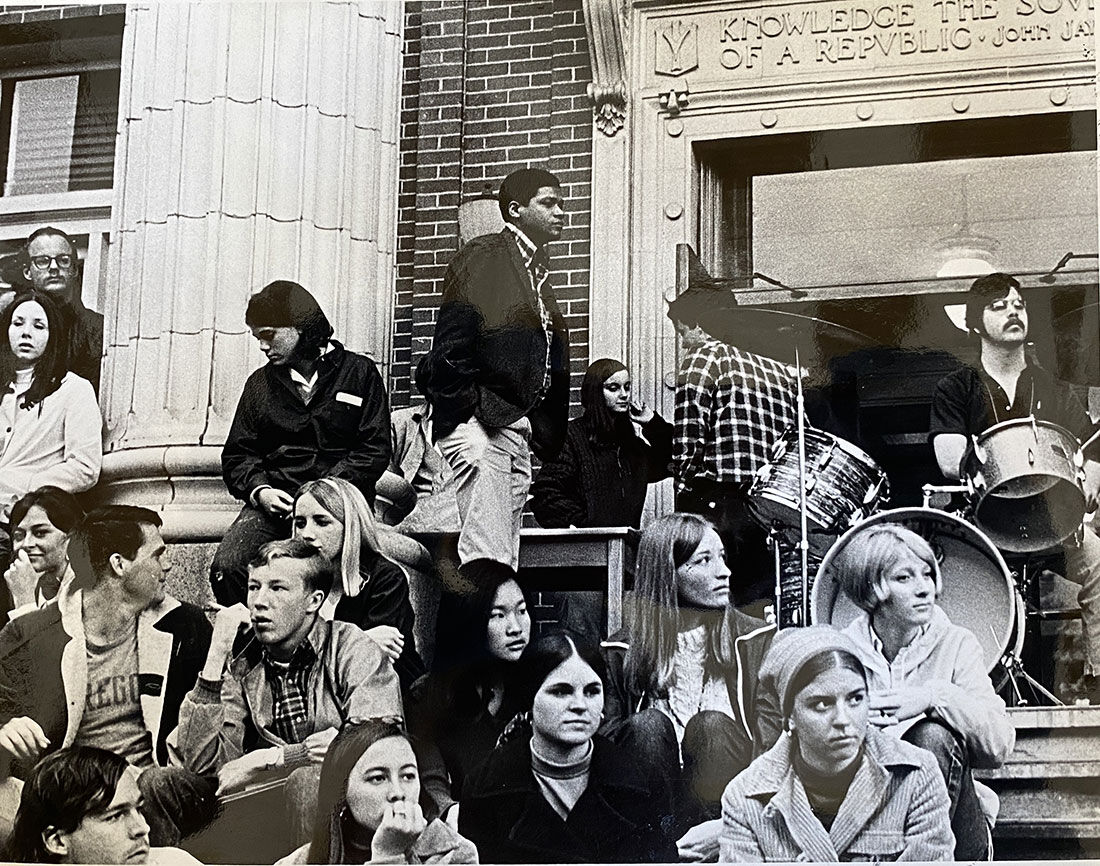
More than 50 years ago, University of Oregon student Martin J. Bennett marched down 13th Avenue alongside hundreds of other students and Eugene community members, chanting in protest of the Vietnam War.
Today, nearly six decades later, Bennett is part of a University of Oregon Libraries project revisiting that moment, contributing to a digital collection compiled between 2023 and 2025 by Special Collections and University Archives documenting the campus and community anti-war movement of the late 1960s and early 1970s.
The collection consists of recordings and transcripts from 19 oral history interviews with people who were active in the movement in Eugene, including students, community members and then faculty at the university.
Interviews were conducted by Bennett, a retired instructor of history and social sciences at Santa Rosa Junior College.
Bennett said that in the fall of 1968, the movement was growing, evolving and shifting from a minority on the UO campus to a majority that opposed the Vietnam War. Support for the movement also grew beyond the campus into the greater Eugene community.
“This collection interviews people who were students like me and primarily engaged on campus, but also people who were in the community and developing and organizing in the community, sometimes apart from what was going on on campus,” Bennett said.
Bennett conducted all 19 interviews himself, reaching out to individuals through personal networks or outside connections, in addition to receiving oversight and technical support from archivist Nathan Georgitis.
Throughout the interviews, people talked about their participation in the anti-war movement efforts and reflected on their experiences with protests and demonstrations they were involved in.
Bennett said the intention of this collection made it very unique, as very few people sought out participants to give them a voice to speak.
“This was the first time they’ve had this kind of conversation, and I think it was very fruitful for those who were being interviewed,” Bennett said.
Firsthand accounts
What began as a small minority emerged into the majority, with a profound shift in public opinion, particularly regarding the anti-war movement in Eugene. Bennett described this as a grassroots social movement where people learned how to be organizers, develop organizations and put together coalitions.
“They developed organizations and put together coalitions at the local level,” Bennett said. “Then they connected with national coalitions, and most historians say that the anti-war movement was the most successful and effective anti-war social movement in American history.”
During the interviews, Bennett asked many questions, such as when they came to Eugene, what their background was and what their aspirations were. He asked questions based on each individual’s role, depending on whether they were a student, faculty member or townsperson, trying to get as many different perspectives as he could.
Jack Maddex was a faculty member at UO who was heavily involved with campus activism at the time and reflected on his role in the movement during his interview with Bennett.
“Some of the faculty role was being asked by student groups to speak at the free speech platform or organizing teach-ins,” Maddex said. “It meant getting a lot of faculty from different perspectives together, and you would have one lecture after another with a lot of interaction with the audience sometimes.”
Dennis Gilbert arrived at UO in 1968 as a graduate student and immediately saw many students interested in labor movements against the war. He took part in a faction that saw it needed to be a movement of both the college and the whole community, which was a broader coalition area that was “very diverse and open-ended.”
The 1969-70 academic year was a turbulent year of protests and major demonstrations, which saw campus activism reach new heights of violence and disruptive activities.
The Reserve Officers’ Training Corps program is designed to train, educate and recruit students to become commissioned officers for the U.S. military. It became a major target for anti-war protesters because it represented U.S. military involvement and sought to train new officers to join the military.
In January 1970, protesters escalated their actions toward ROTC. Groups of people threw animal blood at an ROTC recruitment table, broke into the ROTC office and scattered books and papers around the room while vandalizing the walls, and a dozen hecklers disrupted an ROTC information session.
Some protesters escalated their actions even further the next month when they started a fire in the ROTC storage area in Esslinger Hall, which led to $250,000 in damages to the building, the perpetrators were never discovered.
After a vote by UO faculty in April 1970 that allowed ROTC to remain on campus, protesters broke into the ROTC facilities, “ransacked the area” by breaking lights, doors and windows, threw rocks, torches and kerosene at the building, and attempted to start a fire. Several students were arrested and charged with inciting a riot.
In the same month, students occupied Johnson Hall and successfully closed East 13th Avenue, calling it “The People’s Street.” Further, on Oct. 2, 1970, a bomb was set off in the basement of Prince Lucien Campbell Hall.
“There were constant demonstrations, political education and various forms of debate over the war in Vietnam, and I think in the best of American traditions, that debate was very vigorous and very open,” Bennett said.
The impact of veterans on the anti-war movement
In addition to local citizens opposing the war, Vietnam Veterans Against the War was an organization that began taking action and became public about the anti-war movement. Bennett interviewed a veteran named Rick Diggs, who returned and became active in the local VVAW chapter.
Bennett also said that other veterans he interviewed reflected on the fact that by the late 1960s, “there was a profound discontent and dissent internally within the military.”
“The anti-war movement spilling over into the military is actually one of the reasons why (former President) Nixon decided to abolish the draft and to incrementally draw down the amount of troops in Vietnam,” Bennett said. “So I would say they played a very major role in the anti-war movement.”
Marion Malcolm worked with community-based organizations, including VVAW, which she said became a key part of the anti-war movement. Malcolm understood their small role as part of a nationwide effort to stop the war and said that Eugene citizens were always part of big nationwide protests and coalitions, outside of attending local demonstrations.
But Malcolm highlighted the impact of the veterans who returned from the war, who provided extensive firsthand accounts of being in combat and became credible sources who voiced their opposition to the war.
“I think the anti-war movement did make it harder and harder for the administration to continue the war, although I have to say that what really happened, finally, was that the anti-war movement among service people and veterans probably is what really pushed it,” Malcolm said.
Connections to protests today
Many individuals like Gilbert and Malcolm identified similarities between the anti-war movement they participated in and the protests that have taken place at UO over the last few years.
Gilbert believes the events that unfolded in Eugene during the Vietnam War can be remembered by students today to learn a few lessons from, particularly by listening to those firsthand accounts in the SCUAs.
“Obviously, there’s lots of reinvention in every movement, but it means that things like this have happened before,” Gilbert said. “It isn’t really easy getting kicked out of a class or losing your job or doing something like that as a student.”
Bennett made the connection to how directly relevant these interviews are when thinking about movements on campus today. In relation to America’s current activity in other countries, he said that it’s “all too timely to look back at what happened” during the Vietnam War.
“If there’s something to why we all agreed to be interviewed, that’s the reason. Not to be personally famous in the library at UO, it was to make a contribution to an ongoing struggle that didn’t end with the end of the Vietnam War,” Gilbert said.
Malcolm said she thinks there’s something to be learned from the collection documents because of the parallels with what we see today. She added that something listeners would get out of hearing those interviews is a sense of solidarity in a movement they knew they were a part of.
“I think Marty intended that students and faculty members today would feel inspired, that they would feel that they could make a difference, that maybe looking back 40 years later, they would feel good about anything that they do taking a stand now,” Maddex said. “Whether that’s actually true varies from one person to another.”
As a message to student advocates today, Malcolm emphasized that engagement matters to everyone involved and encouraged students to stay focused on the objective at hand.
“Try to remember what the goals really are and don’t get distracted from them,” Malcolm said. “And I would say that when there can be active partnerships between the campus and the community, everybody is stronger.”




Theodore James • Mar 31, 2026 at 11:47 am
Joseph shows clear understanding and passion for the topic of the Vietnam war. He shows the impact it had on students at the time very well, and I leave this article with a greater knowledge of a time period that I wasn’t around for. Thank you, Joseph!