


This fall, the University of Oregon will turn 150 years old; at the same time, administrators will confront one of the largest financial crises of the century that will result in sweeping budget cuts across the institution.
The university is preparing to cut roughly $65 million from its budget across the next several years, in addition to last summer’s cuts of about $30 million that resulted in 176 job cuts across departments, of which 117 were layoffs, 59 were unfilled positions. The new cuts come after the administration projected a decline in out-of-state student tuition revenue, after college decision day, May 1, offered further insight into enrollment numbers.
The impact of last summer’s cuts will begin to be felt this fall, as the faculty union’s bargaining agreement requires one-year layoff notices.
In an announcement on May 14, UO President John Karl Scholz said there would be an immediate hiring and pay action freeze as well as a limit on non-essential travel, save for September pay increases that the university already committed to.
UO relies primarily on tuition revenue for operational costs — undergraduate tuition accounts for 79% of the Education and General Fund’s revenue as of 2025, with 59% of that number coming from nonresident tuition costs.
Most of the fund’s expenses, 79%, go toward compensation packages for faculty and other employees, according to the university’s fiscal stewardship website. Most of the remaining expenses include utility costs, leases, travel and loan payments on academic buildings.
Last summer, projections for 2026-2030 indicated the university would face a $25-30 million yearly budget deficit in the E&G fund. During that time, nonresident enrollment was cited as a major issue for the university.
To address that projection in September 2025, the university cut roughly $24.9 million from the E&G fund by laying off university positions, according to a communication from the president’s office.
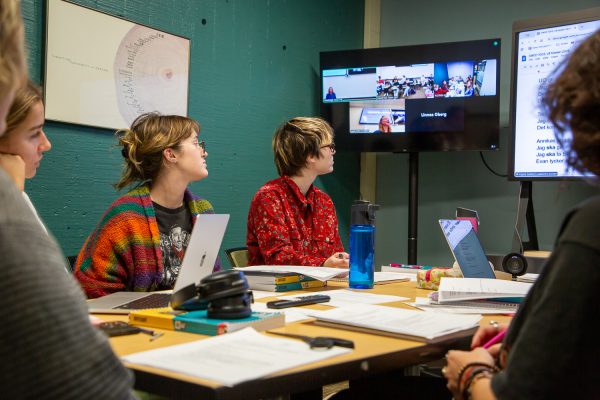
Language programs in particular saw a significant reduction in academic service. The Swedish and Swahili language programs will be completely phased by this fall. The last cohort of Swedish students had to turn to online instruction through the University of Minnesota to finish their required language courses remotely.
The trend persists
At the final UO Board of Trustees meeting on June 1 and 2, after hearing public comment that raised concerns about budget cuts, Board Chair Steve Holwerda said that the more significant cuts this year were due to unchanged forecasted enrollment.
“One of the reasons for the more significant cuts this year is because last year we chose not to change our forecast of enrollment in future years. Had we made that change, we would have to make more significant cuts last year. We felt it was the right decision to do because we were hoping the decline was temporary,” Holwerda said.
According to budget projections presented to the board by Chief Financial Officer Jamie Moffitt, 1,888 first-year nonresident students are projected to enroll at UO in the fall. This number is lower than this fall’s 2,306 nonresident students, and lower than even fall 2020, which enrolled 1,948 nonresident students.
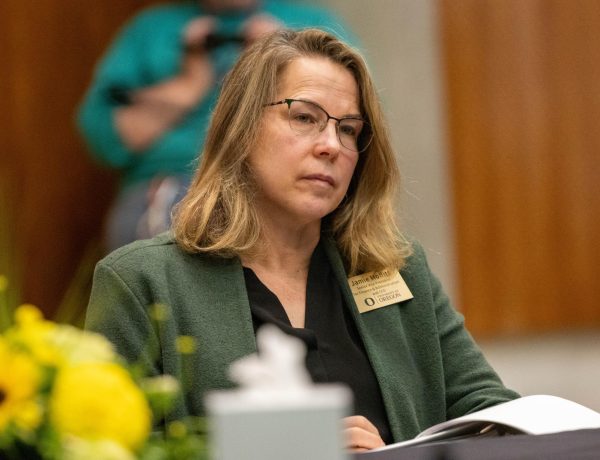
Resident student enrollment is also expected to decrease, but minimally so in comparison to nonresidents. Overall undergraduate enrollment is projected to continue to get lower: this fall’s projected enrollment is 20,265. By 2031, this number is anticipated to fall to 19,207 students.
Scholz’s opening remarks also touched on the budget cuts, including a brief mention on how the $65 million number is primarily driven by lower nonresident enrollment.
According to Scholz, average out-of-state net tuition is approximately $40,000 per student. If the university had 500 fewer nonresident students than expected, the resulting shortfall would be around $20 million. Currently, Scholz said the financial projections for next year is a $23 million deficit once “other factors are considered,” but fewer nonresident students represents the bulk of this deficit.
Scholz and Moffitt both attribute these numbers to a blend of less trust in universities, increased competition between UO and peer universities and “political environments that have affected international enrollments.”
Fiscal year 2027’s financial forecast is expected to have an overall 0.7% year to year decrease from last fiscal year. Net tuition and fees is expected to have a 1.7% decrease and other revenues a 3.7% decrease as compared to last year. State appropriation slightly reduces these decreases, resulting in the 0.7% expected decrease.
During public comment at the university’s board meeting on June 2, students, faculty and staff expressed frustration and unease at looming budget cuts, with some questioning why the university had not previously taken steps to address the deficit.
Vice President of United Academics, UO’s faculty union, and professor of Chinese literature Maram Epstein said that last year’s cuts were “devastating for faculty morale and confidence in UO’s commitment to the liberal arts.”
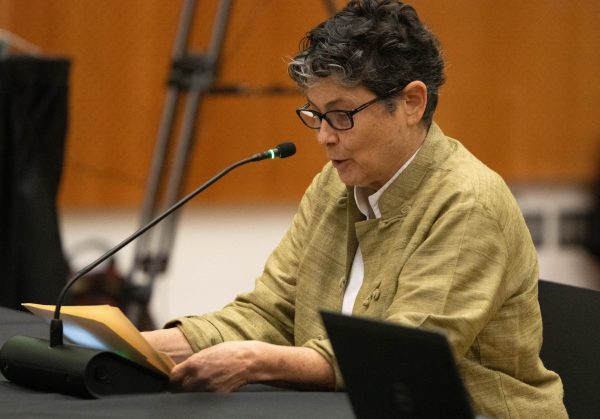
“The first thing I learned after joining the board of a nonprofit was that budgets are an expression of values,” Epstein said. “Increasing class size and laying off faculty and academic support (officers of administration) is counterproductive to our mission.”
Epstein went on to request “greater transparency” from the university in communication with faculty so that decisions can be made to best spend limited resources.
Chris Sinclair, UA’s secretary and an associate professor of mathematics, expressed how important it is to engage students in long classes, and that requires work and support for professors.
Questions raised by campus unions
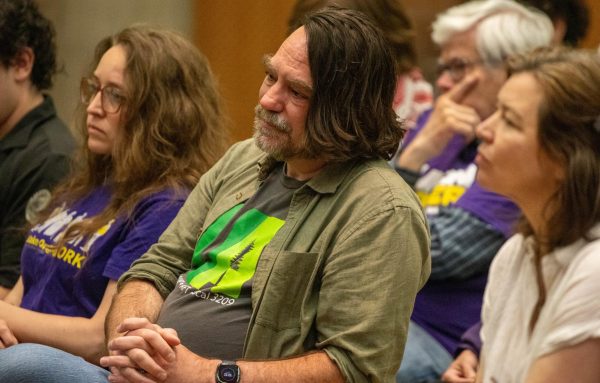
Current UA president and professor of psychology Kate Mills was informed of the budget cut announcement a day in advance due to her position on the UO faculty senate, which had a meeting regarding cuts on May 13. The university also reached out to the union in advance, according to Mills, but there was little to no details about the hiring and wage freezes.
Mills said that the general response from the union, though not uniform across UA leadership, was frustration. Mills said that for some, there was surprise to the cuts, but for others it was expected because this is “not the first time that (UA) has seen the administration’s leadership be surprised that they find themselves in this position of potentially not bringing in enough revenue.”
Mills said that the university makes an effort to inform UA of announcements regarding budget cuts before it occurs so faculty are not “blindsided.”
Despite awareness of the announcement, Mills said there is a lot of gray area about how freezes might impact employees going forward. In Scholz’s announcement, he emphasized a strategic hiring plan — which is an area Mills said is lacking specificity.
“What does it mean if there’s a hiring freeze and then you still have this strategic plan? Who is involved?” Mills said. “Is it a uniform freeze? Or is just another way of saying ‘oh, we’re going to take this how we want and not allow hiring in certain areas versus others.’”
Mills said she is on several department mailing lists that are still hiring or in the process of extending offers for their employees. These departments raised concern over whether or not things like academic “partner hires,” in which the partner of a researcher may be offered a position at the university during the recruitment process, will still move forward or not amid the freezes.
UA is most concerned about any departments that have recently requested more instructional support, according to Mills, because they will not receive that support due to the freeze.
(Tarek Anthony)
The union will continue to monitor individual academic units for things like workload distribution as freezes go on and cuts are anticipated.
UO Student Workers, the union that represents all student workers across the university, is similarly lacking clarity on how the freeze will affect workers. In a statement to union members, UOSW said they are planning to meet with administration for more clarity on the effects freezes will have on student workers.
At present, the hiring freeze does not affect reappointment of student workers, but departments can choose not to fill student worker positions to cut costs, according to the union’s statement. Reappointment occurs for student positions that do not operate over the summer and students are offered a return to their position after the break.
Per UOSW’s collective bargaining agreement, student workers are scheduled to receive an hourly pay increase of 2.5% on July 1. The pay scales for the three levels of student workers must increase by either 3% or the amount that is needed to comply with minimum wage.
UOSW met with UO Employee Labor Relations on May 27 requesting clarification on the anticipated length of freezes and if workload will increase on remaining student workers when additional positions are cut and how student workers will be included in decision-making.
UOSW did not provide comment to The Emerald on the outcome of this meeting by print deadline.
According to UO spokesperson Angela Seydel, the current hiring freeze does include student workers, but student workers will still receive the raise per their contract in July.
Rising tuition
Nonresident students who started at UO in September 2025 pay $47,466 in tuition each year. One nonresident student who graduates in four years would pay approximately $189,000 in tuition fees over the course of their studies.
Resident students, in comparison, would pay an estimated $69,900 across four years.
A joint annoucement from Scholz and Provost Christopher P. Long in May 2025, which marked the first announcement of significant structural changes to the university going forward, identified a downward trend of nonresident students which was expected to continue. The announcement said it is likely more investment would be needed to attract more nonresident students as future cycles continue to predict less enrollment from out of state.
In the same 2025 announcement, Scholz and Long said the university was facing a structural deficit of $25-30 million in the E&G fund which resulted in layoffs across campus. At that time, Scholz and Long estimated a 4% average reduction in administrative unit budgets and a 2.5% average reduction to school and college budgets.
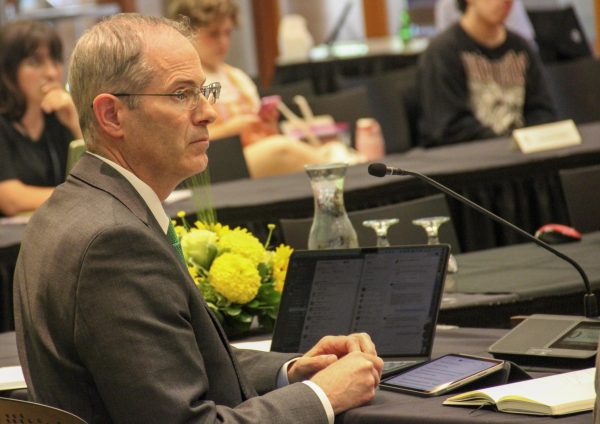
The Academic Modification Advisory Committee, which was formed at a faculty senate meeting on May 20, will provide advice and input related to “significant academic change” to Scholz. It consists of six faculty members, one member representing Officers of Administration, one representing classified staff and one student representative.
AMAC will provide a written report to the university senate with input before significant academic changes are made. The report will include feedback from the university community and the public.
During the board meeting, Long said that the committee will be a primary part of the six-month “process and community dialogue” about cuts.
“However imperfect, the AMAC process builds on the formative efforts we made last summer to create the conditions for the Senate to provide meaningful feedback on the difficult decisions we need to make,” Long said. “New habits, especially those that depend on trust, take time.”
Dyana Mason, outgoing senate president, said that the AMAC will have several roles throughout the budget cuts process. One is to ensure that deans have “done their work to identify” options, alternatives and proposals that will be brought to the committee to be discussed with the provost. Another will be that members of the committee are observing that the input process was “rigorous” and gave department heads and other impacted faculty the opportunity to provide feedback.
Mason said feedback from the senate will be provided during the “private” period of AMAC work, followed by a public period where the committee can seek further community input before plans to enact cuts are finalized.
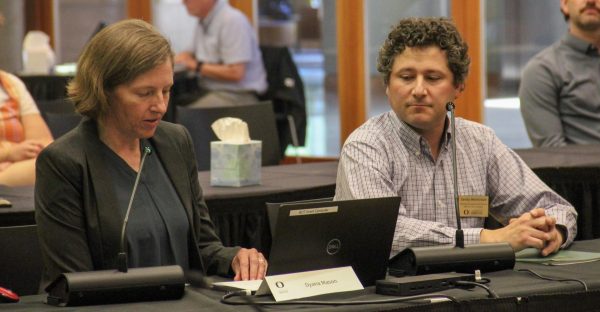
“People will have a chance to be heard on this matter regardless of what unit they’re from. Will everybody be satisfied? I’m sure the answer to that is no, especially if their unit is one that may be impacted,” Mason said. “All we can do is try to make sure those decisions are well-informed.”
According to the motion that outlines AMAC’s goals, each report will evaluate that the administration’s plan for academic changes will ensure that students are provided opportunities to complete their degree if that department is impacted, that changes are compliant with university policy and procedure, that changes preserve essential academic record and curricular function and mitigate harm to programs and units.
The budget reduction plan that addresses the multi-year deficit, which will be informed by feedback collected in the AMAC process and developed over the next six months, will be presented to the board on Dec. 15, the second day of the university’s board meeting.







Steve Scarich • Jun 10, 2026 at 4:57 am
Despite the endless verbiage of the reporter, it is actually very simple. UO provides mediocre education, at exorbitant prices. Young people are voting with their feet. The faculty needs to look in the mirror, and acknowledge that UO is not an Elite university, cannot charge elite tuition. It is not going to change in our lifetimes, so time to provide the academic experience that young people are willing to pay for, not the education that faculty ‘want’ to provide.
Charlie • Jun 8, 2026 at 8:20 pm
UOwe, as with other university loan mills, didn’t anticipate curtailment of Federal Department of Education loan subsidies. Without taxpayer underwriting, UOwe can’t sustain admin mismanagement of the flagship.
The Empire of Debt is collapsing…