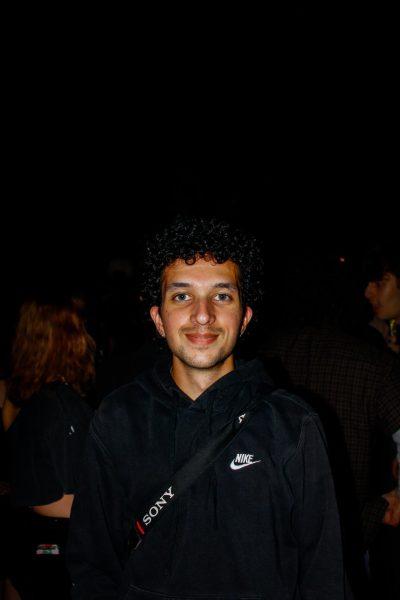
UNIVERSITY PARK, Pa., ALTOONA, Pa., CHICAGO, DETROIT and PITTSBURGH — By the time we made it back to Lot 14 outside Beaver Stadium at 1:36 a.m. Eastern Time, we’d walked somewhere north of eight miles, run something like 800 meters in Chicago O’Hare International Airport and watched four quarters and a double-overtime of football.
In Lot 14, where we left our rental car, we recorded a podcast on the hood of a Toyota RAV4 and headed to Altoona, PA., and finally breathed.
Daily Emerald Sports Associate Editor Owen Murray and Photo Editor Saj Sundaram traveled to State College, Pennsylvania, last weekend to cover the Ducks’ heavyweight, top-six bout with the Nittany Lions. Over three days, we produced this experience piece, a game story, a photo story and reported live from the stadium before, during and after Oregon’s season-defining win. Parts were written in the stadium press box, in the hotel at 4:00 a.m. postgame and at airports in Chicago, Detroit and Pittsburgh.
Oregon’s 30-24, double-overtime win over Penn State on Sept. 27 — in the white out which is billed as “the greatest show in college sports” — was one of the most pivotal games of our careers. Ducks head coach Dan Lanning called it, “The best game I’ve ever been a part of.”
In Lot 14, everything felt good.
To cover a conference game played 3,600 miles from our newsroom, we drove from Eugene to Portland, then caught the first of two flights, to Chicago (where we nearly missed our connection and made that 800m run), and then to Pittsburgh. We spent the night at America’s Best Value Inn, watched the Oregon State Beavers lose in overtime and ate an extra-large Domino’s pizza.
That’s how you prepare to cover what might be the biggest game of your life.
Gameday began with a two-hour drive to State College, where Penn State is located. There, we found our spot in Lot 14 — a field with a row of porta-potties — and began.
At first, we tried to stop every Oregon fan we saw for an interview, out of the belief that we wouldn’t find that many. We found too many. We talked to a father and son from Salem and a man and his college roommate, whom he converted to Duck fandom. We met a Penn State usher who drives with his family from Pittsburgh and Philadelphia every weekend to work behind the scenes. Only one of the half-dozen is an alumni.
It felt like we could’ve never entered the stadium — maybe never played the game — and had enough stories to tell. That wasn’t, though, our job. We walked into Beaver Stadium just after 1:30 p.m.
It’s hard to quantify just how large a six-figure capacity stadium is. It’s like seeing the world in front of you, and to either side, and above you, too. It more than doubles Autzen Stadium in size.
At some point, it has to just be another game — and that means routine.
In the press box, the focus was on a first half that flew by. In-game, the Daily Emerald produces live updates posted to its website — the first-half batch, in part, looked something like this from the press box:
“Oregon gets a play off.”
“Kenyon Sadiq does Kenyon Sadiq things.”
“Nittany Lions go three-and-out on first drive.”
“Ducks go play-action on fourth down, convert.”
“Ducks try another field goal, convert, tie game 3-3.”
“Two-minute drill stalls.”
“Halftime.”
From the field, it was more of the same. Saj barely moved, a stark difference to most games, where he’s usually running all over the field.
After the third quarter (“Penn State can run the ball now.”; “TOUCHDOWN, DUCKS. Oregon leads, 10-3.”; “Dierre Hill Jr. is on fire.”) and 10 minutes of the fourth, the media is allowed to watch from the sideline. Again, it’s routine — Autzen Stadium allows something similar.
What’s not routine is having to plan for a field rush, then calling it off when Dillon Thieneman made the game-sealing interception in (double) overtime. From there, you try to go with the flow: take video, soak in the moment and remember scenes.
From there, you sit with a dozen or more reporters in a 10-person tent as the marching band plays, and watch head coach Dan Lanning try to explain the significance of this win to his program.
From there, you write, edit and publish your recap. From there, you take your 4,000 photos from three different camera bodies, cut to 5% of your total photos, then edit, crop and caption.
From there, you walk to Lot 14, where everything feels good.
![Oregon outfielder Angel Laya (53) greets outfielder Jax Gimenez (7) before the first pitch. On May 30, 2026, The Oregon Ducks defeated the Washington State Cougars [4-0] in game 4 of the NCAA D1 Baseball Regionals at PK Park, at University of Oregon, based in Eugene, Ore. (Fred Hall/Emerald)](https://dailyemerald.com/wp-content/uploads/2026/05/2026.5.30.EMG_.FJH_.BSBLvsWashingtonStNCAA-1-1200x800.jpg)


![Oregon players celebrate on home plate with infielder Naulivou Lauaki Jr. (18) as he rounds home after his home run. On May 30, 2026, The Oregon Ducks defeated the Washington State Cougars [4-0] in game 4 of the NCAA D1 Baseball Regionals at PK Park, at University of Oregon, based in Eugene, Ore. (Fred Hall/Emerald)](https://dailyemerald.com/wp-content/uploads/2026/05/2026.5.30.EMG_.FJH_.BSBLvsWashingtonStNCAA-13-1-1200x800.jpg)
![Oregon third baseman Drew Smith (17) looks to the mound as he comes up to the plate. On April 24, 2026, The Oregon Ducks defeated the Penn State Nittany Lions [5-4], at PK Park, at University of Oregon, Based in Eugene, Ore. (Fred Hall/Emerald)](https://dailyemerald.com/wp-content/uploads/2026/04/2026.4.24.EMG_.FJH_.BaseballVsPennSt-10-1200x800.jpg)