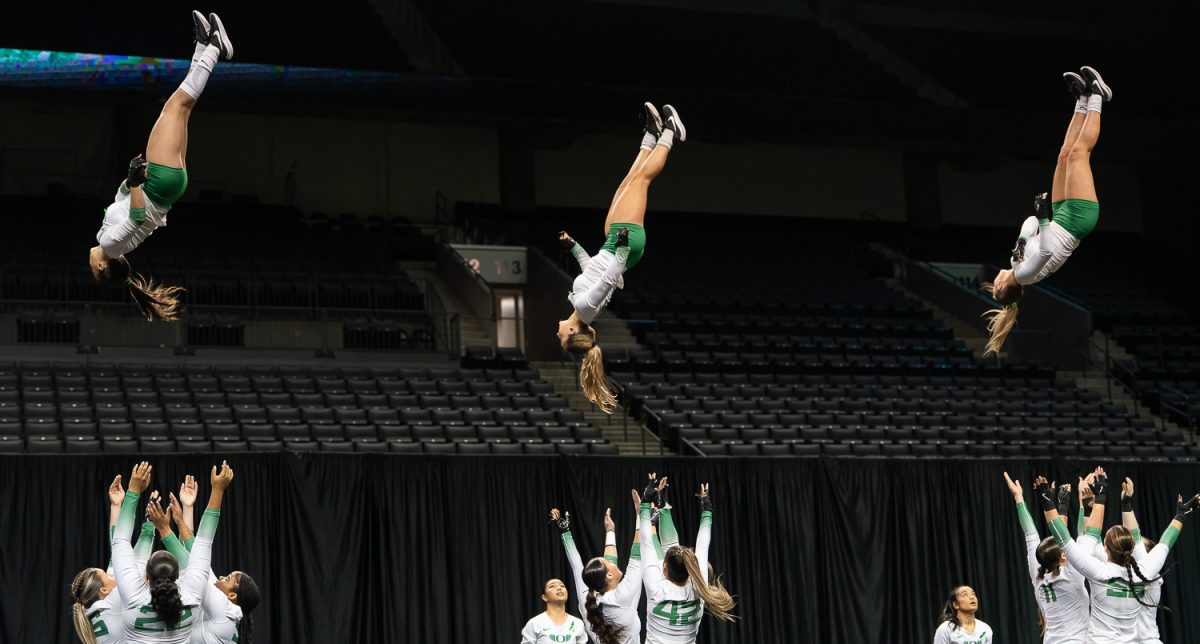
As of next week, it’ll have been five years since anyone has beaten No. 1 Baylor University. That timer started March 6, 2021, and it didn’t end on Saturday, when No. 2 Oregon acrobatics and tumbling (2-1) hung with the Bears through the team event despite start value differential in the second half in its first loss of the season.
I wrote yesterday, and before the meet, that this probably wasn’t the one the Ducks needed to win — that’ll come in Eugene next month, or maybe in the NCATA National Championship. There was an opportunity here, though, and the takeaway for an Oregon team that is gradually raising start values after replacing key contributors from the 2025 season could be a measure of success.
On Saturday, the Ducks proved once again that they’re one of two truly elite teams in the NCATA. They also proved they’re still No. 2.
Six-element acro is back on the table, but still needs to improve
This was the first bullet-point in the preview for this meet, so it feels right that it should land here. It was vital to the Ducks’ chances that they didn’t put themselves in a first-half hole, and the heat they’d struggled with the most through two meets was six-element acro.
Against Baylor, a 9.000 score is much better than what the Ducks earned against Missouri State or Quinnipiac, but it was also nearly a point below the Bears’ score in the same heat. There’s success to be noted, especially with first-year acro heat additions Maya Khauv and Ashlyn Parlett in the left group in the heat.
It was enough to keep the Ducks in the meet, but not enough to put them in a position to take full advantage of the open pyramid fall an event later. The Ducks trailed by a quarter of a point at the half, and the difference in their six-element heats was 0.700. Baylor ultimately won by 5.550, but that six-element gap was the largest of any heat in the meet, save the open pyramid or team. Combine that with a 0.650-point gap in open toss, which was in part due to start value gaps, and the team event difficulty gap, and you’ve got a good idea of the difference in the meet.
This meet was a great sign for six-element acro, and it’ll be one to continue to keep an eye on as the Ducks navigate a difficult end-of-season slate. It proved there’s more to come. It proved Oregon’s ability to adjust and improve. Those are both great takeaways.
Higher start values should even this out, but Baylor might not risk this much again
In likely the only meet of its season where it’ll face a negative start value differential, Oregon and head coach Taylor Susnara opted not to raise its five non-10.0 heats (two toss heats and trio, quad and aerial tumbling) to maximum difficulty. Its team event’s difficulty still trailed the Bears’ difficulty by multiple points.
Once the Ducks entered the half down 0.250, they’d trail in start value difficulty in every event. The Bears had a half-point advantage in open toss (which ended up a 9.700 to the Ducks’ 9.050 score), and a 0.750-point advantage in tumbling. By the time they hit team event, the lead had ballooned to 2.250 points, and the Bears’ start value advantage meant they could likely afford a mistake.
The meet on April 6 should have as close to maximum difficulty as we’ll see in the regular season — it’s the last meet, between the two best programs, likely for the top seed in the postseason. That’ll eliminate most, if not all of the second-half differential that extended Baylor’s lead Saturday afternoon, but there’s something else to account for.
Right after Susnara joined the halftime broadcast to say she was happy with the first half and that the Ducks needed to hit team event, Bears head coach Felecia Mulkey sat down. She surmised that they had an open pyramid which, “is probably going to score a 10 when we do it,” but that they’d opted for the more difficult skills to entertain the home fans.
I’d expect to see that other pyramid in Eugene next month, and it’ll mean the Ducks have to find another way to hang with Baylor. Open pyramid is one of Oregon’s highest-scoring and most consistent heats — it scored 9.800 against the Bears — and it’ll need to be in order to put the Ducks in a position to take advantage of those raised second-half start values next time out.
This wasn’t enough to win
Saturday was Oregon’s best overall score, best team event score and likely best meet. After its win over No. 2 Quinnipiac, this section title read, “Is this enough?”
The answer, apparently, is “No.”
The Ducks got what I thought they needed from the Bears to win this meet, which was an open door in the form of a Baylor mistake that cost the home team nearly a full point of differential. They didn’t execute a perfect meet, but also didn’t make mistakes outside the team event. Make no mistake: this was the best the Ducks have been this year. Now, they need to raise the ceiling.
That comes with higher start values, but also with elite performance in the heats where it doesn’t hang its hat. Oregon was a good toss team on Saturday, but it had two scores of 9.350 or lower in a heat where it needed to press its advantage. It’s more evident than ever that only a six-event showing will beat the Bears, and that’s not what the Ducks got in Texas.
So no, this wasn’t enough to win. It was a great litmus test for a team which proved it remains solidly elite — top two — ahead of a stacked run-in. The Ducks will face No. 4, 9 and 13 before running into No. 1 again, and it’d be a surprise if they struggled with any of those three. Barring an upset, this season will be defined by Oregon’s results against the best — the Bears.
But what else is new?
Oregon faces No. 9 Gannon (3-1) on March 6 in Eugene. The meet is scheduled for 6 p.m. PT.



![Oregon third baseman Drew Smith (17) talks to pitcher Will Sanford (28) during the first inning. On April 24, 2026, The Oregon Ducks defeated the Penn State Nittany Lions [5-4], at PK Park, at University of Oregon, Based in Eugene, Ore. (Fred Hall/Emerald)](https://dailyemerald.com/wp-content/uploads/2026/04/2026.4.24.EMG_.FJH_.BaseballVsPennSt-4-1200x800.jpg)