

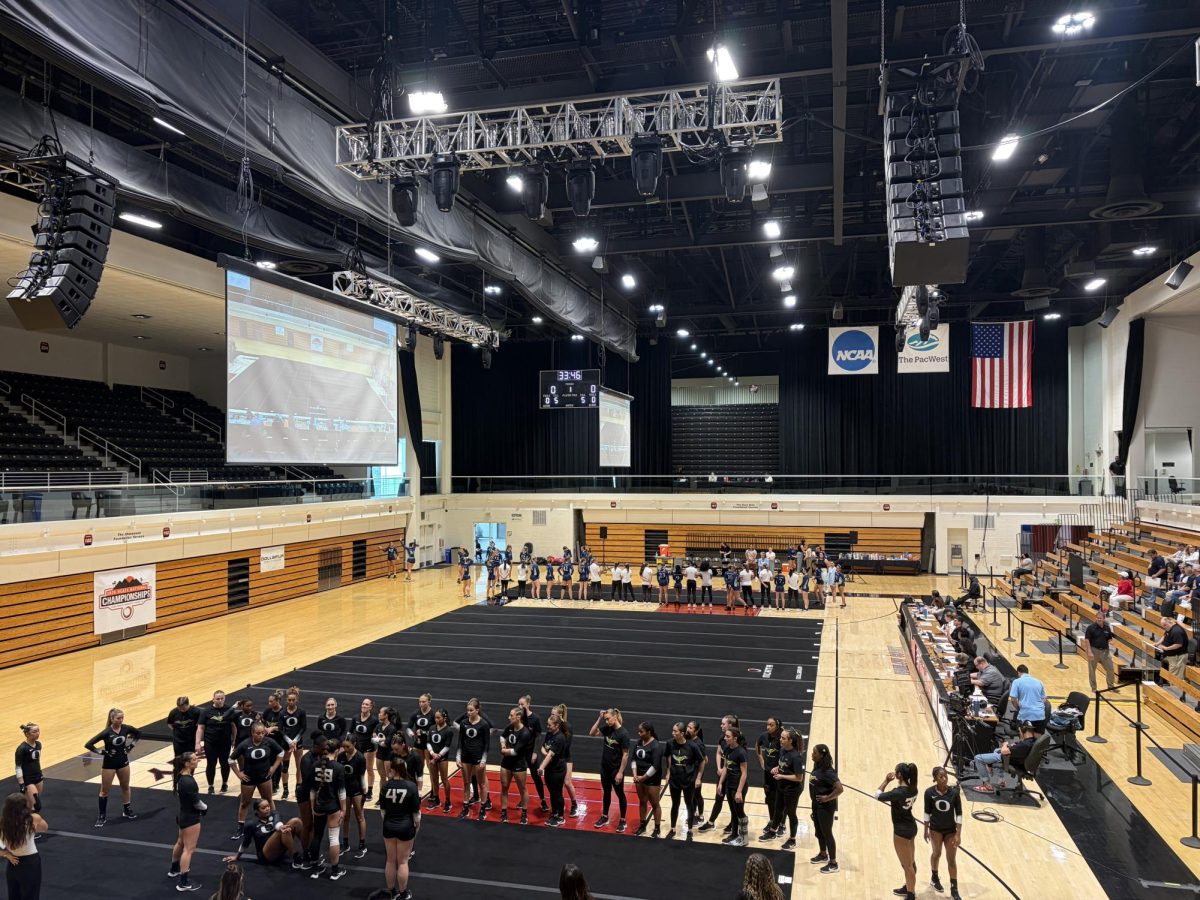
A midweek trip to Hawaii, it turned out, was relaxing for No. 2 Oregon acrobatics and tumbling.
The Ducks (5-1) never trailed, scored season-highs and completed a comprehensive victory over No. 15 Hawaii Pacific University with their second-highest team score of the season in a 275.355-263.375 win. The postseason horizon is all-but-here, and the Ducks executed (head coach Taylor Susnara’s buzzword from after their last meet) to what’s essentially the peak of their across-the-board ability.
That doesn’t mean every heat was their best, but it does mean that the Ducks achieved their previously-stated goal to win — really win — their next meet. Events that have spent time out of the spotlight grabbed it in the Shark Tank. Saying the Ducks are good enough to beat their rival is difficult, but this win argued that they’re prepared to do it.
Was this Oregon’s most complete meet?
By the numbers, it might have been. The Ducks finished the night with their second-best total score (275.355) and second-best team score (92.980), both behind the Gannon meet. That win over the Golden Knights still stands out as their top outing, mostly because while the across-the-board floor was equally high, Oregon’s best was better against the Golden Knights.
But what was most impressive about Wednesday night was the consistency with which the Ducks scored. Against Gannon, while they posted a better tumbling event than against Hawaii Pacific, their toss heat and compulsory acro and tumbling — heats which have typically been lower-scoring this season — both took steps forward. There was never a point where Oregon lost control of the meet (not even after instability in six-element acro), and while part of that goes down to the fact that the Sharks never had enough to match the Ducks, they won because they posted high scores across the board.
Oregon scored under 9.000 just once (in compulsory tumbling) and under 9.550 five times. Only one of those sub-9.550 scores came in a non-group-tumbling heat (six-element acro). That’s the standard the Ducks have been seeking, and Wednesday was the first time they’d scored under the 9.550 mark less than six times all season.
The peaks still need to arrive at the same time to win a meet like the Ducks’ next, and probably to win their postseason pathway. This, though, means that the consistency needed to do so is there.
Toss stands out
One of those less-high-scoring heats has been toss, in which Oregon has submitted its 450 Salto heat with a 9.90 start value throughout the 2026 season and capped its total points in the event at 29.90. It’s sandwiched between what’s arguably the Ducks’ two best heats, pyramid and tumbling, and has been able to lean on those for support, too.
Not against Hawaii Pacific. Oregon scored season-highs in synchronized (9.550) and open (9.750) toss, and a season-high event total (28.850). It’s scored more just three times in the past two years, and not since its regular-season-ending meet against Baylor last season, and the open toss score was its joint-best of any toss heat this season.
This is coming full circle in a couple of weeks, when Baylor rolls into Matthew Knight Arena. In the Ducks’ last matchup with the Bears, after Baylor fell in its open pyramid and opened the door for a first Oregon win since 2021, its slim lead grew immediately when the Bears outscored the Ducks 28.750-28.000 in toss.
The most obvious gap? Open toss, where the Ducks’ 9.05 trailed the Bears’ 9.70 and erased what was a near-even meet. Since then, Oregon has scored 9.350, 9.100 and now 9.750 in the heat. It’s not the only key to a win in the next meet, but it was one of their issues in their last loss. Now, it’s at least approaching beneficial status.
What did this meet mean?
Oregon entered its second-to-last meet with a clearly-stated goal: to win its meet, not let the other team lose it. It did so, even though the Sharks weren’t going to capitalize on any mistakes.
The Ducks did make them, for what it’s worth. The save in six-element acro kept a heat that’s troubled Oregon all year from becoming a major problem on the scoresheet. Another fall, in the acro portion of its team event, didn’t end up mattering either. This was the floor of a national-championship-contending team: fairly high scores across the board, with few mistakes and a strong team event. That’s why it stands as the Ducks’ second-best meet of the season, behind that Gannon meet, without the peaks of that outing.
They’ll need more of those high scores, of course, to win the postseason meets. Its best score against Hawaii Pacific, a 9.950 in open pyramid, was a joint-season-best in its best heat. Morgan Willingham and Briya Alvarado continued to trade strong passes, and Carly Garcia’s aerial wasn’t out of place, either. The pieces are there — this meet proved it.
It just all has to come together.
Oregon faces No. 1 Baylor University (7-0) on April 6 at Matthew Knight Arena. The meet is scheduled for 6 p.m. PT.






![Oregon third baseman Drew Smith (17) talks to pitcher Will Sanford (28) during the first inning. On April 24, 2026, The Oregon Ducks defeated the Penn State Nittany Lions [5-4], at PK Park, at University of Oregon, Based in Eugene, Ore. (Fred Hall/Emerald)](https://dailyemerald.com/wp-content/uploads/2026/04/2026.4.24.EMG_.FJH_.BaseballVsPennSt-4-1200x800.jpg)
