
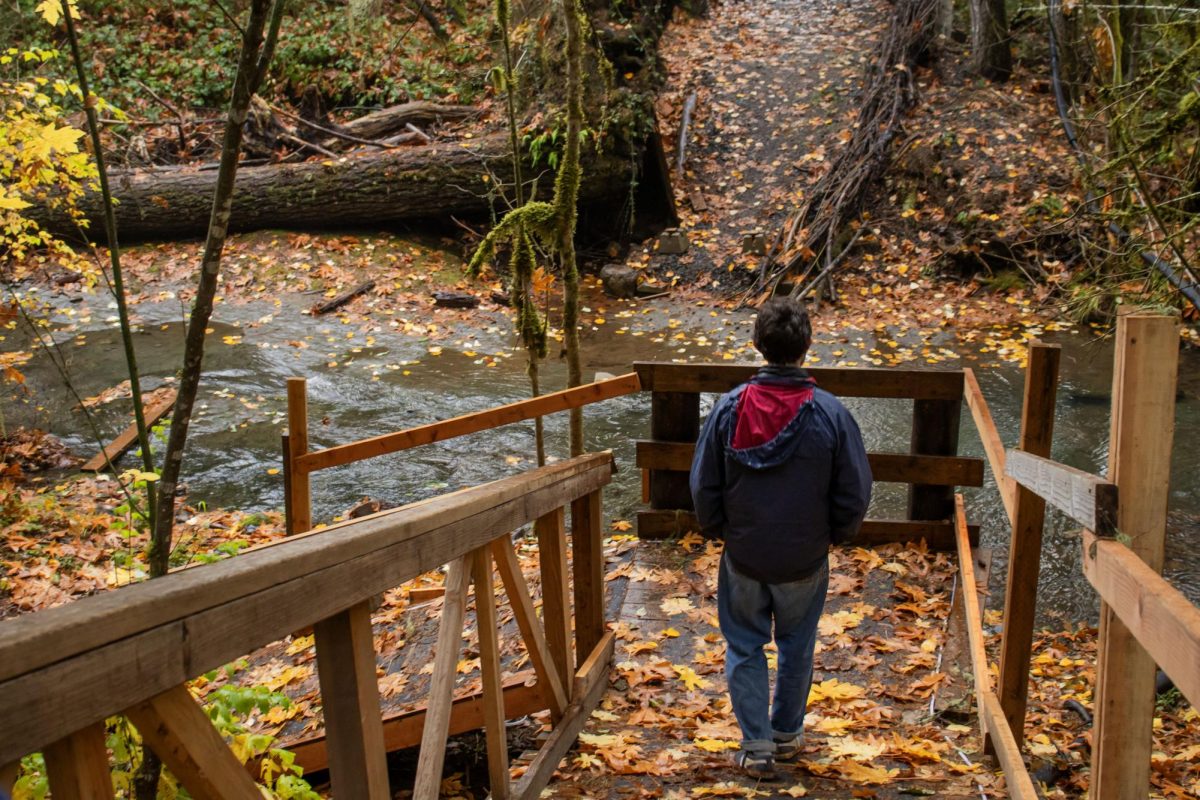
Tucked into the misty foothills of Oregon’s Willamette Valley, Lost Valley Education Center sits quietly amid a landscape of towering evergreens and rolling fields. Up the hill, a small campus of modest classrooms blends into the forest, surrounded by trails where lessons in permaculture and regenerative living take root.
Down below, wooden cabins are scattered along winding paths, their moss covered windowpanes catching the soft glow of evening light. A yurt glows warmly in the dusk, and the communal kitchen buzzes with the sounds of dinner preparation. Vans and tiny homes are scattered across the campus alongside garden plots and signs pointing to basketball courts and tree-laden river posts. Solar panels catch the afternoon sun in a field that edges into thick woods, while a nearby cob-made sauna sends gentle steam into the cool air.
This collection of spaces forms Meadowsong, a 36-year-old intentional community where homes and shared areas cluster together, bound by narrow paths and a shared purpose. Residents range from young families and recent University of Oregon graduates to long-term members, all drawn to cooperative living, shared resources and ecological ideals. But sustaining that vision over decades requires more than good intentions.
Practical challenges of intentional living
Lost Valley emphasizes ecological sustainability through conservation, permaculture and cooperative living. Its programs, from
Permaculture Design Certificates to youth-focused environmental education, offer immersive experiences in harmony with nature. At dinner, potatoes are piled into a huge oven, a woman wrangles the hens and residents stroll about, catching up as the sun sets.
Lost Valley depends heavily on tuition, grants and volunteer labor. Infrastructure maintenance, land ownership and programming demand steady income and manpower. This is where idealism and pragmatism collide: the desire to offer accessible, community-centered education often conflicts with the financial and logistical realities of keeping the place running.
Financially, tuition and program fees account for over 70% of Lost Valley’s revenue. The organization uses a tiered pricing system to promote accessibility, yet it continually struggles to balance inclusivity with financial sustainability. Only 18 individuals are responsible for maintaining a compound that serves about 50 residents.
Of these 18, 12 are paid staff members earning between $12 and $20 per hour. The remaining six are unpaid interns who work 20 hours per week in exchange for room and board.
Questions about sustainability at Meadowsong depend largely on how one defines the term. Approximately 20% of the food consumed at Meadowsong is grown on-site, while the rest is purchased in bulk. Kelson Gorman, Lost Valley’s garden manager, emphasizes food sovereignty as central to true sustainability: “Ideally, you’re providing for the community while also building relationships with surrounding farms. That’s the whole system’s picture of what it actually takes to
have true sovereignty and resilience.”
Community labor presents another challenge. Most residents work outside jobs and cannot contribute to the maintenance of shared spaces, while others take on tasks and committee roles with little coordination or oversight. As a result, much of the day-to-day work falls on the 18 staff members who keep the community running.
Work at meadowsong
The community survives through a patchwork of resourcefulness and trust: salvaged lumber becomes benches, a fallen tree becomes firewood, and, on one memorable occasion, a roadkill deer was turned into meat, jerky, broth and drum skins.
There is a thin line between collaboration and exhaustion, idealism and the unrelenting demands of shared survival.
Bodhi Sellers, a recent UO graduate completing a three-month administrative internship, spoke candidly about this invisible pressure:
“There’s this common theme here where I feel we are putting the pressure on ourselves. I’ll be working on a project and my hours are up, but I feel like I need to keep going, for the community.”
For many interns, that sense of obligation is both the glue that holds the place together and the weight that makes it hard to breathe. Interns join supervised work parties, typically three hours long and four days a week, filled with tasks like gardening, repairs, controlled burns and communal upkeep. Participants are encouraged to follow their curiosities. But in a place where “free time” often translates to “more work to be done,” balance remains elusive.
Glen Carlberg, the internship coordinator and a two-year resident of Meadowsong, has watched this dynamic play out time and time again: “Most of the interns have expressed that they don’t feel like they have enough time, in any given week, to do all the things they want to do here.”
Carlberg sees the internship as more than labor, but as a social and spiritual experiment that demands humility and adaptability. “There’s a different set of skills needed to successfully integrate into any community of place,” he said. The program’s orientation week, weekly meetings and educational offerings are structured to help interns develop a clearer understanding of themselves, creating a foundation for deeper personal and professional growth. “They can form stronger, more grounded connections with others and with the more-than- human world in which we live.”
Even with these supports, the tension between freedom and structure persists. Some struggle to reconcile the dream of intentional living with the reality of uneven effort and emotional strain. Former resident Erica Dallman captured this contradiction with sharp honesty.
“I participated and worked. And when some people didn’t do either, it was frustrating. People would get really excited and get really involved in structures or community meetings, and then they’d get burnt out and stop.”
For all its beauty and intention, life at Meadowsong asks a simple but relentless question: how sustainable can community be when the cost is carried unevenly?
Expectations and reality
Joining Meadowsong is not as simple as moving in; it’s a gradual process meant to test both compatibility and commitment. Prospective residents go through a provisional interview, followed three months later by another conversation to assess whether they want to stay. A year after that, a final check-in asks a more personal question: not whether someone met a community standard, but whether they lived up to their own word. As Carlberg explained, the goal is less about judgment and more about honesty: did residents show up in the way they said they would?
To support this culture of accountability, Meadowsong shared a document known as the Community Living Agreements, a living framework for how people coexist. Based on lessons learned from decades of intentional communities before them, the CLAs blend insights from self-help, spiritual and ecological traditions into a code of cooperation.
Carlberg acknowledged that people inevitably fall short of these ideals. “People are messy,” he said. “They’re going to mess up. What matters is whether they’re honest about it, whether they can say, ‘Yes, I broke an agreement, and here’s why.’”
Within community meetings, residents can raise concerns when someone’s actions violate the agreements, not as punishment, but as a chance for reflection and repair.
Mediation without a map
Conflict resolution at Meadowsong, like in many intentional communities, draws inspiration from past experiments in communal living. It borrowed tools from mediation and self-help traditions, but without the structure or credentials to support them. “It’s difficult because I believe in community structures,” Dallman said. “But no one there had psychology degrees or conflict-resolution training.”
In practice, neighbors often step into the role of mediator simply because they feel intuitively equipped, even when their good intentions accidentally escalate tensions. The process relies less on established methods and more on the community’s collective instinct or, as Dallman put it, “on vibes.”
For all its aspirations of harmony, Meadowsong reveals how difficult intentional living can be. It takes far more than good intentions to sustain a shared vision; it takes communication, accountability and willingness to confront what the community truly demands of its people.
Idealism under review
Voices within the broader sustainability and intentional community movement have grown increasingly self-critical, sparking vital conversations about economic inequality, reliance on volunteer labor and accessibility. This introspection is not isolated to individual ecovillages like Meadowsong but resonates on a global scale. The Global Ecovillage Network, an international coalition connecting ecovillages worldwide, explicitly acknowledges these systemic challenges.
In its 2023 Annual Report, GEN Europe calls for ongoing self-reflection and evolution in governance and economic models to better address issues of equity and sustainability. The network emphasizes that communities must adapt their structures to become more inclusive, recognizing that idealism alone cannot replace pragmatic reforms.
Critiques on community
At its best, Meadowsong is envisioned as a space for experimentation, a “window” into new ways of relating to each other and to the Earth, as Gorman described: “But at this moment, it is keeping this alive, to try and see a different way of us all relating to each other, as human beings to each other, and to the earth.”
Carlberg framed Lost Valley as part of a broader societal transition: “From one way of living and relating to each other, into a different way of living and relating to each other.” Still, social challenges emerged in everyday interactions.
A utopian paradox
For outsiders, Lost Valley might appear as a picturesque refuge from the outside world, a quiet enclave of ecological ideals. For those
living there, it is a constant negotiation; a place where potatoes are baked, chickens are herded and conflicts must be navigated with patience, empathy, and, sometimes, blunt honesty. Its successes are measured not just in harvests or workshops, but in the resilience, reflection and learning its members cultivate along the way.
The paradox is clear: the very qualities that make Meadowsong inspiring — its openness, its commitment to shared responsibility and its willingness to experiment — are the same qualities that create tension, conflict and occasional disillusionment. These communities are less about achieving perfection and more about engaging deeply with the process of living deliberately:
“Almost every interaction is based on our individual needs. In one way, shape or form. So, if you’re being intentional and transparent about those needs, you’re far more likely to co-create some sort of beneficial connection.” Carlberg said.




M • Dec 2, 2025 at 7:46 pm
I really appreciated, this article, it clearly articulated the beauty and troubles of Lost Valley. I’m a former administrator for LV and saw how the very structures that maintain order also create insecurity, inequity and burn people out.
I will say, one of the things that was not as thoroughly addressed is the social culture which arises from consensus decision making – it creates a sort cult of thought and stagnant decision making.
Particularly as it related to membership decisions – they were slow to remove problematic members and it would in turn cause an large exodus.
It struggles to retain talent, although I still wish them well. At least they are trying to do something incredible.