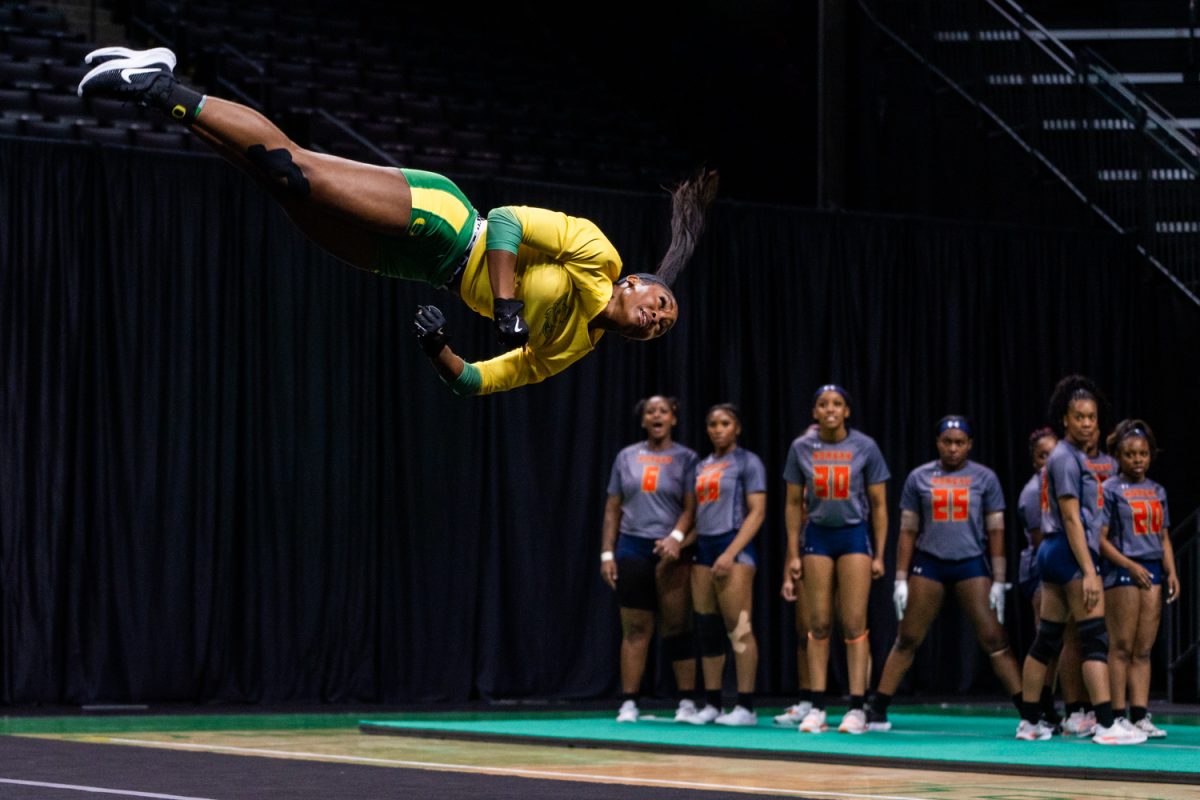
Morgan State watches as Morgan Willingham (30) flips through the air. The University of Oregon Ducks Women’s Acrobatics and Tumbling team in a home match against Morgan State at Matthew Knight Arena in Eugene, Ore., on Feb. 15, 2025. (Rowan Campbell/Emerald).
AZUSA, Calif. — Under head coach Taylor Susnara, Oregon’s acrobatics and tumbling program has been defined by her former event: tumbling. The Ducks have risen to regular top-two status on the back of a near-unmatched fifth event which develops and features solo tumblers year after year.
As No. 2 Oregon chases an NCATA national title in 2026, it’ll have to achieve a pair of lofty goals to get there: turn a top-two tumbling event into the top one, and do it while stabilizing the rest of its heats. There’s five athletes who’ll be key to those efforts, and The Daily Emerald breaks down why:
Blessyn McMorris (22), graduate student base
McMorris, a multi-time NCATA Athlete of the Week, multi-time 2026 NCATA Specialist of the Week, 2022 Freshman of the Year, 2025 All-American and 2025 open pyramid event national champion, has the credentials to back up whatever she’s going to do. For Oregon, that’s usually bridging its most important heats.
The fifth-year base is Oregon’s most experienced athlete, and it shows. She’s the base for the open pyramid heat that won a national title last season in South Dakota and has continued to impress in 2026. She’s scattered across the rest of Oregon’s events, and will continue to anchor the Ducks’ pyramids.
Morgan Willingham (30), sophomore top/tumbler
Willingham, a national event finals qualifier in both the duo and six-element passes last season, has emerged as a star for the Ducks in 2026. Alongside fellow sophomores Briya Alvarado and Carly Garcia for much of the season, Willingham scored a season-high 9.925 in her six-element pass in the Ducks’ March 6 meet against its opponent on Thursday, Gannon University. She’s unshakeable, near-perfect and one of the strongest parts of Oregon’s fifth event. If Oregon is to challenge for a national championship, it’ll need its tumblers to turn in near-perfect performances on short rest, and Willingham has led the pack in 2026.
Cassidy Cu (19), sophomore top; Angelica Martin (59), sophomore base
These two, of course, come as a package deal. Despite Oregon’s struggles in six-element acro this season, there’s been little instability in the two heats that sandwich the synchronized outing. Cu and Martin, who debuted as freshmen in the five-element heat a year ago and brought it to the national stage in South Dakota, have been rock-solid with a modified version of that heat while taking their slide-to-split into the seven-element slot with aplomb.
Both have taken home recognition from the NCATA already this season — Martin for Specialist of the Week on March 18 and Cu for an honorable mention in the same category on Feb. 25 and — and are the strongest part of the Ducks’ first two events. When Oregon needs to set the tone early, this is who they turn to.
Maya Khauv (40), sophomore top
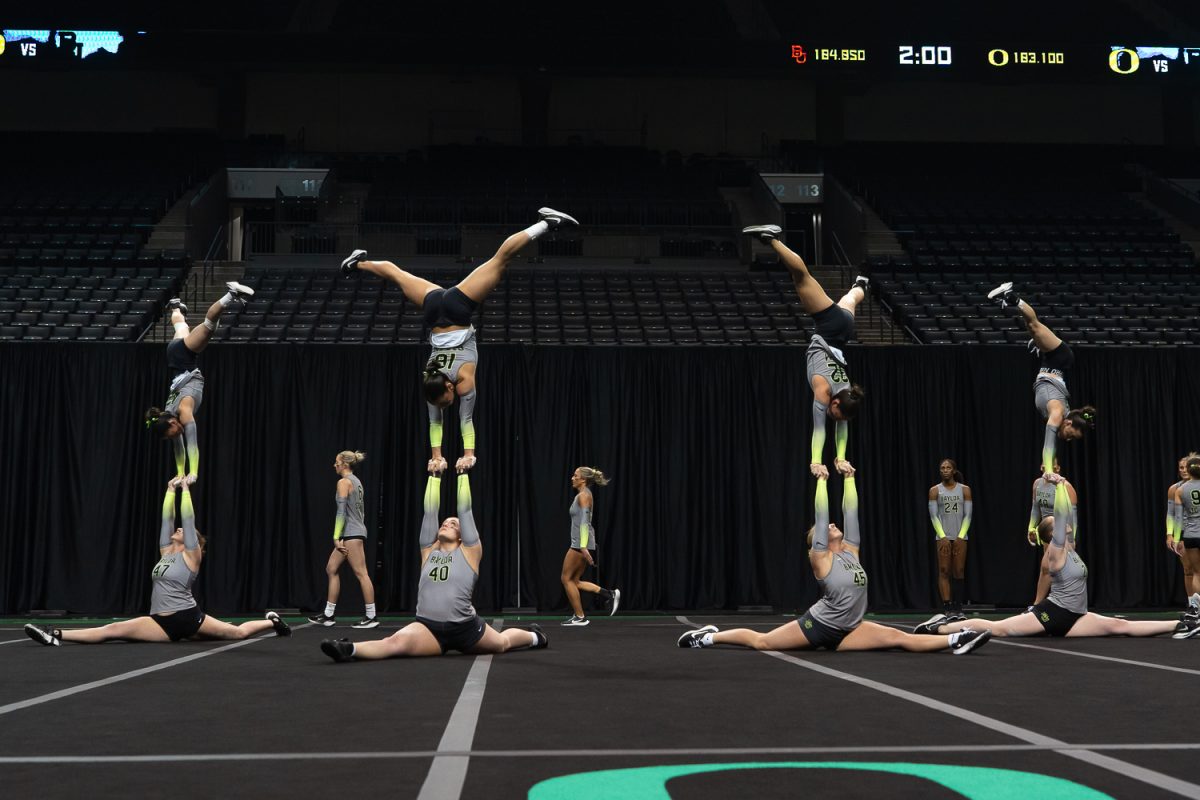
Khauv, a second-year athlete who didn’t compete in 2025, was who the Ducks turned to when they needed a shakeup after the heat scored sub-8.000 in both its first two outings. Oregon head coach Taylor Susnara put Khauv into the heat ahead of the Ducks’ first matchup with No. 1 Baylor University and was rewarded with a 9.000.
It hasn’t all been perfect, as the heat has wavered since then, but Susnara was pleased with Khauv’s work — and it’ll be crucial that she steps up if the Ducks are to go a meet without having to overcome a second-event struggle. Oregon has expanded its available tops this year, adding sophomore Briya Alvarado as an option and widening Cu’s range, but Khauv, alongside Mari Fukutomi, Selah Bell, Kamryn Horiuchi, Avery Dodd and Logan Davis, should play a major role.
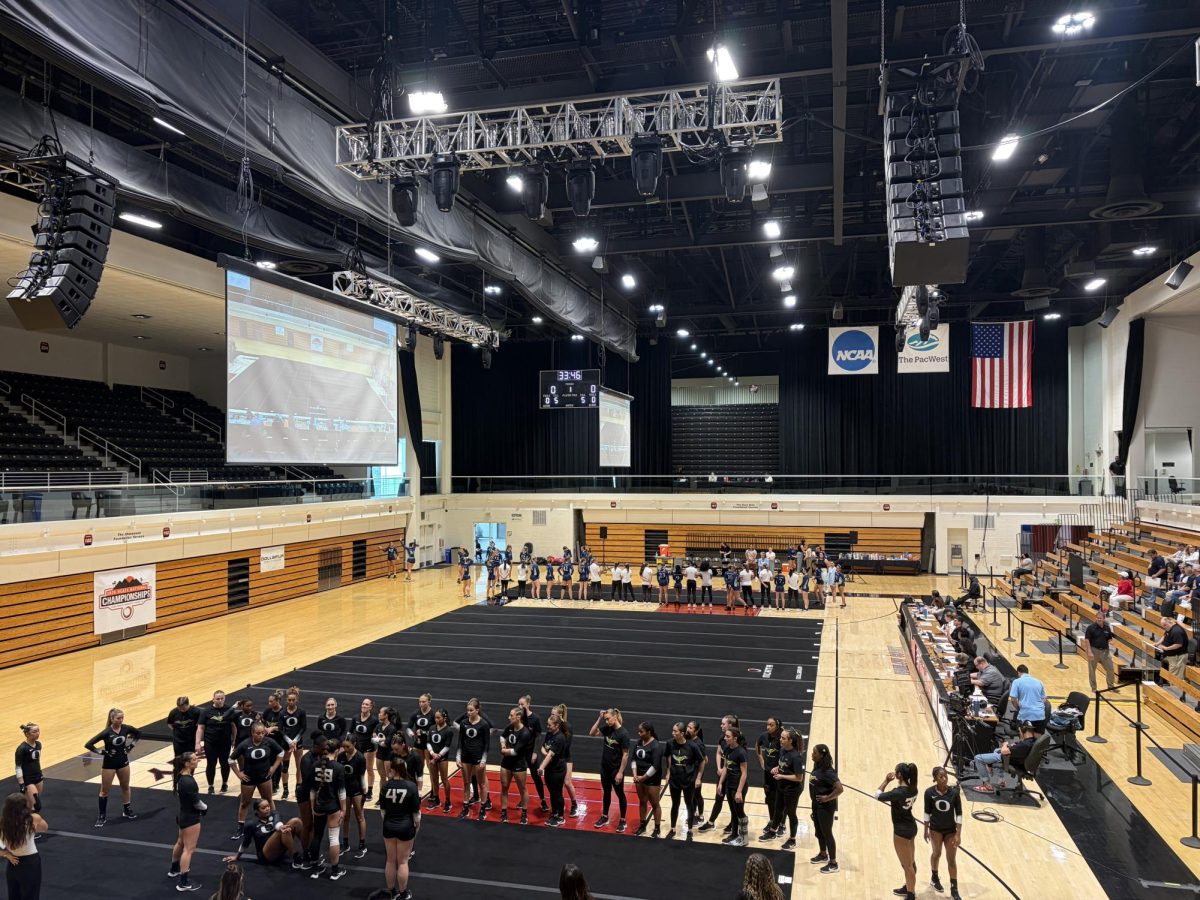
Oregon faces No. 7 Gannon, its quarterfinal opponent, on April 23 in Azusa, Calif. The meet is scheduled for 1:30 p.m.







![Oregon third baseman Drew Smith (17) talks to pitcher Will Sanford (28) during the first inning. On April 24, 2026, The Oregon Ducks defeated the Penn State Nittany Lions [5-4], at PK Park, at University of Oregon, Based in Eugene, Ore. (Fred Hall/Emerald)](https://dailyemerald.com/wp-content/uploads/2026/04/2026.4.24.EMG_.FJH_.BaseballVsPennSt-4-1200x800.jpg)