
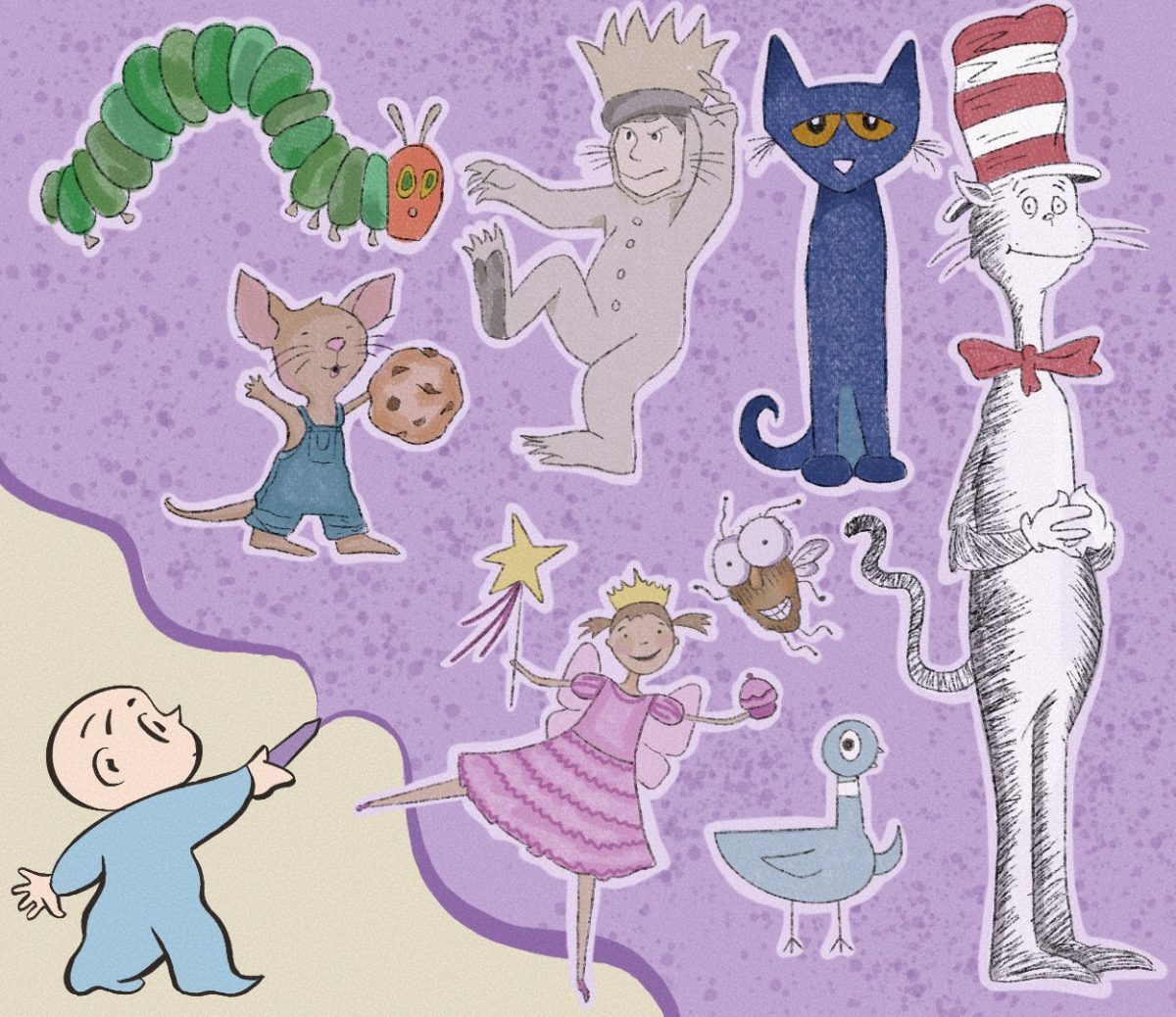
Children’s Book Week, the longest-running nationwide literacy initiative, was held earlier this month. The program has celebrated children’s books and the joy of reading since 1919, inviting schools, libraries and booksellers to encourage high standards for children’s books, and a love of reading among young people — an invitation wholeheartedly accepted by the Eugene Public Library, even beyond the initiative’s celebration window.
This year’s CBW theme was “Books: Get Curious.”
“We are living in a time where there is a segment of the population that is trying to curtail that curiosity with book banning and unnecessary restrictions,” Grace Lin, the illustrator of this year’s CBW poster, said. “Right now, curiosity, with all its joy and wonder, needs protection.”
A way to protect curiosity is to foster it, and what better way to foster curiosity than to encourage reading?
Linda Ague, president of the Friends of Eugene Public Library and former librarian at Cal Young Middle School, said reading needs to be introduced to young people, as opposed to miraculously stumbled upon. Ague grew up in a town outside Pittsburgh with no public library and parents who refrained from reading to her, so Ague’s school was critical to her discovery of reading.
“Just having books lined up on the shelf with the spines out is not a particularly attractive way to get kids involved in books. Somebody needs to be mentioning them, talking,” Ague said.
Ague recalled her library as a perpetual mess, if only to encourage children to pick up one of the many books ever-scattered across tables.
UO student Rachel Wallace credits her mother and programs such as Oregon Battle of the Books with fostering a fondness for, and curiosity about, books which has allowed her to experience reading as a source of joy and escapism. Wallace admitted that she has been spending time in the children’s section of bookstores, reminiscing on her younger years with books.
“(My mom) used to take me to read-alongs at the library, both my brother and I, just as something to do, but also she wanted us to use the library from a young age. And that I still use it constantly today, so definitely had an impact,” Wallace said.
With an introduction to the literary world and subsequent support that caters to children’s interests, kids can become literate and develop a sense of confidence that translates into other aspects of their lives.
“Having an opportunity to add to your base of understanding of language is critical, and then it will generalize. Confidence in reading, confidence in — you know, if you believe that you’re reading something, and you understand it, and that you know you can (understand it), then you’re not afraid to try things you don’t understand. Reading will give you that understanding,” Ague said.
According to UNESCO, literacy is part of the human right to education and expands capabilities that lead to poverty reduction, greater participation in the job market and positive health effects.
The EPL supports kids throughout their literacy journey in hosting storytimes, providing online resources such as Libby and maintaining Dolly Parton’s Imagination Library, a program that mails a book each month to children, from birth to age five.
Despite EPL’s best efforts to provide equitable services, literacy opportunities such as storytimes can prove inaccessible for reasons beyond the relatively far location of a library or the lack of a stay-at-home caregiver. “Some families just don’t have that advantage,” Ague said.
“There’s a huge consequence to being a non-reader at the end of third grade. There’s a giant catch-up piece that you have to do if you want to get to be part of the world that those people that read fluently in the third grade will engage in,” Ague said. “It’s just a huge difference and we know it.”
In an effort to maintain current literacy initiatives amid inflation rates and millions of dollars in budget cuts, the EPL and its counterparts are advocating for the passing of a levy, which will be voted on today. The levy also seeks to introduce a position dedicated to children’s outreach and to expand “Storytimes to Go” — an initiative that allows librarians to host read-alongs at various locations far from EPL’s library branches such as child care centers, parks and schools.
The vote will determine the future of children’s reading programs in Eugene, namely the extent to which they are accessible.
“Our concern is there’s a lot of library love in the city of Eugene, but the people in Eugene don’t vote; and it doesn’t help to love the library if you don’t vote,” Ague said.
Equitable programs that ensure children are introduced to books and mentored in reading are crucial to the literacy, and therefore the success, of generations.
“The more you read, the more you learn and the better you write,” Wallace said. “The most coveted skill is somebody that can write well, and I think that’s really will distinguish you, especially in the job market now.”
If keeping kids curious and introducing them to books is the first step in setting children up for lifelong personal and professional success, then the next step is advocating for legislation that preserves communities’ abilities to do just that.
“We need to be a nation of readers,” Ague said. “That would make a huge difference in the way we dealt with each other, and with the government and, you know, with our lives.”
Click here to learn more about how you can vote today to support the future of Eugene’s young readers.


