Oregon’s economy is losing momentum just as new U.S. import tariffs drive up business costs, reducing profit margins and increasing consumer prices already strained by inflation.
State economists say Oregon is trailing the nation in growth, and that job losses are mounting across several industries. The state in July had nearly 25,000 fewer jobs than it did a year ago.
“This is economically unprecedented territory,” Oregon Chief Economist Carl Riccadonna said.
Tariffs at historic highs
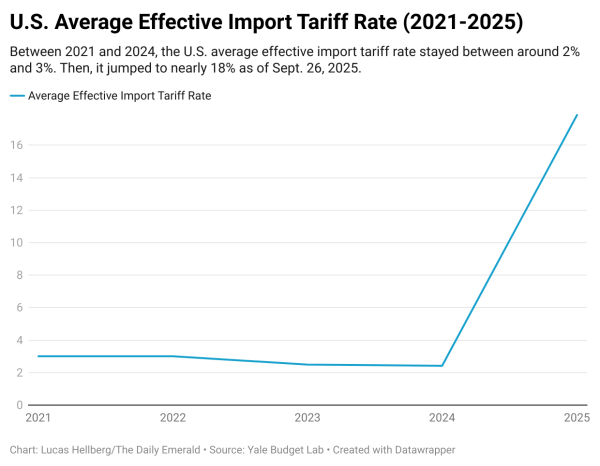
The Trump administration has increased import tariffs through executive action this year, raising prices of imported products like bicycles and wine. The average effective U.S. import tariff rate has risen to its highest level since 1934, reaching 17.9% as of Sept. 26, according to the Yale Budget Lab.
Tariffs are “a tax increase of sorts,” Riccadonna said, adding that tariffs can be paid, in whole or part, by importers, companies and consumers.
Bicycle Way of Life, which has two locations in Eugene, is seeing the new tariffs show up in nearly everything it sells.
BWOL Partner Owner Jeff Reynolds can only name three U.S.-made products in his stores. He said the rest, about 98%, is imported. But he said his suppliers are “definitely” paying some of the tariffs. He also noted that he is buying some items at a bulk discount to reduce tariff price increases.
Reynolds said price increases have varied in recent months, with cheaper bikes for kids remaining stable and more expensive bikes increasing.
“If a kid’s bike that’s $300 goes up 20%, that’s not really an affordable kid’s bike anymore,” Reynolds said. “But if a $14,000 bike that only a few people buy goes up 20%, that person will probably still buy that bike.”
For Reynolds, the new tariffs have added strain to an already tight margin industry.
“It’s so hard for us to raise the price,” Reynolds said. “In the bike industry, we typically have about a 30% profit margin.”
Other industries feel tariff strain
As Oregon’s economy continues to lag behind the nation, Lane County businesses say rising costs and economic uncertainty are slowing growth.
“Uncertainty is just bad for business,” Steve Baker, the owner of Authentica Wines in downtown Eugene, said. “People don’t feel good when they don’t know what’s coming next. They don’t feel like spending money.”
Baker said about 90% of his wine inventory is imported. He said many importers initially tried to absorb the tariffs by splitting them with the foreign suppliers they buy from. But he said tariffs are now being passed on to him because they can no longer absorb the increased expenses.
He said some imported bottles now cost nearly 20% more. He also noted that even domestic wines have become more expensive as the cost of imported wine rises.
Some people think that tariffs are “really going to help American wine,” Baker said. “It really isn’t doing that. I have seen price increases on domestic wines … (because) people think they can get more now.”
Despite higher wine prices, Baker said his business has stayed “very steady” thanks to buying before the higher tariffs took effect and loyal consumers.
In Springfield, similar pressures are rippling through many businesses.
Vonnie Mikkelsen, president and CEO of the Springfield Area Chamber of Commerce, said nearly 70% of local businesses identified rising costs as their top concern in a recent chamber survey, surpassing workforce issues. She said that’s a first since the chamber started the survey three years ago.
Inflation has been “pretty sticky,” Mikkelsen said, adding that the new tariffs and higher labor costs are also raising costs for local businesses.
Mikkelsen said local businesses are taking a range of steps to manage rising costs, including scaling back hiring, delaying new investments and even raising prices for consumers. However, she said many locally owned businesses with thin margins are not able to pass on higher costs to consumers because consumer demand and discretionary spending are in a “pinch.”
Brittany Quick-Warner, president and CEO of the Eugene Area Chamber of Commerce, echoed a similar sentiment, saying many of her members are also delaying new investments and scaling back hiring.
While many businesses are tightening their budgets, Mikkelsen said wood products manufacturing is a bright spot. She said about $500 million in industry investment is planned over the next three to five years in the Eugene-Springfield area.
Sierra Pacific, which has two sawmills in Lane County and is one of the largest lumber manufacturers in the country, declined to comment on this story.
Forest Economic Advisors Principal Paul Jannke said the new tariffs have not yet impacted production costs for Oregon sawmills. He said earlier tariffs and duties have significantly improved the competitive position of Oregon sawmills, and that the latest tariffs are likely to further enhance that advantage.
But for manufacturers that rely heavily on imports, the opposite is true.
Amber Patterson is the chief financial officer of Burley Design, a Eugene-based bike trailer company. She said Burley, which currently manufactures all of its trailers overseas, has managed to avoid price increases on most products so far, thanks in part to suppliers absorbing some tariffs. However, she said tariffs have forced the company to raise the prices of some lower-volume products that typically cost more because there isn’t enough volume to absorb the new tariffs.
“There’s just only so much you can raise your prices before you price out all of your customers,” Patterson said.
At the same time, Patterson said the company is not filling most positions when people leave, forcing it to put its plans to invest more in technology and marketing on hold.
Despite the pressure from the tariffs, Patterson said the company is committed to keeping its entry-level trailers affordable for families.
Columbia Industrial Products, a Eugene-based company that manufactures composite bearing materials and exports its products, declined to comment on this story.
Looking Ahead
Lane County businesses are trimming expenses, delaying new projects and holding off on hiring as they wait for clearer economic signals.
As Quick-Warner put it, “One of the hardest parts of doing business is the uncertainty, which drives business costs more than anything else.”