
I stopped using Amazon Prime over a year ago, despite its often-celebrated convenience. My choice to boycott the company was rooted in its ethical and environmental issues. This is why Eugene’s planned Amazon mega-warehouse is deeply concerning to me.
Amazon initially denied its intent to build the e-commerce center in Eugene in early 2025, but the company paid $2 million on Dec. 26, 2025, for a lot on Highway 99. Locals have voiced a range of concerns about the facility.
Stan Taylor is a co-leader of the advocacy group Indivisible Eugene Springfield and a former instructor of political science at Lane Community College.
Taylor pointed out the flawed argument that the warehouse would bring in money to solve Eugene’s financial crisis. “It’s not enough to solve the city’s problems, and it’s certainly not enough to sell your soul for,” he said.
While some argue that the warehouse has the potential to create openings in Eugene’s job market, Amazon has also shared its plan to replace the majority of its workers with robots and AI technology. The New York Times wrote, “documents show that Amazon’s robotics team has an ultimate goal to automate 75% of its operations.”
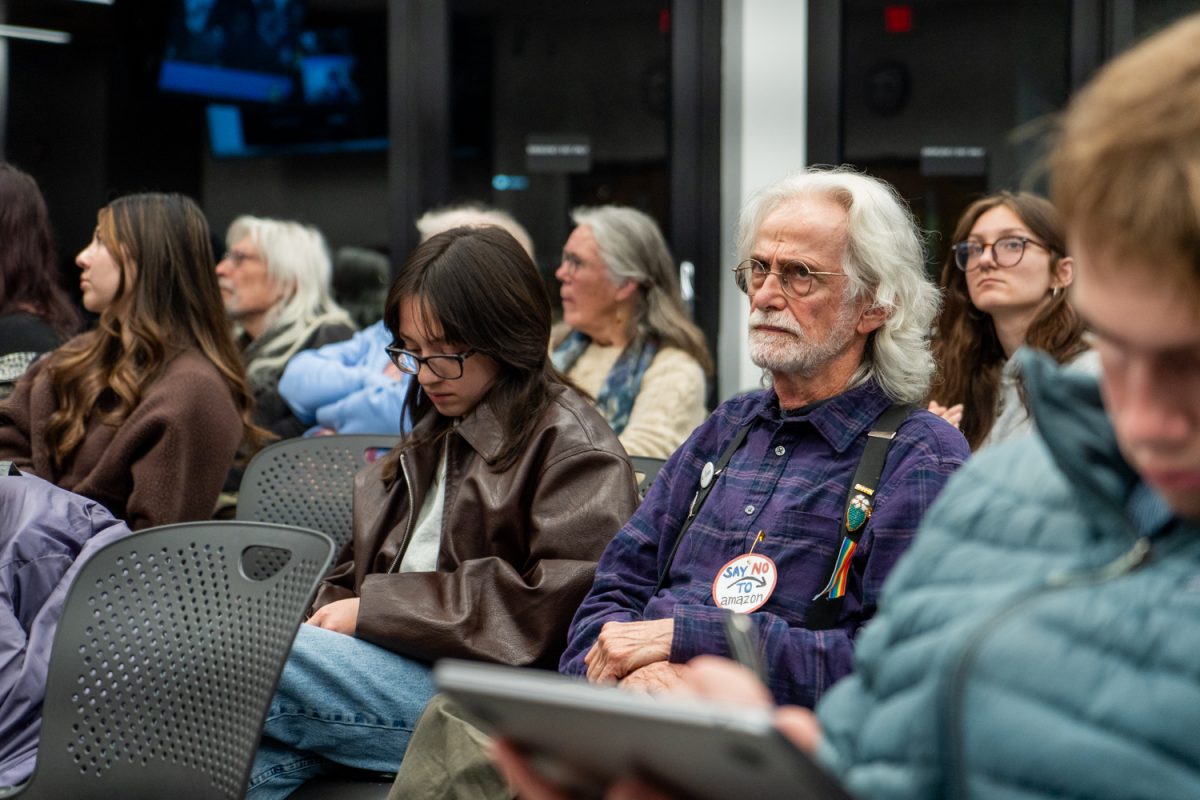
The advocacy group also formed “Say No to Amazon,” a collective looking to stop the implementation of the warehouse. At the Eugene City Council meeting on Jan. 26, members showed up wearing matching shirts and pins, with speeches in hand for the public comment portion of the meeting.
The group handed out a six-page packet filled with sources detailing Amazon’s connection with ICE and aiding deportations, the company’s historical anti-union stance, its poor working conditions, its poor climate record and history of tax evasion.
Taylor also shared his deep concern for members of the Bethel and Santa Clara community who neighbor the purchased land. He said that no one from the city had informed them of Amazon’s intent and purchase.
“How hard would it have been for the city to reach out to the two closest neighborhood associations and let them know so that you could actually get real feedback?” Taylor said.
While economics and labor practices both raise serious questions, the environmental impacts remain one of the most critical reasons residents oppose the warehouse.
Victoria Acosta, an 18-year-old Eugene local, also spoke at the Jan. 26 Eugene City Council meeting to share her desire to see action taken by the city.
Acosta cited her concerns for Eugene’s wetlands, which will face the brunt of the damage with the implementation of the mega-warehouse.
The facility will be located on what was protected farmland until 2017 and will impact 9 acres of wetland, which the Willamette Valley has already lost 57% of. The project will permanently alter the wetlands, removing soil and infill.
“The wetlands are also flood protection, so if we get rid of this, what happens when we have heavy rain? We’re on the border of a climate disaster, and they’re not doing enough about it,” Acosta said.
Acosta also shared her view on the display of hypocrisy from the Eugene City Council for starting its meetings with a land acknowledgement while simultaneously harming the local land by allowing this project to take place.
The facility requires a pollution permit as “2,592 daily vehicle trips (are) projected to move in and out of the facility,” according to LookOut Eugene-Springfield. It’s clear that the environmental impacts will be wide-reaching.
It seems that city officials are unwilling to reconsider the facility despite the vast and deeply profound public concerns. As the project moves forward, it’s important that locals continue to voice their concern and find alternative retailers.


