Getting off the ground is one of the most difficult things to do. Whether it includes delving into a new hobby, learning an unfamiliar skill or simply starting an essay, beginnings are formidable. Motivation is what stimulates action; it encourages us to finally take that leap.
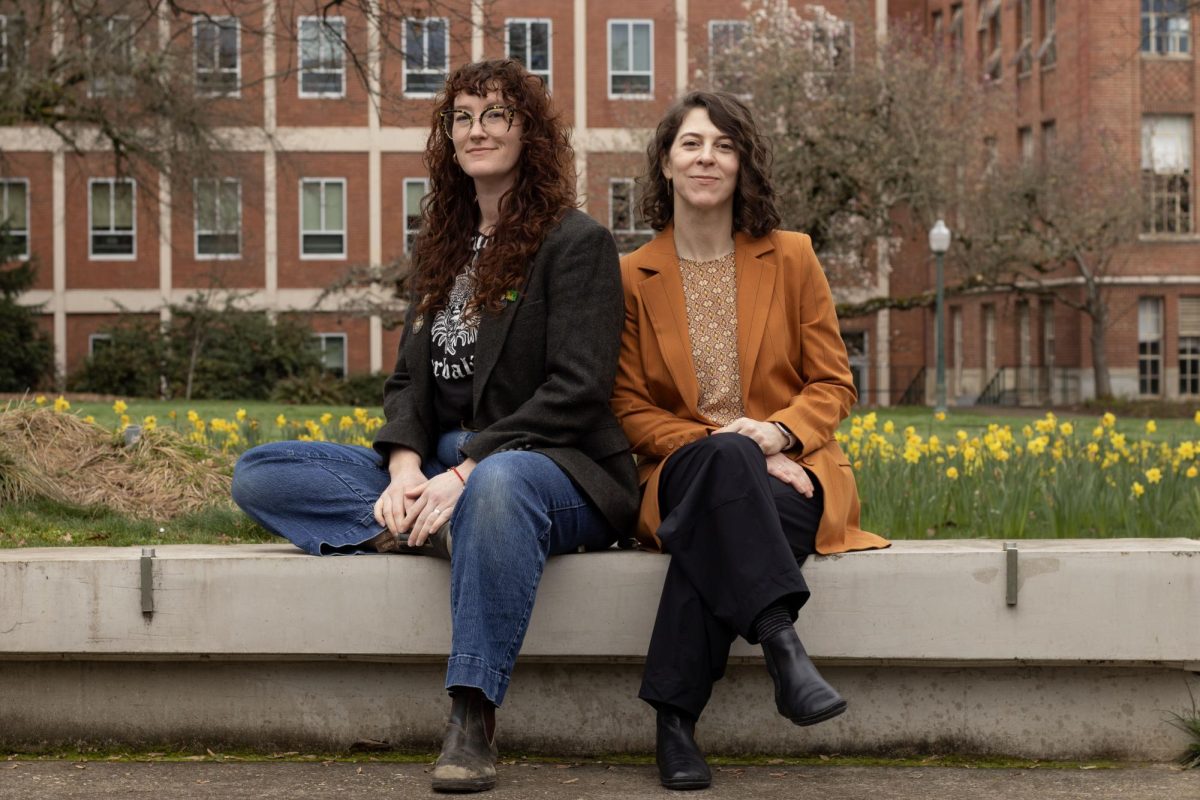
University of Oregon juniors Cassia Williams and Dori Vaughan share this necessary motivation. They are co-founders of Student Pole Collective, a space created to teach students pole dancing basics. The collective is aimed at fostering community and a safe environment for students to build confidence in their bodies, and challenge stigma surrounding the sport. Williams and Vaughan have high hopes for this collective, but they’ve struggled to get it off the ground.
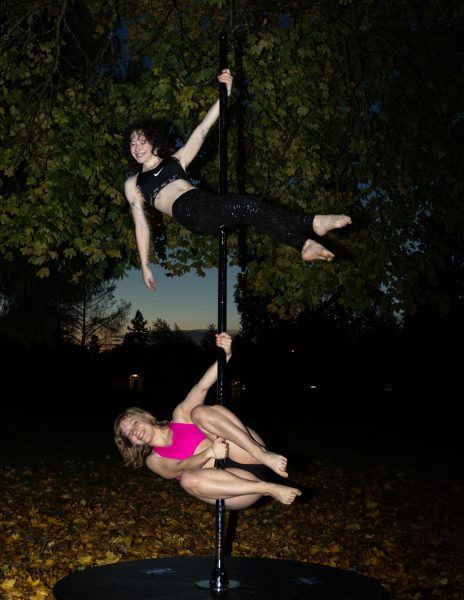
Pole dancing – referred to simply as “pole” by those who practice it – is often identified in relation to stripping and erotic performances. Notwithstanding, the twenty- first century has seen a massive expansion in pole applications. According to the International Pole & Aerial Sports Federation, the turn of the century marked a shift in the popularity of pole fitness and competitions. In 2006 pole dancing became associated with the sports world, and in 2009 the IPASF was born. Today, pole is used for exercise, artistic expression and competition. Williams is a member of the U.S. Pole Sports Federation and is training to compete in national qualifiers for the U.S. Aerial Federation. Williams started doing pole both competitively and recreationally in high school, as a substitute for their previous athletic activities, like soccer.
“Once I was in high school, I realized that I was trans non-binary,” Williams said. After this realization, they felt many of their sports teams weren’t the right “fit” anymore, because “sports in general are so inherently gendered.” Pole, which is more gender inclusive, became a better space for Williams to challenge themself athletically.
Unlike Williams, Vaughan’s journey to Student Pole Collective did not begin with pole, but rather aerial silks and lyra – also called aerial hoop. Vaughan was originally drawn to aerial sports because they gave her a new mechanism to explore dance and movement.
“For me, dance has always been something inaccessible because of some combination of poor hand-eye coordination or body awareness,” Vaughan said.
With something tangible to hold onto, she found she could participate in dance and perform physically in ways she previously thought were unavailable to her. Already proficient in aerial sports, pole was both a new challenge – because it involves more movement on the ground – and a natural progression of aerial athleticism.
“Hoop and silks are siblings, and pole’s like a cousin almost, but they’re all in the same family,” Williams said.
Both Vaughan and William’s personal connections with pole relate to its strength in encouraging expression and empowerment. “When you picture someone pole dancing, you picture somebody attractive, someone seductive, someone very in control and confident,” Vaughan said. In Vaughan’s opinion, this image often inspires people with a desire to feel more self-assured and poised to start pole. Williams strongly believes that this courage in expression is available to all. “Pole dancing is for everybody – doesn’t matter your gender, your body type, anything,” Willliams said.
Williams and Vaughan both attest to the beginner-friendly nature of pole, especially in comparison to lyra or aerial silks. Oftentimes, the two find that people are surprised at what they can accomplish as a beginner. In her work as an instructor at an aerial sports studio, Vaughan has seen this first-hand. “I think it’s exciting to show people what their bodies can do,” she said. Student Pole Collective hopes to make pole even more accessible by helping people begin their pole dancing journey, a first step that can feel daunting. “Getting off the ground is the hardest part,” Williams said.
Upon hearing that Williams participates in pole dancing, they note that many people respond with “I’ve always wanted to try that.” In fact, since Student Pole Collective was announced on Instagram in June, there has been a massive amount of community engagement from UO.
However, even with this interest, the two still must navigate the stigmas that surround pole, much of which comes from its aforementioned association with stripping and sex work.
“We are not here to promote sex work, we are not here to teach people how to be strippers, Williams said. “But we are also not here to say that stripping is bad or that sex work is bad.”
Vaughan emphasizes that the two are prepared to discuss this perception with those who are interested in their collective.
Echoes of pole’s stigmatization have already surfaced in the campus climate since Student Pole Collective’s creation. In July, Student Pole Collective posted a flyer promoting their first event: a “Pole in the Park” gathering at Alton Baker Park. This flyer was later reposted by a popular, unaffiliated, student-run commentary Instagram account – with the caption “Excuse me?
[embarrassed emoji]. ”
The post wasn’t explicitly mean, but Williams and Vaughan felt that it came from a place of misunderstanding about their collective and pole in general. Fortunately for the collective, this post only served to generate more excitement about the new potential club.
As the response to the post illustrates, many people, especially women and queer individuals, have found they can harness pole’s stigmas in ways that contribute to pole dancing’s unique ability to foster bodily liberation.
“As a woman, it’s very easy to feel shameful about things that remind people of sex, even if there is nothing actually connected or of substance within that,” Vaughan said. “To take something that people very much associate with sex and do it in a way that is not about sex, but is about you, is empowering.”
Unfortunately, on Oct. 30, Student Pole Collective announced on their Instagram that they could not move forward with this collective
on campus.
Vaughan explained that many clubs only require a space and people who want to join, but said that bringing in a physical activity makes it a lot more complicated. Due to these constraints, Williams and Vaughan purchased a second-hand portable stage pole for their developing club. While stage poles are much more expensive than the classic tension poles, Williams and Vaughan knew that only a stage pole would allow them to bring this collective on campus. They were willing to make that investment.
According to Williams, the primary reason that Student Pole Collective is no longer a possibility on campus is because of liability concerns from the university. In a risk assessment meeting with the Center for Student Involvement, the two were told they would be completely liable for any injuries club members might sustain while participating. They would also need to purchase insurance and hire a lawyer. These expenses would be on top of the fees to rent a specialized location in the Student Recreation Center.
After careful consideration, Williams and Vaughan decided that there were too many obstacles to continue the collective on campus.
Going forward, they hope to create an accessible and empowering off-campus student community for those interested in pole, perhaps with more “Pole in the Park” events starting in the spring. Williams and Vaughan are still optimistic that pole dance will one day be brought to the university’s campus, they just may not be the ones to do it.
Perhaps, Vaughn said, “It’s something someone could get off the ground someday.”