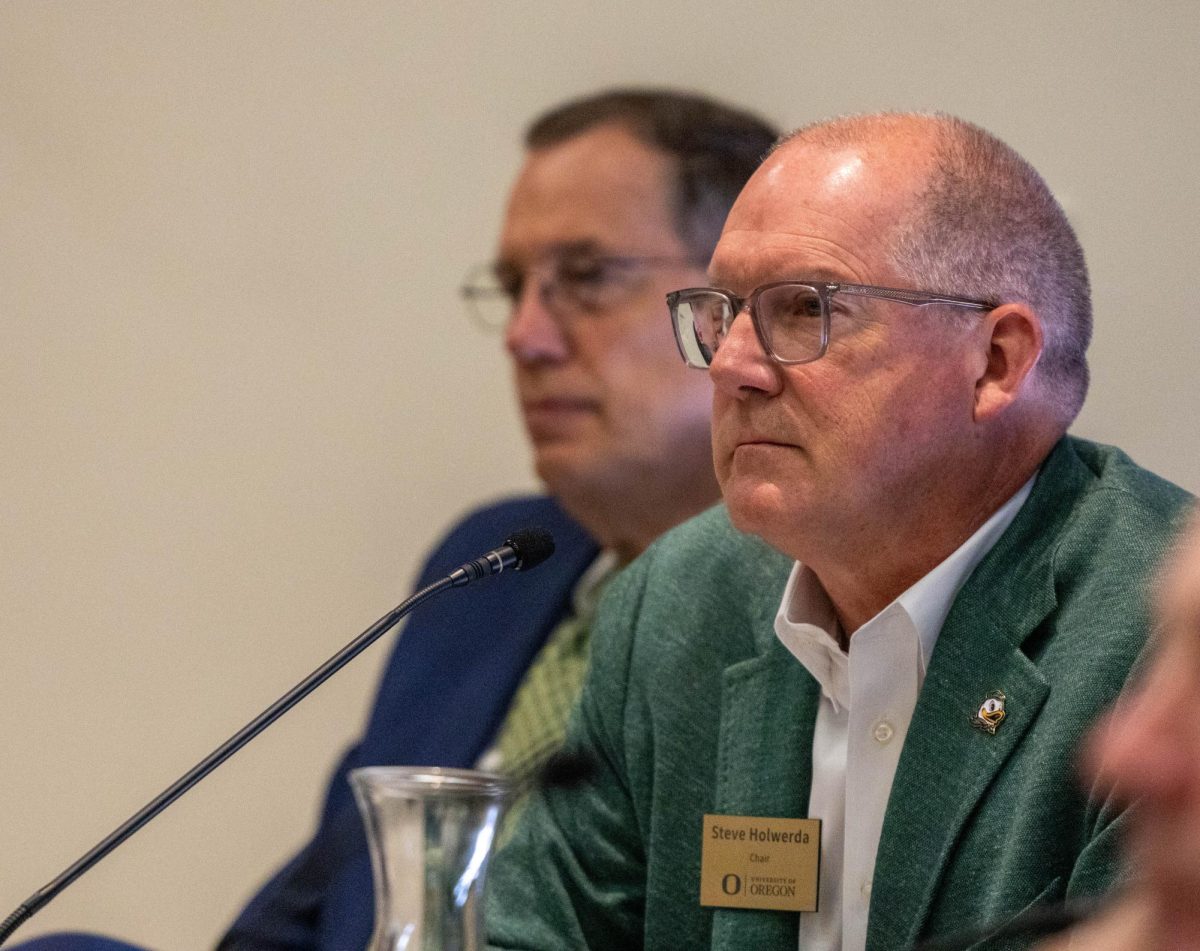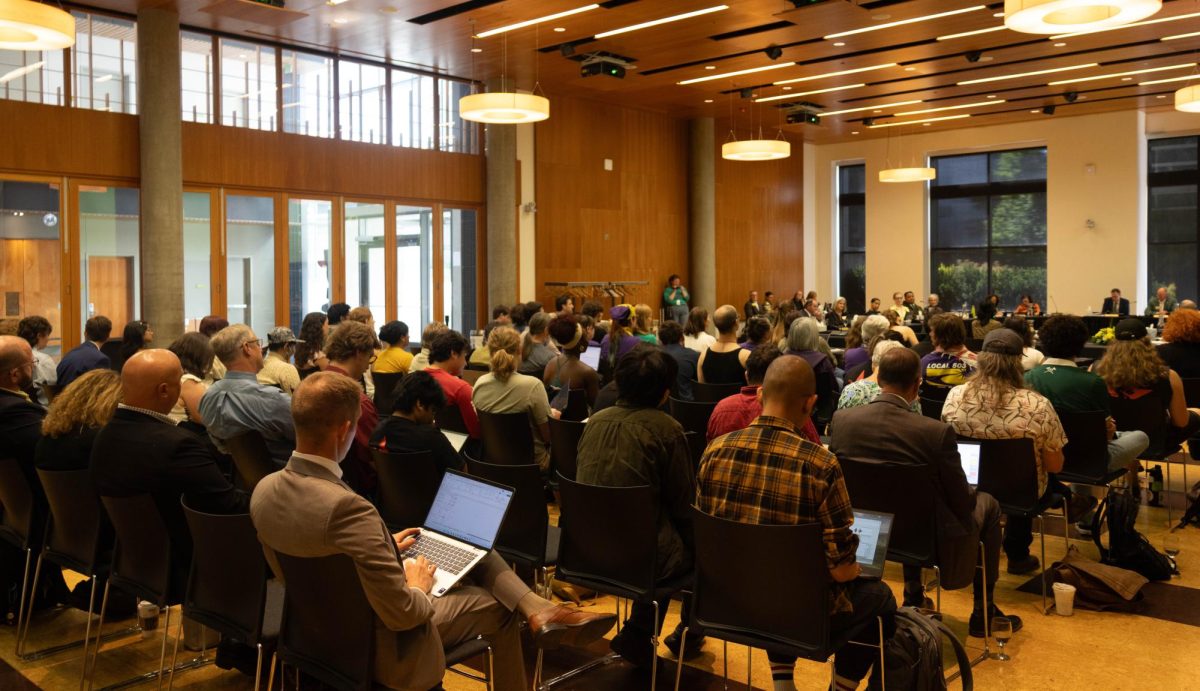
The University of Oregon’s final Board of Trustees meeting for the 2025-26 academic year was held on June 1 and 2 at the Ford Alumni Center. The second day drew dozens of students, faculty and community members to public comment.
Many concerns were raised about the recently announced budget cuts and how the cuts will impact the upcoming school year.
Multiple representatives from campus unions and councils spoke to their experiences and hopes for improvement in the upcoming budget process. Twenty eight speakers, including students, faculty and community members, provided comments to the board and countless others watched along.
Vice President of United Academics Maram Epstein delivered remarks first, followed by SEIU President and incoming Eugene Ward 3 City Councilor Jennifer Smith prior to public comment.
Both individuals spoke to their disappointment in the budget cuts process and described a lack of meaningful faculty input during the cost-cutting. Each pushed for greater transparency and collaboration in the last round of cuts, which is expected to amount to approximately $65 million.
Nedzer Erilus spoke third, delivering comments on behalf of the Officers of Administration Council. Serving as both a co-campus partner liaison on the council and as director of housing for residence life and educational initiatives, Erilus said that council members have an invaluable perspective on budgeting matters.
“The physical choices ripple outward, affecting not just a spreadsheet but the actual quality of student experience and retention of our most vulnerable campus populations,” Erilus said. “We choose a path of collective wisdom where decisions are informed by data, rooted in trust and shaped by the very people who do the work.”
The Graduate Teaching Fellows Federation, represented by Co-President and Vice President for Equity and Inclusion Sanjula Rajat and Vice President for External Relations Jacob Schmidt, addressed the harm in budget cuts coming primarily from the bottom by comparing the cost difference between an annual salary for graduate employees and UO President Karl Scholz.
Graduate Employees’ nine-month base rate is $51,627; GTFF is currently bargaining for a 10% raise, which would increase the rate to $56,789.
Scholz currently makes $769,000 and is set to receive a 3% increase starting July 1, resulting in a $792,000 annual salary.
Rieley Umphress, a catering sales coordinator and lead bargaining delegate for SEIU, described that it was “disheartening” to see the president receive a 3% raise set for July 1.
Scholz recently announced a hiring and wage freeze that would provide SEIU employees with zero cost-of-living increases or raises for four years.
Electrifying the university boiler
Following comments by GTFF, 28 individuals were invited to speak to the board members under a two-minute time restriction. Of the 28 speakers, 20 were undergraduate or graduate students. The remaining eight were made up of current and retired professors, union representatives, university employees and community members.
Students who spoke were members of many organizations such as the Climate Justice League, Young Democratic Socialists of America, Anti-ICE Coalition, Student Workers Union, Latinx Coalition and more.
Over a dozen of the speakers focused solely on the state of the climate in Eugene and the overdue need for change. This group included Student Planning and Construction Committee chair Skyla Bird, who formally addressed the board later in the meeting, as well as Jack Dodson, a member of Climate Justice League, who spoke in front of the board for a tenth consecutive meeting.
Additionally, students Jordan Ackemann, Joie Blakey, Graham Burtle, Louis Dix, Isa Eisenberg, Hazel Fiedler, Sophie Gordon, Annabel Kramer, Alex Moorhead, Clarissa Nuuja, Bella Zarate and Declan Zupo all spoke in favor of the SPCC recommendation and emphasized the need for climate action.
Wafiya Hasan, a first-year advertising student, expressed disappointment in the disconnect between the university and its actions on climate goals.
“How can the UO teach me about green living and sustainability when the very buildings that I sleep, study, work and eat in promote the opposite,” Hasan said before the board.
She went on to advocate for the electrification of the boiler, explaining that supporting the SPCC resolution is “an opportunity for the UO to support the community and practice what it preaches.”
In addition to advocacy for climate action, students protested the upcoming budget cuts and proposed ideas for how to improve financial sustainability.
Fourth-year student and “longtime student worker” Teddy Coates asked what the university risks by continuing down this fiscal path. “All you will be left with is a country club with a football team,” Coates said.
Coates urged the board to “plead with the donors of the UO Foundation (and alumni) to give their money to the aspects of UO that have been abandoned.”
Additionally, they suggested lobbying for more state funding and finding donations to “subsidize the educational heart of our university.”
Kathleen Gekiere, a Ph.D candidate in environmental studies and member of GTFF, illustrated the need for a change of strategy for gaining revenue and approaching budget cuts. “We cannot damage our university and the quality of education it provides by eliminating the jobs of instructors and educators. If we must cut, chop from the top,” Gekiere said.
This notion was echoed by Jacob Leinwand, a member of the Anti-ICE Coalition, who condemned the board’s past actions and lack of attempts to collaborate with students. “My next three years here are dedicated and dictated by your frivolous budgeting and your inability to satisfy your cravings for capital,” Leinwand said.
During the June 1 meeting, former ASUO President Prissila Moreno addressed the board, highlighting some of the work she did throughout her tenure, including her efforts toward achieving a Latinx Cultural Center on campus.
This goal was referenced directly by two other individuals during public comment and endorsed by others. The president of Latine Students in STEM Max Jaimes-Estrada addressed the difficult position advocates for this goal are in currently.
Money from student building fees could be used to fund a cultural center; however, it was recommended by SPCC to be used for the electric boiler process.
“Don’t try to make us the villain by having us choose between our center or decarbonization on campus. Work with us and benefit your students. That’s why you guys are in this position,” Jaimes-Estrada said. “You guys are not here to make money; you are here for us — and know that. Without us, you guys don’t exist.”
Cooper Burke, a member of the Anti-ICE Coalition, outlined the student support and advocacy for both the cultural center and decarbonization. They emphasized that “the cultural center must not come at the expense of climate action or vice versa. Both are needed, so put in the effort to find solutions.”
Faculty perspectives
Faculty used their time to illustrate the importance of curricula, urging the board to consider the long-term impacts of budget cuts on the school’s reputation. David Hollenberg, a professor of Arabic, Islamic and religious studies, read a “mock history” of what UO may look like if they continue down this path.
Associate professor of religious studies and UA member Jeff Schroeder criticized the lack of “creative methods” for fundraising or increasing revenue. He urged board members to consider alternative methods of funding to avoid any more harsh budget cuts and layoffs of staff.
Recently-retired professor of computer science and member of UA Kathleen Freeman also spoke, stressing the importance of open dialogue and financial transparency.
“To do otherwise sows confusion, lessens trust in leadership and introduces the possibility of reactive, fear-based and destructive approaches to addressing real issues, as happened last year,” Freeman said.
Miranda Carr, an office generalist in the College of Arts and Science and full-time non-traditional student, described the effect of last year’s budget cuts in the final public comment to the board.
Carr explained being hired two years ago, building a brand new role from the ground up to fit the needs of the role, only to now have it reshaped by “how it fits in a spreadsheet.”
Carr said this administrative action proves the university hopes to make a more “corporate structure.” However, they argue that it is impossible, “because these are students’ educations we’re dealing with, not product lines.”
Carr illustrated the painful effects of budget-cutting actions on their personal experience and on the livelihoods of many other staff members like themself. In their final statement, following the expiration of time, they said, “Good economics doesn’t just follow money; it follows the people. I’m asking you, respectfully, to follow yours.”
Following the meeting’s conclusion, secretary of UA and associate professor of mathematics, Chris Sinclair, expressed the importance of public comment and collaboration with the board, saying, “This was the most exciting meeting we’ve had in the last 11 years.”