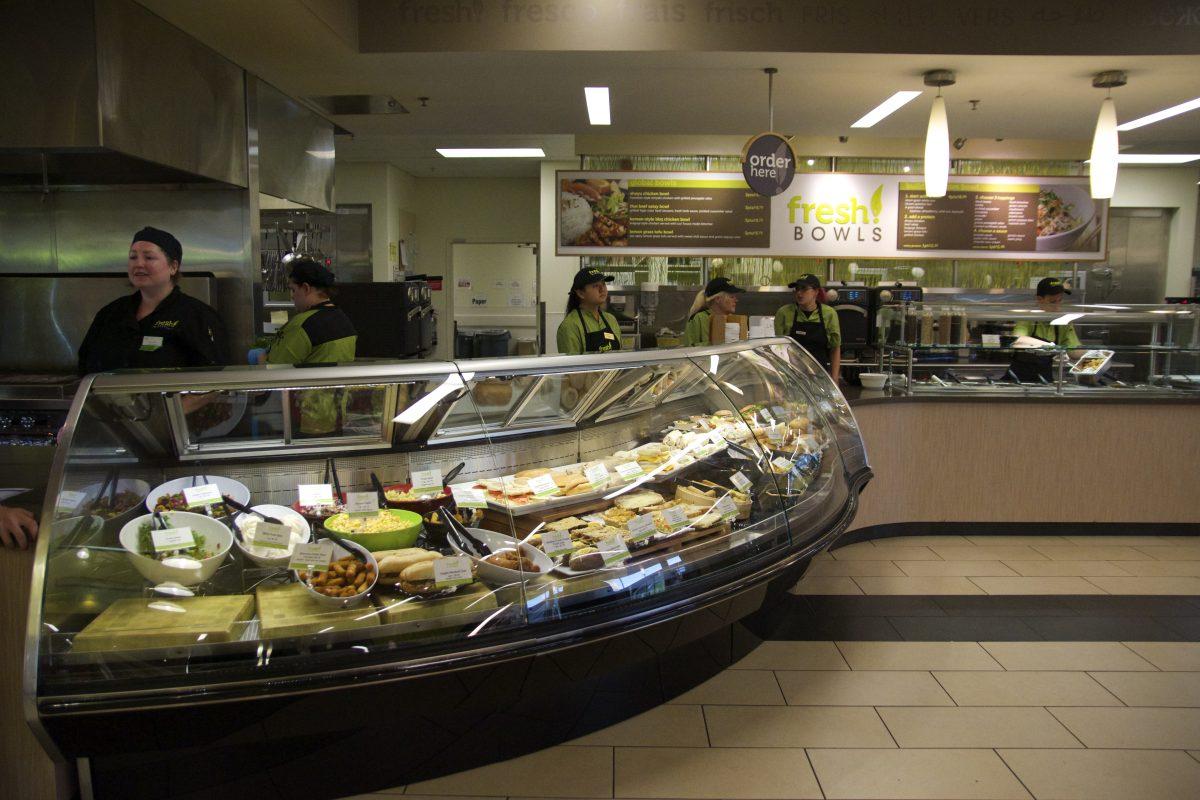
Amid changes in scheduling processes, several student workers in University of Oregon dining halls were unable to pick up enough shifts to meet the 10-hour-per-week minimum hours set for all UO student workers, and effectively lost their positions for the upcoming academic year.
According to several student workers in dining, shifts were full around an hour after they opened at 10 a.m. Aug. 22.
“Something that is most frustrating for me is the uncertainty that has come from this,” Sophia Jones, UOSW vice president and three-year dining hall worker, said. “I was notified that I was offered reappointment about a month ago so I thought I had my job secured but then the scheduling system changed.”
The changes resulted in Jones assuming they had lost their job, until they contacted their manager and was placed on a waitlist to receive more shifts.
In previous years, Jones said their manager had arranged their work schedule so that it didn’t conflict with their class schedule and fulfilled the 10-hour requirement. Other student workers in dining also recalled what Jones described.
“Managers are supposed to create the schedule for workers and I wished they maintained that and kept them in the loop,” Jones said.
In an Aug. 1 email sent to student workers, UO said the changes occurred so student workers could fit their schedules to both “business needs” and “academic commitments.”
According to UOSW and UO, 50 student workers also received letters notifying them they would not be reappointed, citing “performance issues” as the reason.
Appointments for student worker positions are renewed each year at the discretion of the university. According to a statement from UO, “reappointment has varied historically.”
UOSW called the decisions to not reappoint these workers “reckless.”
“It’s really upsetting to not have any real transparency from management or the university,” Bella Hoffert-Hay, a dining hall worker at Global Scholars Hall, said. “These non-reappointments make it evident that our administration does not care about workers or this campus. So many of my coworkers have been here for their entire college careers and we feel deeply betrayed by these cuts.”
In a statement regarding the reasoning behind staffing cuts at UO, the university emphasized its projected $25 million to $30 million “structural budget deficit.”
“We are currently finalizing budget reduction conversations across the university as part of a consultative process with academic leadership and the university senate,” UO said. “Unfortunately, as almost 80% of the educational and general fund budget is invested in people, these actions are expected to include layoffs of both faculty and staff.”
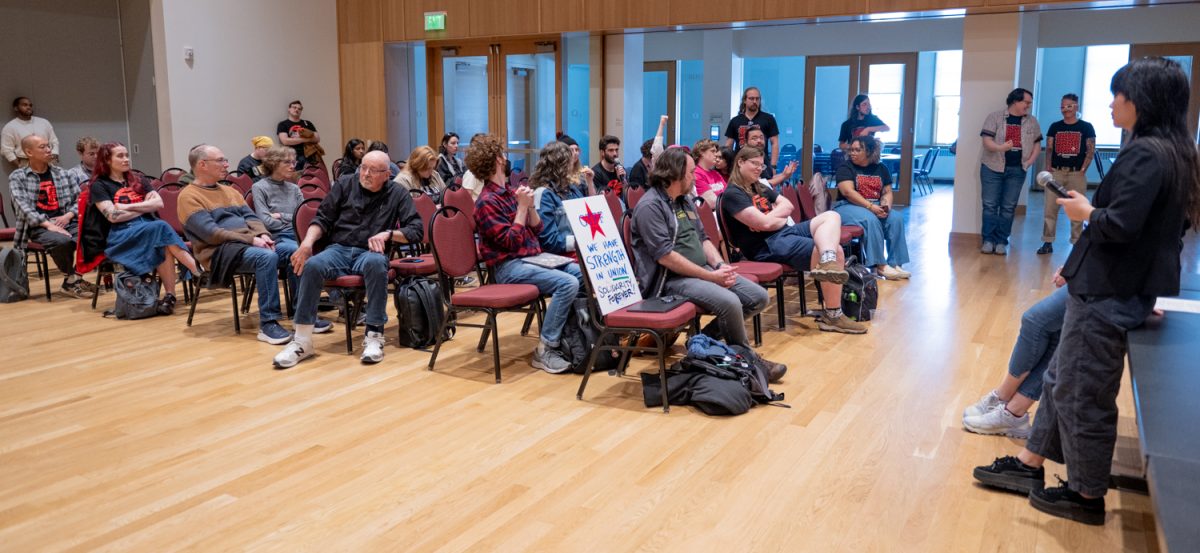
UOSW organizers said union members were not given adequate opportunities to be represented.
“Usually if students have attendance (performance) issues they’re notified by a manager that they need to meet with them and they are allowed to have a union representative present,” Hoffert-Hay said.
This meeting with a representative, commonly referred to as Weingarten rights, is the right of all union members in the U.S., but only applies to investigatory meetings and not when decisions of employment have already been made.
Hoffert-Hay said it has been “really challenging” for the union to respond to the notices of non-reappointment because so many workers are not on campus during the summer.
“We are still looking into if there’s anything that we can do that is upheld in our contract… it won’t be until the fall that we’ll be able to push back against this — against the scheduling, against the non-reappointments, and layoffs,” Hoffert-Hay said.
Several student workers cited concerns of increased fall student traffic and a decreased workforce.
“It is very disappointing because beyond being involved in the union I do love my job and with a record-size freshman class it is really disappointing they see us as replaceable and not valuable,” Jones said.





![Oregon players celebrate on home plate with infielder Naulivou Lauaki Jr. (18) as he rounds home after his home run. On May 30, 2026, The Oregon Ducks defeated the Washington State Cougars [4-0] in game 4 of the NCAA D1 Baseball Regionals at PK Park, at University of Oregon, based in Eugene, Ore. (Fred Hall/Emerald)](https://dailyemerald.com/wp-content/uploads/2026/05/2026.5.30.EMG_.FJH_.BSBLvsWashingtonStNCAA-13-1-1200x800.jpg)