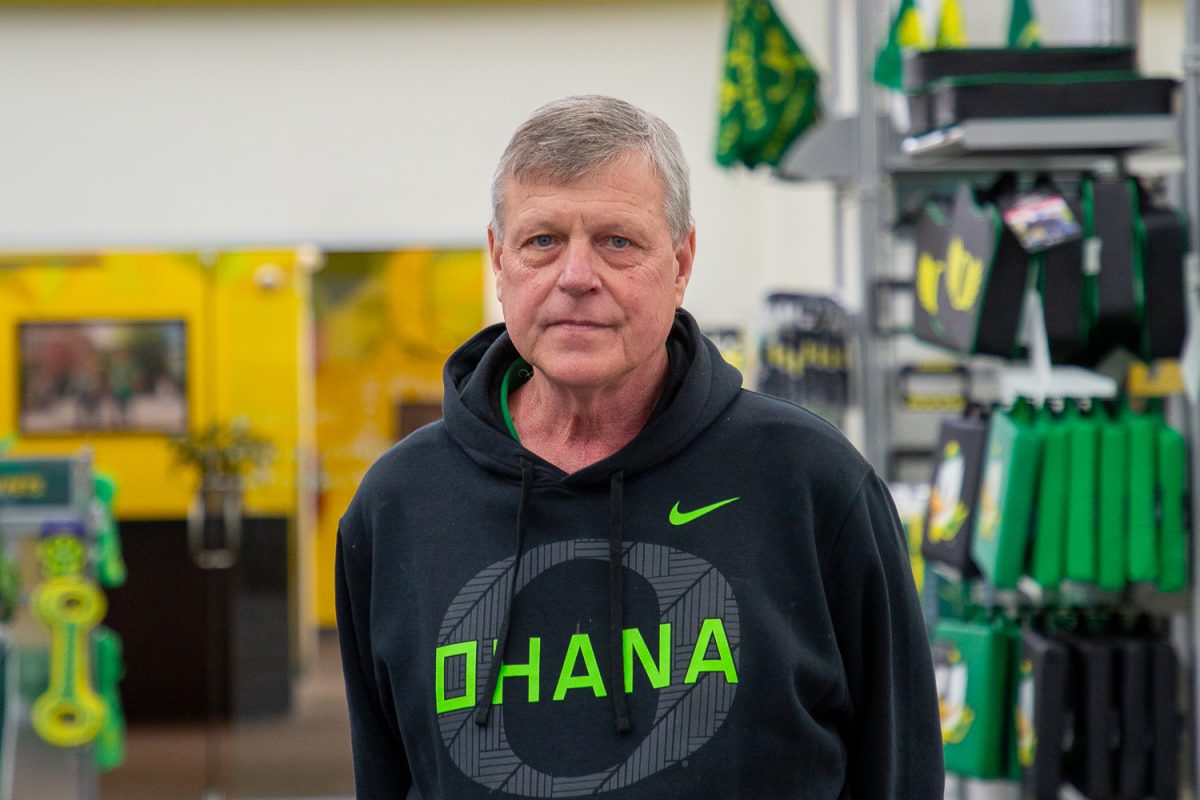
When Arlyn Schaufler started working at the Duck Store, he was welcoming in an era of Walkmans and Sony televisions. In his 20s, the store partnered with Kodak to create a film developing station, a major hit at the time, and through COVID-19, Arlyn transitioned the “book” part of the bookstore to an online platform that prioritized curbside pickup.
“We have always felt like we want to pioneer things,” Schaufler said. “The Targets of the world were way out in front of us, and we need to behave like regular retailers — not like just an old-fashioned college store.”
The Duck Store has remained an independent nonprofit since the 1920s, while other campus bookstores like The Husky Shop at the University of Washington have transitioned to for-profit models. This business model has allowed the store to operate under a board of directors that includes students, faculty and staff that give input on how the store should operate.
“We’re owned by the university students, faculty and staff, but we’re not owned by the institution,” Schaufler said.
Alex Lyons, the incoming Duck Store CEO, said hearing opinions from the University of Oregon community helps determine the store’s direction.
“Every decision that we make has to do with what’s best for the student,” Lyons said. “They are able to have their voices heard about what their concerns are and what some of the challenges are that they face. We’re connected with them in a really unique way.”
Lyons said students provide valuable feedback by bringing new ideas to the table and pointing out marketing trends aligning with a college-aged audience.
“They are able to provide us with this vantage point of how to connect with people their age,” Lyons said. “Online and in the store that’s really unique and really valuable.”
The community-oriented model of The Duck Store was also a large part of why Schaufler continued to work at the store for so long.
“For me, it always comes down to the people. I love working here. I love the people that I work for and serve on this campus: the community, the students and the fans,” Schaufler said.
Through his time at the store, he has always been “looking for the next thing” and he doesn’t want that energy to fizzle out after he retires.
That’s why Schaufler and the board chose Lyons to be the next CEO. Schaufler has been training Lyons for nearly a decade and said she is always looking to the future.
“She’s wicked smart, OK? She’s gonna do things that I couldn’t do. She can take this place, this store, places I couldn’t take it to,” Schaufler said.
Lyons started out in the information and technology department of The Duck Store solving computer challenges. Now, she wants to apply her problem-solving skills to leadership.
“Programming and coding is about problem solving at its core and so if you take those same theories of problem-solving and you look at it across the board in leadership, there’s a lot of opportunity to apply the same type of philosophy,” Lyons said. “As we get more and more enmeshed in that world of technology, you have to find the connection between the technology and the people.”
Since 2010, Lyons has been working to make e-books more available and accessible. As technology changes, she plans on continuing to build these partnerships with e-book systems and providers, while working with UO Basic Needs on textbook affordability.
“Every student can come here and feel like they belong and that we are trying to give as much value to the student experience as we can,” Lyons said.
Upon retirement, Schaufler plans to coach his granddaughter’s fourth-grade basketball team with his newfound freetime